





As an iterative approach, a minimum viable product (MVP) has been the starting point of many successful businesses.
Uber is a good example of how to leverage an MVP. Initially, the transportation giant focused on users booking limo rides within San Francisco. The founders capitalized on the positive response they received and went on to build the application it is today.
It’s not surprising that startups today are going the same route. Statistics say that 72% of startups follow the MVP approach.
Most startups and businesses opt for an experienced company offering MVP development services to create the initial version of their software idea.
There are innumerable benefits to building an MVP (which we’ll discuss later).
But the one that stands out is cost.
MVP development cost will be reduced by 60%, which is advantageous for startups with limited budgets.
Now that you know how useful an MVP is, it’s time to dive deeper into the topic. Keep reading to learn how to build a minimum viable product, the advantages of an MVP, and more!
What is MVP in Software Development & Why is It Important?
A minimum viable product is the most basic version of a software application that is released to the market. It offers the opportunity to collect user feedback with minimal financial requirements and resource usage.
Did you know that the MVP approach was introduced by Eric Ries, author of The Lean Startup?
As the name suggests, an MVP will have one feature or a set of features that will address the end user’s pain points.
Here’s an Example.
Now, let’s dive into why building an MVP matters.
The Importance of a Minimum Viable Product in Software Development
An MVP acts as the entry point in the software development lifecycle (SDLC). Rather than building a complete product, businesses can release a stripped-down version featuring the core idea.
The investment required to build an MVP is minimal, and it can be launched in three to six months. The lower software development costs and time benefit the SDLC.
An MVP also helps validate a product idea. It gives businesses real-time data on how their software meets the target audience’s expectations and the areas for improvement.
Risk reduction is another important feature of an MVP in software development. The data collected throughout the process is useful for businesses to gauge the marketability of the software.
MVP development comes with several benefits, which we’ll explore in the next section.
Top Benefits of MVP Development for Startups
The benefits of an MVP include emphasis on core value proposition, reduced rework, building stronger customer relationships, and attention to other business functions.
Here are the advantages of an MVP.
✅ Focus on the Core Value Proposition
An MVP helps decide the software application’s value proposition. It showcases how the product will address the pain points of the target audience, giving businesses a clearer picture of their growth goals and the strategies to achieve them.
✅ Minimal Rework
During launch, the MVP will only have the core feature. This makes rework, if necessary, easy, as the time and resources required are minimal. As the MVP moves from one iteration to the next, newer and more advanced features will be added based on user feedback.
✅ Forging Stronger Customer Relationships
Early adopters are the biggest proponents of an MVP, as the product addresses their pain points. They are instrumental in marketing the app and building a supportive community around it. Additionally, the feedback they share is critical to the success of the application, both functionally and financially.
✅ Emphasis on Critical Business Functions
An MVP also evaluates the strengths of other components of a business, namely the marketing approach and the sales channel. With an MVP, businesses have actionable data on how effective their marketing approach is, which they can implement in future campaigns.
With that done, let’s take a look at how businesses can build an MVP.
How to Build a Minimum Viable Product(MVP)?
To build an MVP from scratch, start by researching the market you plan to enter and identify the problems faced by the target audience. Then, design the UI for a seamless user experience and plan the features to be included. Develop the MVP using the chosen tech stack and test it for bugs. Launch the MVP to the early adopters and follow the B-M-L loop to iterate and improve the application.
Let’s Take a Closer Look at the Key Steps Involved in MVP Development:
1️⃣ Market Research
Market research takes precedence when building a minimum viable product. It helps identify the marketability of a product. Research also reveals important information about the competition in the specific domain, data that can contribute to the product’s success.
There are numerous methods to perform market research. One recommended approach is conducting surveys. Businesses should leverage tools like SurveyMonkey, Google Forms, Typeform, and SurveyPlanet to gain insights on domain-specific challenges.
By the end of this step, businesses will have a clear picture of the current status of the market they are planning to enter, which is vital to building an MVP that is functional and successful.
2️⃣ Define the Problem
This phase is all about questions and answers.
Questions like:
How does my product benefit the end user?
Would I buy the product as an end user?
How is my product different from the competitor’s?
It gives a fresh perspective in deciding the core feature(s) of the product.
The Jobs-to-be-Done approach can also be of help here. This customer-centric strategy puts the business in the end-user’s shoes to comprehend their requirements when they build an MVP.
Both methods are great at determining the unique value proposition (USP) of the product.
3️⃣ Design
A user-friendly design plays a significant role in the success of a software application. While designing User Interface (UI) and planning User Experience (UX), businesses should consider the end user’s point of view (POV).
From the moment they access the application, the end user must have a clear path to finding a solution to their issue. The design must assist in the execution of essential tasks the application is expected to complete, like making a purchase or accessing information.
4️⃣ Feature Prioritization
It’s important to not go overboard when determining the features to be added in the MVP. A minimum viable product will only have a few select features, or in some instances, a single core feature, giving it enough room to improve in the future.
Most businesses opt for the MoSCoW method to prioritize the features to be added.
M is for Must Have, features that must be included.
S is for Should Have, features that add value.
C is for Could Have, features that aren’t essential.
W is for Will Not Have, features that aren’t a priority.
5️⃣ MVP Development
A tech stack is chosen based on the requirements of the business. Selecting the right tech stack when building a minimum viable product is critical, as it will have an impact on the time to market, development costs, scalability, flexibility, and application performance and security.
The MVP goes into development once the tech stack is finalized and the necessary resources are allocated. With an MVP software development agency ensures that the build process is both efficient and aligned with business goals.
6️⃣ Testing and MVP Launch
As most dev teams follow the agile methodology, the MVP is regularly put through testing to find and eliminate bugs. The testing process also identifies usability and optimization issues.
After testing, the MVP is launched to a group of early adopters. The group usually consists of 40 to 50 individuals who have shown early interest in the MVP.
7️⃣ The B-M-L Loop
B-M-L stands for Build, Measure, Learn. It is an iterative process of developing an application and analyzing end-user data, and then using the data to improve the application. The goal is to learn what the target audience wants through multiple iterations.
After feedback analysis, the application goes into development again. The updated version is tested for bugs and released to the early adopters, and the entire process is repeated again.
The application continues to evolve as it goes through multiple iterations, collecting user feedback and making optimizations wherever necessary.
Launching an MVP? Avoid These 5 Developer Mistakes
Even the most innovative or groundbreaking app idea can fail if you don’t know what you shouldn’t do.
Meta’s founder, Mark Zuckerberg, is guilty of this. He has said that relying too much on HTML5 instead of native was the reason behind the failure of one of Facebook’s ventures.
Here Are Five Mistakes Those Investing in an MVP for Software Development Must Consider:
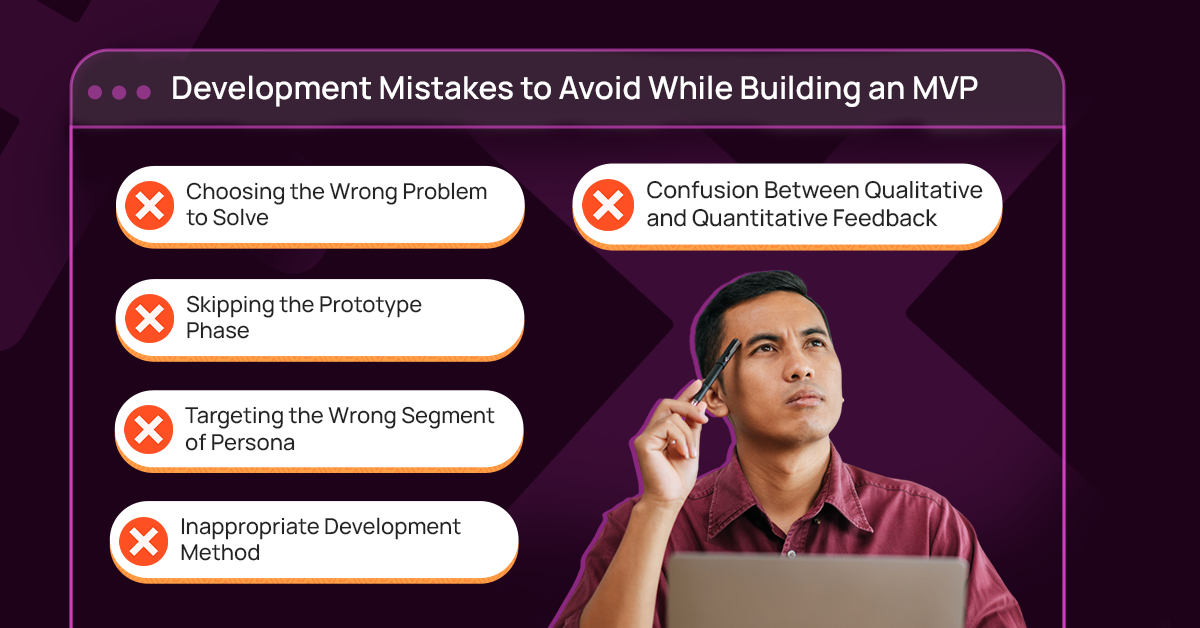
Mistake #1: Insufficient Market Research
Comprehensive market research reveals insights that are beneficial to the MVP development process. The chances of failure are high when businesses build an MVP without sufficient market research.
Surface-level knowledge of your target audience and the market leads to overestimating market demand, overlooking competitors, and an inability to understand user requirements.
Mistake #2: Adding Too Many Features
An MVP is a barebones version of an application with a single core feature or a set of features. Some businesses go overboard by including features that aren’t essential to the core app idea (core value proposition).
The result is an application crammed with unnecessary features. Feature creep is counterproductive to SDLC, as it drags out the development process, uses additional resources, and takes the focus away from the core idea.
Mistake #3: Over-Implementing User Feedback
User feedback is a critical component of an MVP in software development. It provides valuable insights on the effectiveness of the MVP in handling the end user’s pain points and the optimizations required to improve its efficiency.
However, that doesn’t mean all feedback should be considered. It’s important to separate constructive feedback from the rest and work on it.
Feedback implementation is also a resource-intensive and time-consuming task. Modifying the app based on every single piece of feedback leads to development delays.
Mistake #4: Poor Outlook on App Future
Scalability and flexibility are two critical aspects of an MVP in software development. Businesses should be clear on the path the MVP will take, the features to be added, the potential challenges that may arise, and the resources required for development, maintenance, and support.
When businesses build an MVP without a planned outlook for the future, it can lead to undesirable outcomes. The app or the development process may switch tracks or completely derail without a proper framework in place.
Mistake #5: Choosing the Wrong Tech Stack
The tech stack is vital to the performance and scalability of the app. It also has a role to play in the development and maintenance costs. The wrong tech stack can lead to performance issues. It may even interfere with the ability to add new features.
The infamous “Twitter is over capacity” is a great example of choosing the wrong tech stack. Users received this message when Twitter’s servers were unable to handle the number of requests it receives.
Stop Wasting Money: 10 Questions to Ask Before Planning Your MVP Development
It’s the lean startup way to validate your idea without burning through your entire budget.
But here’s the brutal truth: most MVPs fail. Why? Because they skip the crucial groundwork. They build something nobody wants. Ouch.
Before you write a single line of code (or spend a dime on development), you need to answer these 10 critical questions.
1️⃣ What Pain Point Are You Solving?
Is it a real, urgent problem — or just a “nice-to-have” feature?
2️⃣ Who Are Your Ideal Customers?
Be specific. Who will use your product, and why?
3️⃣ Is There Real Market Demand?
Do people actually need this, or are you guessing?
4️⃣ How Will You Measure Success?
What are your key metrics — user signups, engagement, revenue?
5️⃣ Who Are Your Competitors?
What’s already out there, and how are you different?
6️⃣ What’s Your Unique Selling Proposition (USP)?
Why should people choose your MVP over the rest?
7️⃣ Why Now?
What makes this the right time to build and launch?
8️⃣ What’s Your Go-to-Market Strategy?
How will you reach your audience and get traction?
9️⃣ What Are the Must-Have Features?
What’s absolutely essential to test your core idea?
🔟 Based on the Data, Should You Build This?
Be honest — does the research support moving forward?
Final Thoughts
MVP development is instrumental to the success of an application.
It gives businesses the ability to adapt based on user feedback and market trends, which is vital to the success of the business.
Scalability and marketability aside, the MVP approach in software development also helps businesses build solid relationships with their customers.
This is crucial in the current era of reviews and ratings.
While there are numerous benefits to a minimum viable product in software development, it is also important to avoid some of the common mistakes.
Overloading the MVP with too many features or opting for the wrong tech stack when building an MVP can cause more harm than good.
Also, remember to consult an SaaS MVP development company to test the validity of your app idea and build an MVP.
The resources at their disposal and their expertise in building scalable MVPs make these specialists a reliable option to partner with.
You cannot go wrong with the right MVP app development company.
FAQ’s to Build a Minimum Viable Product
1. How long does it take to build an MVP for a business?
The time required for the creation of MVPs varies based on product complexity, its functions, and development strategy. In most cases, MVPs can be created within 8 to 16 weeks, making it possible to validate an idea, collect user feedback and launch products at a relatively affordable cost.
2. Can an MVP be launched without coding?
Yes, it is possible to release an MVP without coding or through low-code/no-code solutions when dealing with simple business ideas and product validation. Nevertheless, in case of need for custom features, scalability options, or enterprise-level security, then it makes more sense to opt for custom software development.
3. How do you measure the success of an MVP?
The success of an MVP is measured by tracking key metrics such as user adoption, customer feedback, engagement, retention, and conversion rates. These insights help businesses validate product-market fit and identify improvements before full-scale development.
4. How do I prepare for an MVP for my product?
Prior to the development of an MVP, it is necessary to define the problem that is being solved by the product, find out who the target customers are and what are the key features that need to be prioritized along with the measurable goals for business.
5. What is the difference between a prototype and a Minimum Viable Product?
Prototype is an early version of a design which is employed to test and develop the concept of a product. On the other hand MVP is a product that contains all of the features which real customers can utilize. MVP is designed to prove demand for the product and provide feedback for further improvement.
6. When should you stop iterating and start building the full product?
You should move beyond the MVP once it demonstrates strong product-market fit, consistent user engagement, and validated customer demand. At this stage, businesses can confidently invest in additional features, scalability, and long-term product growth.
Connect With Our Team, Discuss Your MVP Development Requirements, and Begin Your Project in Just Next Few Days.


