



Have you ever been intrigued by Alexa, voice assistants, virtual digital assistants, chatbots, robots or self-driving vehicles? If so, then you’ve already experienced the world of AI /artificial intelligence by now.
If you’ve ever wondered what AI actually is and why it was created, AI branched out from computer science and focuses on developing computer-based systems that can work, perform tasks. Automate workflows and respond in ways that replicate human intelligence/behavior.
If you’re still not aware of AI’s impact on business productivity, IT, marketing, employment and investments, then you need to take a look at the most compelling statistics that have the potential to shape the future.
After evaluating thousands of leading AI statistics, we have curated the top 50+ AI statistics to help you explore the latest AI trends and its meteoric evolution. These statistics are curate organized in a way to help you get a better understanding of AI’s importance today, its growing influence, the way it boosts business and its future scope.
Let’s dive in!
TL; DR: Artificial Intelligence Key Statistics:
Here are the top AI statistics to help you understand current AI trends, its growing presence and future potential.
If you’re looking to kick-start your AI-driven strategy and take your business, customer service, support or marketing to the next level, here’s what you should know:
- By 2030, AI will contribute $15.7 trillion to the overall global economy.
- At least 72% of companies across the world are now using AI for business operations.
- By 2030, China is foreseen to become AI global leade, achieving a market share of 26.1%
- AI will replace nearly 85 million jobs worldwide and may come up with 97 million new job roles.
- Worldwide, AI technology is used by 35% of companies.
- According to PWC, by 2035 AI is expected to boost productivity by 40%
- In the healthcare industry, around 38% use computers as part of treatment processes and healthcare services.
- About 54% of organizations using AI as cost -effective
- 48% of IT firms use AI for automation and 45% of them use AI for IT cybersecurity.
- AI is used by 92% of companies and they are planning to increase investments at least in the next few decade.
AI Adoption by Industry 2026
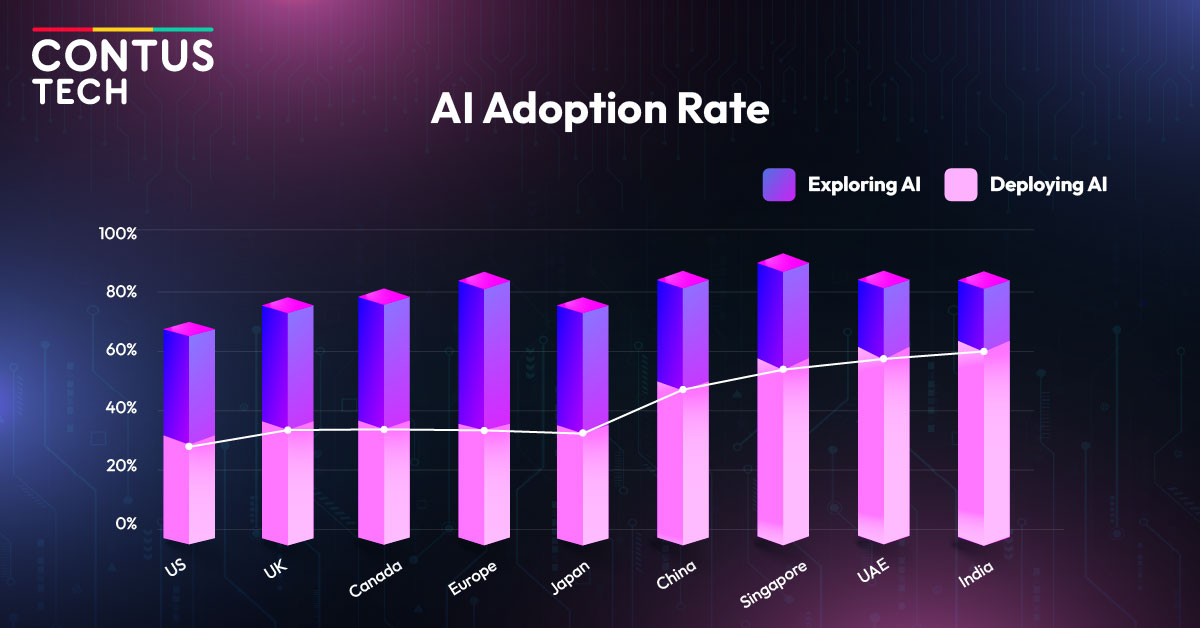
The AI adoption rate is growing in each industry at a different pace. Major adopting industries include education, healthcare, finance, and the workplace due to productivity improvements, cost reduction, and automation requirements.
A detailed summary of AI statistics in industries, including major use cases, growth, ROI, and productivity, is presented below.
AI Adoption Statistics by Industry 2026
This section explores the recent AI adoption statistics across industries and organizations to see how leveraging AI enhances efficiency, automates workflows and boosts customer experiences.
These top trending statistics explain how the AI adoption rate differs by each sector while showcasing the growing role of AI in business operations.
- 50% of businesses & entrepreneurs plan to incorporate AI technologies.
- 29% of business people use Claude AI.
- 97% of business promotions use ChatGPT.
- AI is said to boost the customer relationships of nearly 2/3 of business owners.
- By 2026, 60% of SMBs are expected to adopt AI-powered tools, powered by SaaS accessibility.
- Marketing and sales automation uses AI, with 40–45% of businesses using it for content creation, ad targeting, email marketing and CRM insights.
- According to 54% of consumers think AI could improve the customer experience.
- The manufacturing industry will achieve the greatest benefit of $3.8 trillion by 2035 from AI
- The IT and telecom sector organizations utilize 63% for AI.
- Automotive organizations implement AI by 44%.
- 87% of educational professionals said to have not received any AI training as part of professional development.
AI Demographics Statistics 2026
This section highlights how AI is being embraced across different age groups, genders, and children who have been increasingly connected to AI technologies.
It is essential to understand how users interact with AI through valuable insights that suggest AI adoption, demographics and its future scope.
- Women use AI more often than men every month, mainly looking for virtual assistants and fitness-related queries.
- More than men, Women use algorithmic recommendations for playlists.
- Only 84.7% of women use autonomous vehicle than 85.6% men.
- In the United States of America, 53% of Americans have already use AI.
- LLM is not used by 4 out of 5 people aged 18-25 years.
- People aged 61+ years who are 30.8% use AI every week.
- Men have slightly more awareness of AI than women, making it 38% vs 23%.
- 53% of users with postgraduate qualifications use AI.
- 65% of AI users today belong to the Millennial or Gen Z.
Artificial Intelligence Growth Statistics
While realizing AI’s impact across industries, demographics and adoption trends that are essential for tracking growth rate is also equally important.
These top trending insights can help businesses and industries make smarter investments, develop effective strategies and make better decisions to maximize AI opportunities.
- By 2023, the global AI market is expected to grow to USD 3,497.26 billion, showing rapid growth and increasing adoption worldwide.
- 70% of companies will be using AI to handle routine tasks, freeing human intervention by 2030.
- For the next decade, AI in healthcare is expected to grow and be valued at over $187 billion.
- By 2028, the AI models used for energy and climate is said to optimize, grow and save utilities up to $20 billion annually.
- By the next decade, the education industry that uses AI to personalize learning is expected to increase student proficiency by 15%.
Usage of Artificial Intelligence Statistics
To better understand how AI can be used as a tool to enhance your business strategy, it is important to analyze usage frequency and how AI is perceived by users across the globe.
These notable insights can help you make informed decisions, identify opportunities and create growth strategies that maximize the potential of AI.
- Only 77% of consumers think they are using AI platforms.
- 35% of parents have discussed the usage of AI with their kids.
- 28% of organizations that use AI say that their CEO oversees AI governance.
- Globally 500 to 600 million people use AI tools every day for various purposes.
- Marketing and sales teams report that 45% to 50% of their work uses AI, mainly for branding and customization.
AI in Marketing, Customer Service & Sales Statistics
Utilizing AI in marketing, customer service and sales through automated virtual voice agents, AI chatbots, AI-powered social media tools and AI editors has helped businesses improve traffic and conversion rates by up to 20X.
Therefore, it is important to understand how AI has become a powerful support system for these industries, enabling better results without doubling the effort and time.
- According to McKinsey, the Marketing and sales departments are said to adopt Gen AI faster and smarter.
- For marketing teams, those who use AI in lead generation see a maximum conversion rate by 25%
- 47% of businesses say using AI in their customer support is a great advantage.
- By 2032, AI-driven sales are expected to reach $1.3 trillion.
AI Use By Employees Statistics
Understanding how employees, laborers, and professionals perceive and use AI reveals how this technology has become a valuable support system in the workplace.
These advanced statistics highlight how AI helps people perform their jobs more efficiently, how aware they are of these technologies and whether AI is reducing their workload or creating new challenges as they learn to adapt, regardless of their educational background or profession.
- 94% of employees said they’re familiar with AI technology
- 63% of workers say AI helps them to enjoy their job.
- The best way to increase AI use in their work is to organize formal training, says 48% of employees.
- 52% employees who use AI often don’t admit to using it for their most important tasks.
- Professionals: about 62% said that generative AI should be applied to every day industry work.
AI Replacing Jobs & Employment Statistics
As AI continues to grow, it has become a rising concern for many people in the workforce. There are fears that AI will replace manual jobs, leading to unemployment and fewer opportunities.
However, with the right statistics, insights and preparation, people can better understand these changes and get ready for emerging opportunities. AI is not only transforming existing roles but also creating new career paths and job opportunities in the AI technology field.
- By 2030, cashiers and ticket clerks are expected to lose their jobs because of AI.
- Between 2025-2030, data specialists will see steady job growth.
- By 2030, because of artificial intelligence and machine learning, it is said that 92 million jobs will be replaced in the US.
- AI is said to create approximately 97 million new jobs
- The global workforce suggests that by 2030, AI is expected to create an additional labor demand between 21% to 33%
We hope these well-defined and forward-looking statistics help you understand the scope of AI in today’s world. Instead of building strategies and entering the market without prior knowledge, it is important to understand how these insights and statistics can guide better decision-making, identify opportunities and support faster growth.
Here’s to a great beginning and an AI-driven future.
Sources & References
Connect With Our Team, Discuss Your AI Development Requirements, and Begin Your Project in Just Next Few Days.


