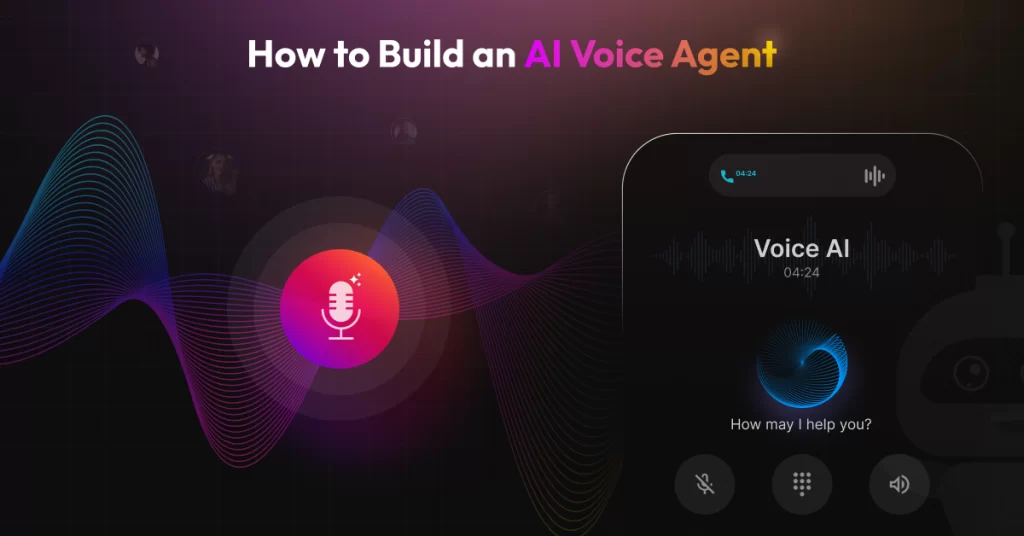
How to Build an AI Voice Agent? Process, Cost & Features
 March 2nd, 2026 Engineering
It didn’t take very long for people to adopt ChatGPT’s voice feature because it has far more advantages than convenience.
This has led businesses to explore how to build an AI voice agent. According to the recent AI statistics of Gartner, AI voice agents will reduce the contact center labor costs by $80 billion.
This blog will walk you through the practical steps of developing a voice agent, its benefits, and the cost.
Key Takeaways
- Precisely what is required to create a voice AI agent (STT, NLP, TTS, ML) and its interaction with other components.
- How do custom development and ready-made platforms differ, and in what situations can each be justified as making business sense?
- Estimated prices to build an AI voice agent based on complexity, integrations, and customization requirements.
Table of Contents
What is AI Voice Agent?
An AI voice agent is a type of intelligent software engine that utilizes speech recognition and natural language processing to participate in real-time two-way conversations across different devices.
In contrast to traditional systems with fixed menus, AI voice agents are capable of complex and unscripted conversations in a natural, human-like conversation flow.
They have the ability to understand, interpret, and act upon user intent and perform tasks like responding to questions, solving problems, and making appointments.
How to Build an AI Voice Agent: A Step-by-step Guide
Here is a custom ai agent development overview before we break down the steps
- Choose your STT, NLP, and TTS models
- Train the model with contextual data
- Apply ML to make the voice agent adapt and improve over time
- Integrate with your business systems using APIs
- Test and refine until the responses are natural
These steps form a foundation for building an AI voice agent that is high-performing and delivers accurate human-like responses. Let’s take a detailed look at the steps.
1️⃣ Define Your Purpose and Use Case
The first step is to define its purpose and use case first. Do you want the AI voice agent to handle appointments, manage customer support, or answer FAQs?
This will set you on the right path to design the necessary conversation flow, interaction paths, brand identity, and fallbacks if needed.
Identify potential user intents and the typical requests as this will form the foundation for a helpful conversation.
2️⃣ Choose and Implement the Core AI Models (STT, NLP, TTS, ML)
- Speech-to-text – To handle accents, dialects, and background noise.
- NLP/NLU – To interpret intent and context, manage conversational complexity, define logic and sequence, and extract entities.
- Text-to-Speech – To deliver human-like expressive voice responses.
- ML – To help the voice AI learn from past interactions, user behavior, and adapt to new phrases to improve over time.
- Combine STT+NLP+TTS+ML to build AI voice agent that responds naturally.
Test the AI model combo, check for latency, and fine-tune responses for native-like, intuitive outputs that users will enjoy.
3️⃣ Choose Your Development Approach
Your tech stack determines how well your voice AI handles user input. If you want rapid prototyping and quicker setup, go for Python. If you want deeper control, go for JavaScript.
- To build from scratch: OpenAI Whisper, GPT-4, or Google Speech-to-Text, or platforms like Google Dialogflow, or Amazon Transcribe NLP.
- For advanced customization: Pipecat and Amazon Bedrock
It can also be combined with the core tech stack, like ASR, NLU, NLP, and TTS. The right combination depends on business goals.
4️⃣ Design Effective Conversation Flows
How do AI voice agents handle real conversations effectively? With a conversation design flow that maps user journey with clear user paths and creates fallbacks when it cannot handle certain queries.
Create flowcharts that include interruptions, pauses, barge-in, and backtracking from contextual data. Ensure your AI voice agent maintains a consistent tone, persona, and brand identity for all dialogues.
This approach strengthens voice UX when planning how to create AI voice agent systems for business tasks.
5️⃣ Integrate with Your Existing Systems
To make an AI voice agent fit into your business, connect it with your existing systems. Use APIs and integration platforms to connect your AI voice agent with workflow tools.
But how to build an AI voice agent that fits business operations? By connecting the voice layer with CRM, ERP, databases, apps, phone systems, or web platforms to fetch data and trigger workflows.
6️⃣ Train and Test the AI Voice Agent
Training
- Feed the AI model with real conversations to help it understand the nuances.
- Diversify the voice data with accents, dialects, and even background noises to improve accuracy.
- Refine responses using feedback from mock conversations to build AI voice agent with a better understanding.
Testing
- Check voice input and output on different devices like mobile apps, web platforms, and smart speakers like Alexa or Google Assistant.
- Check for interruptions, delays, and unusual commands.
- Validate with APIs, integrations, databases, and workflow tools to ensure response accuracy.
7️⃣ Deploy and Continuously Optimize
The final step’s goal is to maintain a voice agent that stays accurate even when the user’s behavior changes. Continuously monitor conversations, record errors to see where it falls short.
Update the AI model, fine-tune the intents, and adjust workflows based on new queries, slang, and accents. This keeps performance accurate in the long run.
How AI Voice Agents Work: A Step-by-Step Breakdown
At a Glance: Here’s how a voice AI agent processes every interaction
- Captures voice: Wake word detection and record voice input
- Speech-to-Text: Remove noise and transcribe audio to text
- Understand intent: NLP identifies the user’s goals.
- Decision & action: Extract data and automate workflows.
- Generate response: NLG creates natural replies.
- Text-to-Speech: Converts text into voice output.
- Learn & Adapt: ML helps adapt and improve over time.
Here is a breakdown of the steps in detail for better understanding.
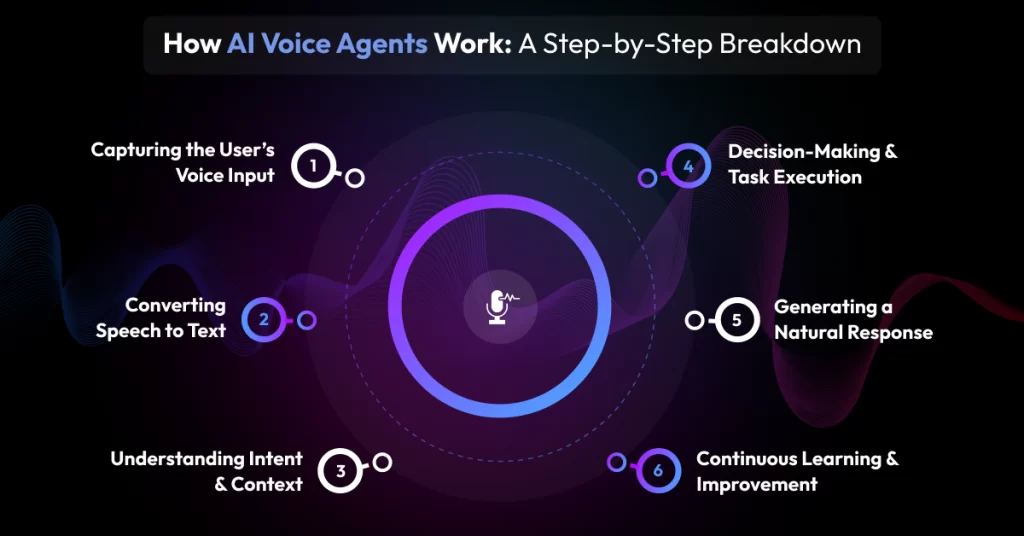
➡️ Capturing the User’s Voice Input
Conversational AI starts working once the wake word is said. A wake word is how you can get the AI voice assistant to work. A keyword like “Hey Siri,” “Okay Google,” or “Hey Jarvis,” if you will.
Wake word detection is how the AI voice agent knows you are giving it a command.
The goal of the Voice AI at this point is to record clear speech. This captured audio goes through signal processing, where the audio is cleaned and prepared for the next step.
➡️ Converting Speech to Text
How will the AI voice agent know to filter your voice in case there is background noise? Well, these conversational AIs are built with a Voice Activity Detection (VAD) filter that isolates real speech from noise.
This filtered audio is sent to the STT (Speech to Text) engine for transcription. The STT processing is quick and can understand the intent and tone of voice to respond accurately.
➡️ Understanding Intent and Context
Once the speech is converted to text,
- NLP interprets the meaning behind the user’s request.
- Intent recognition identifies the user’s goal,
- Entity extraction pulls information from the query and database.
So to build an AI voice agent that can analyze speech patterns and sentiment, it needs an ASR engine. This helps maintain accuracy and context even in the midst of background noise.
For example, if a user asks, “When is my next bill due?” the ASR converts the audio to text. NLP identifies intent to check payments and extracts the due date to provide the correct information.
➡️ Decision-Making and Task Execution
The voice AI agent looks at the intent and context to find the right action.
Depending on the query, the AI voice agent would:
- Fetch necessary data from the database
- Interact with other systems or APIs
- Trigger automation workflows
- Generate a text-based answer
To build AI voice agent that is reliable, make sure its decision-making engine is fast and capable of handling complex tasks with minimal latency.
➡️ Generating a Natural Response (NLG)
With the data fetched in the last step, the AI voice agent can create a meaningful response. Natural Language Generation (NLG) converts data into conversational, human-like text.
This stage plays a key role in understanding how to build an AI voice agent that avoids robotic replies and delivers accurate, human-like conversations.
➡️ Converting Text to Speech (TTS)
The text output from the last step now goes through a Text-to-Speech engine, which creates an interactive conversational flow.
TTS converts text to audible speech using neural voice technologies that mimic human speech. It follows a tone, pitch, and pacing. The voice output is a clear, natural, and accurate response.
➡️ Continuous Learning and Improvement
Voice AI agents improve over time with almost every interaction. It uses machine learning feedback loops to analyze conversations to:
- Understand preferences
- Detect intention
- Reduce errors
- Adapt to accents
Over time, the voice AI agent becomes more contextual and personalized. Now, that is how to create AI voice agent that gets smarter with every interaction.
Benefits of Building Voice AI Agents for Your Business
The voice AI agents are changing the business-to-customer relationship with personalized services. They reduce wait times, offer 24/7 access, and uncover valuable insights from interactions.
While many businesses focus on choosing the right voice assistant, the real value lies in how effectively it improves customer experience and operational efficiency. Here are the key benefits.
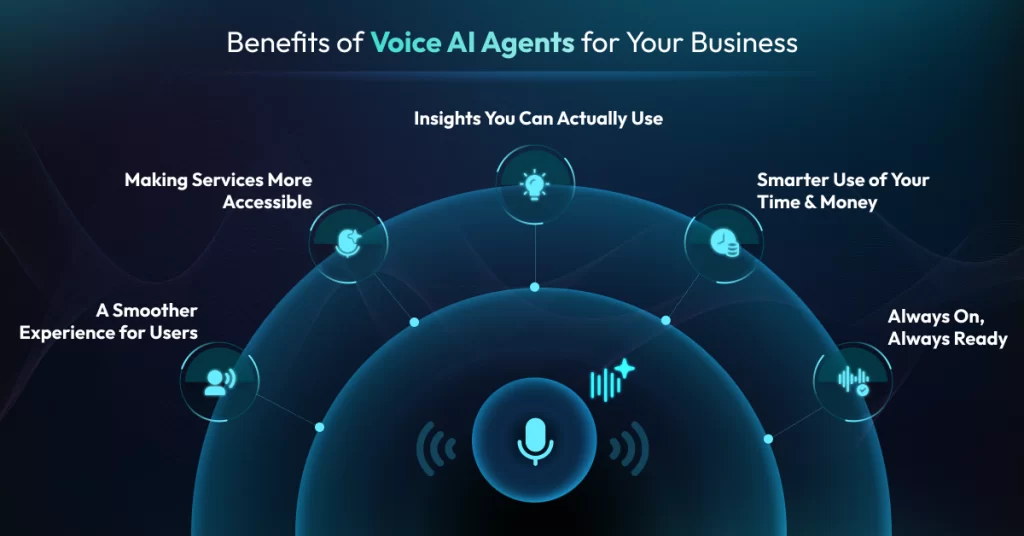
✅ A Smoother Experience for Users
The AI voice agents offer 24/7 availability with low wait times which makes the experience uninterrupted with high-quality calls. This reduces the mistakes and customer frustration.
For example, an e-commerce brand utilizes a voice AI app to help shoppers with checkout processes. It can also respond immediately and modify answers based on the tone and preferences.
✅ Making Services More Accessible
Voice AI agents eliminate barriers by providing multilingual assistance to international target audiences. This enables businesses to cater to more users without recruiting new personnel.
For example, a multilingual voice agent in healthcare can make appointments or give instructions in multiple languages, enhancing user satisfaction and minimizing the human agents’ workloads.
✅ Insights you can Actually Use
AI voice agents record interaction data to help companies understand customers and improve strategies. They identify pain points and opportunities by analyzing tone, sentiment, and trends.
For example, a telecom company may monitor recurrent requests concerning problems in billing, and the business can take action to refine operations and minimize complaints.
✅ Smarter Use of your Time and Money
AI voice agents help businesses optimize operations by handling routine queries automatically, letting teams focus on high-value tasks like strategy, innovation, and customer relationships.
For example, an insurance company can create an AI voice agent to handle policy renewals, policy claim status, and FAQs, to allow human agents to deal with complicated cases.
Pre-Built vs Custom AI Voice Agents: Which Is Right for Your Business?
Deciding whether to build a custom AI voice agent is strategic. Whether for sales, production, or customer support, the choice impacts development time, cost, and control over features.
Here is a short guide to help you decide.
🚨🚨 Option 1: Building AI Voice Agent from Scratch
When you want to have control over every stage of development, choose to build AI voice agent from scratch.
Things to consider
- You need to have a robust AI software development solutions provider team to customize dialogue flows, responses, and clear errors.
- Takes several testing stages to check response times, spot delays, and review logs for failures.
- Perform A/B testing of various features to examine the performance data and feedback.
Pros: Deep control over functions, locations, and customization options.
Cons: Time-consuming and expensive.
🚨🚨 Option 2: Using Pre-Built APIs and Platforms
What if speed and simplicity matter to you most, and if you want a more practical path? In that case, how to build AI voice agent that is reliable?
When to choose this approach
- Quick access to ready-made tools that give natural dialogue flow and interaction.
- For a fast MVP to inspect logs and receive feedback without the need for the entire backend operations.
- For built-in error handling and voice tuning, like Google Dialogflow, Amazon Lex, and Azure TTS.
- Personalize responses with minimal complexity.
- For strong performance without all the heavy lifting.
Pros: Faster implementation and built-in error handling.
Cons: Limited customization and backend process control.
Important Features of an AI Voice Agent
Natural Language Understanding is the most important feature that helps AI voice agents with personalized responses. It also needs TTS for lightning-fast responses and multi-language support for global audiences. Lastly, the ability to be integrated with existing systems for smooth workflows.
🎯 Natural Language Understanding
To develop an AI voice agent that is human-like, it must have strong NLU and NLP capabilities. It helps understand different accents and intent, without sacrificing the accuracy rates.
🎯 Personalization and Contextual Awareness
If you want your AI voice agents to recall past issues, preferences, or open appointments to personalize experiences, they need to have contextual awareness.
It requires capabilities like machine learning, context retention, and sentiment analysis, which allow the agent to adapt to queries, understand emotions, and maintain consistent conversations.
🎯 Multi-Language Support
Enterprises build and deploy voice AI agents that can serve across regions, and this is where strong multilingual capabilities become a necessity.
In such cases, these agents need to understand multiple languages, dialects, tones, and cultural speaking styles. For that, they need advanced language models trained with diverse languages.
🎯 Integration with Your Existing Systems
When you create AI voice agent workflows, they should also be able to integrate with your existing system – be it CRMs, ERP systems, or other business tools.
It must also encrypt data, have access control, and be highly compliant with GDPR/CCPA. Smooth integration ensures better conversations and faster resolution in high-volume environments.
🎯 Lightning-Fast Response
In production environments, low latency, quick reactions, and real-time performance at high volumes become non-negotiable.
TTS should be fast, and ASR should be optimized to achieve higher resolution rates and remove unnecessary fallbacks.
Must be able to be on stand 24/7 without needing human intervention, even at times of demand spikes.
How Much Does It Cost to Develop an AI Voice Agent for Your Business
The cost to develop an AI voice agent depends on the features, complexity, and customization.
- Basic MVPs with limited functionality, like a rule-based agent for fixed queries, cost around 10,000 to $25,000
- Mid-tier Voice AI agents like NLP-Powered Conversational Agents with contextual understanding and personalization cost around $20,000 to $30,000+
- Enterprise-level AI voice agents with custom algorithms and deep CRM/ERP integrations cost around $100,000 to $250,000+
- Advanced Autonomous Voice Agents with autonomous decision-making cost over $500,000
If you are looking into how to make an AI voice assistant that is cost-effective, know that it involves development, ongoing maintenance, and growth-related expenses.
It also hinges on whether you hire an in-house team or outsource to AI voice agent development companies and their location.
Ongoing platform expenses cover third-party API charges, cloud service bills, and maintenance charges. Scaling is another factor to account for, which varies for user volume and feature expansion.
How CONTUS Tech Can Help Build Your Voice AI Agent?
CONTUS Tech develops custom voice agents that are based on your workflows and intents and are integrated fully with CRMs, ERP, and internal tools, as well as developed in an agile and milestone-based process with transparent collaboration. Each agent is scalable for the long term to enable the growing volumes and new use cases.
Here’s how CONTUS Tech builds and deploys voice AI agents for your business.
➡️ Voice Agents Tailored to Your Use Case
CONTUS Tech helps you create AI voice agent customized for your business. Every voice agent is designed specifically for your unique workflows, user intents, and conversation requirements. This ensures a smooth personalized experience for your customers and employees as well.
➡️ Connected to Your Tools, Not Working in Isolation
We ensure the voice AI agent integrates with your CRMs, ERPs, and other business tools. This keeps them ready for production and task execution with context awareness.
➡️ Agile Development with Clear Progress
Our team follows an agile approach, transparent milestones, and delivers in progressive updates. You see real-time progress, review features, and provide feedback at every step of development.
➡️ A Collaborative, Visible Process
Our development process is collaborative, working closely with your team to keep the AI voice agent aligned with your goals. Understanding AI agents in your business context helps shape the right solution.
➡️ Built to Handle Growth
Change, growth, and scalability are inevitable, and scalability is built into the solution from day one. The voice agent is designed to handle rising query volumes without compromising performance.
We ensure your voice agent can handle increasing queries without performance drops. You can be confident that we create AI voice agent solutions that grow alongside your business.
FAQ’s About Building AI Voice Agent
1. Can I connect an AI voice agent to my CRM or existing systems?
Yes, AI agents can be connected to CRM or any existing business tools. CONTUS Tech helps integrate using secure APIs and middleware without disrupting current workflows while giving AI-driven automation.
2. What’s the best way to test and improve my voice AI agent post-launch?
Continuous monitoring and iteration help improve the AI voice agent post-launch. Track call logs, intent success rate, latency, and escalation patterns to see where users abandon conversations.
3. How secure are AI voice agents for sensitive conversations (e.g., banking, healthcare)?
For regulated industries like banking and healthcare, AI voice agents are built with enterprise-grade security measures and compliance to HIPAA, GDPR, and regional regulations. This helps handle sensitive conversations responsibly.
4. Can I deploy my AI voice agent inside a mobile app or web platform?
Yes, AI voice agents can be deployed across iOS, Android, and web environments. CONTUS Tech helps deploy, ensuring low latency, consistent user experience and secure data handling.
5. Do I need a custom model to build a voice AI agent, or can I use pre-trained APIs?
For many common use cases like customer support, appointment scheduling, and FAQs, pretrained models work well. Custom models come in handy when you need to handle domain-specific terminology.
6. Can AI voice agents support multiple languages and accents?
Yes, AI voice agents can support multiple languages and regional accents by using multilingual speech recognition and text-to-speech models. CONTUS Tech helps select the right models for locale-specific tuning.
Connect With Our Team, Discuss Your AI Voice Agent Development Requirements, and Begin Your Project in Just Next Few Days.