

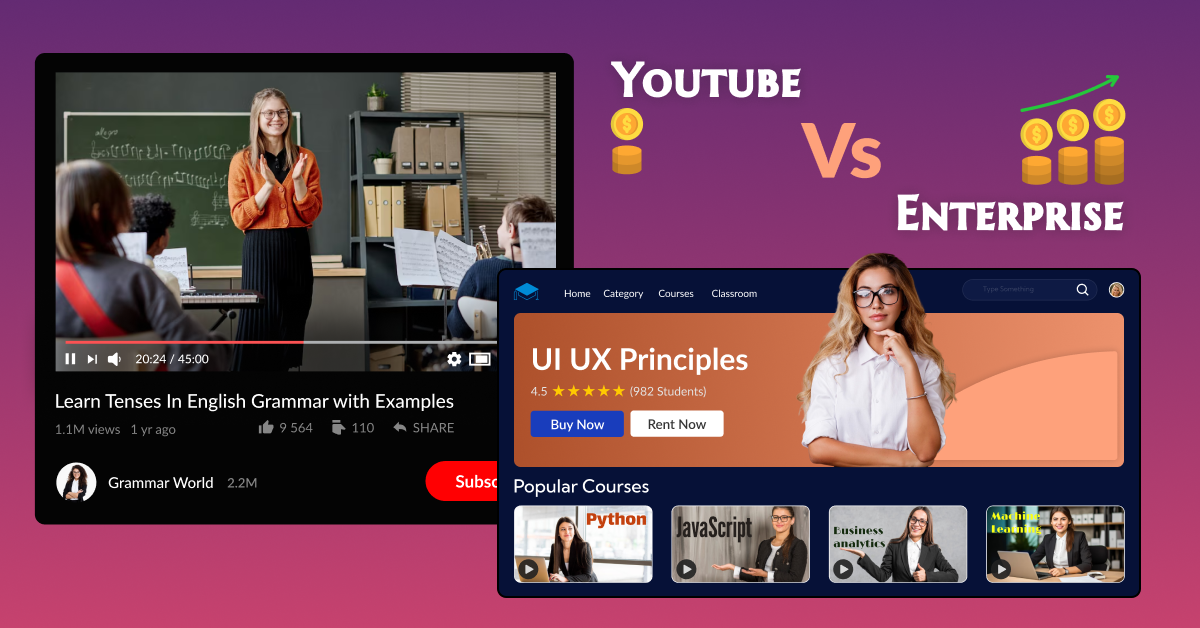


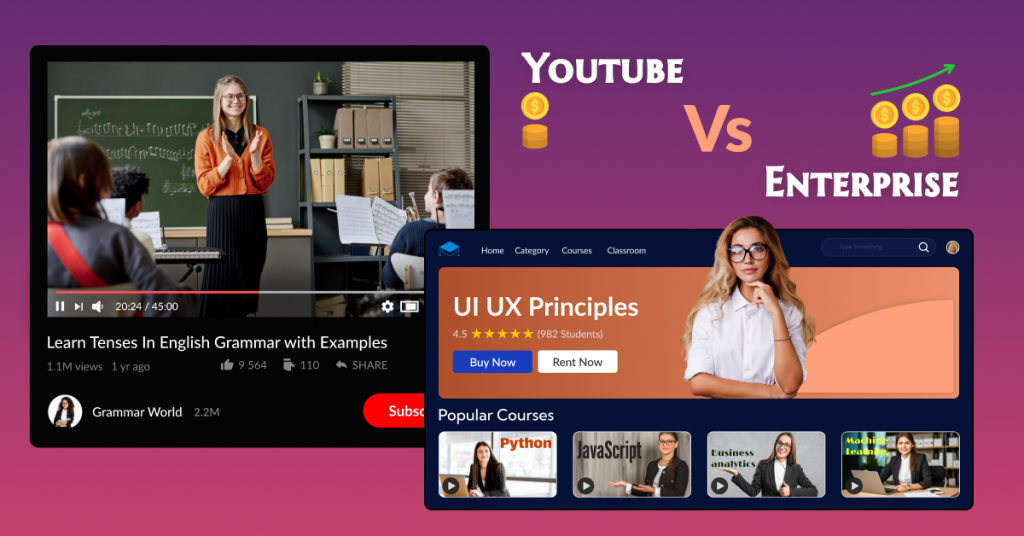
“Nowadays people with a Smartphone are posting casual content and creating engaging results as Content Creators”
If you are serious about how to monetize your educational videos, YouTube should not be your end goal. It might be a good place to get people to discover you in the first place, but trying to build a sustainable education business on YouTube alone is a risky bet.
Plus, let’s be honest, YouTube is basically a platform for entertainment, not learning. While it can get your content out there, it leaves creators with hardly any control over things like pricing, who owns your audience, or what you can expect in terms of revenue.
If you are trying to figure out how to monetize educational content in a way that actually reflects its value, you will quickly see how limited ad-driven platforms are.
The thing is, education isn’t just something people click on out of the blue. It is intentional, people do it with a specific goal in mind, and often it is something they are willing to pay for.
So if you want to earn money from your educational videos, you need a monetization strategy. With this being clear now.
In this blog, we break down why YouTube falls short for educational creators, what educational video monetization actually means, and why owning your own online video education platform is becoming the smarter long-term move in 2026.
- Fully Customizable
- Lifetime Ownership
- On-Premise/On-Cloud
- 100% White-label
- Zero Revenue Share
- Hire Developers
What Is Educational Video Monetization?
Educational video monetization is all about turning the knowledge you have got into a steady income stream. Essentially, it is a way to get paid for the expertise you have got to share and the effort you put into making it worthwhile, often with the support of VOD platforms providers that enable secure content delivery and monetization.
Unlike all those viral entertainment videos that are just about getting views, educational content has a very clear purpose. Here, people are looking to pick up new skills, solve a particular problem or become an expert in something.
This focused approach actually makes education one of the best categories for making money by using a premium model rather than relying on advertising to cover the costs. Indeed, educational video monetization is a whole lot more predictable and reliable as well.
✨Why YouTube Isn’t the Best Platform to Monetize Educational Videos
If you are exploring how to create educational videos, YouTube is excellent. Why? Because the platform helps people discover your content.
But when it comes to monetizing your educational videos, things get a bit more complicated. In this section, let us break this down clearly.
1. Limited Monetization Options (Mostly Ads)
“70% of users are skipping the ads while they start to watch the video”.
On YouTube, making money boils down to advertising. What that means is your earnings will depend on the eyeballs on your videos, not on the actual value of what you teach. For educational content creators, this just doesn’t sit right.
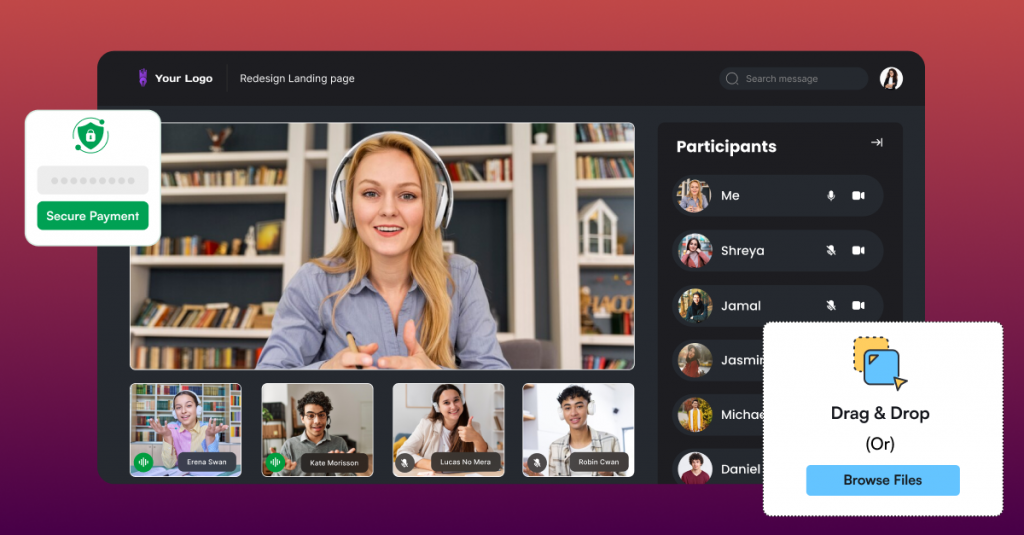
Let’s say a 30 minute tutorial that has got some real value, might earn you peanuts compared to a 30 second clip that somehow goes viral.
If you are serious about how to monetize educational content, relying on ads from day one is a real problem because it limits your earning potential.
2. Very Low CPM for Educational Content
Educational videos usually don’t pull in as much money as compared to entertainment, lifestyle, or finance; the categories that advertisers just love spending big on.
In fact, advertisers are interested in reaching the biggest crowds possible, not a niche group of students looking to learn.
Even when they get a decent amount of views, many educators find that they are still barely scraping by. That is because ad revenue is just not enough to cover the production costs.
This makes YouTube an unreliable option for creators looking to monetize educational videos.
3. High Competition With Entertainment Content
On YouTube, your educational video is competing for attention alongside music videos, vlogs, short clips and all the other viral sensations that are just designed to keep people scrolling.
The algorithm’s priorities are skewed towards content that grabs users attention, not necessarily towards content that actually teaches something.
Because of this, really high-quality educational content often gets stuck at the bottom of the pile, making discoverability inconsistent and growth unpredictable.
4. No Pricing or Brand Control
YouTube does not let you decide how your content is priced. You cannot bundle lessons, offer tiered access, or create premium learning paths natively.
And forget about your brand being the star of the show. When people are on the platform, your content is only as important as everyone else’s.
If you are one of those educators who thinks long-term, this lack of control probably feels like a major hurdle.
5. No Ownership of Audience Data
One of the biggest downsides is you don’t actually own your viewers. All the useful data about who they are, what they are watching and what they are learning, that all stays with YouTube.
Which makes it super hard to build a direct relationship, upsell advanced courses or move learners through a structured program.
All of the things you would need to do if you want to grow beyond just making some money out of ads.
6. Higher Risk of Content Piracy
Educational videos are highly prone to unauthorized downloads, reposts, and redistribution. On YouTube, protecting premium content is quite challenging, especially since a lot of your content is free to access.
For creators investing time into how to create educational videos that are genuinely valuable, weak content protection can directly impact revenue and credibility.
Compare the leading video monetization platforms based on scalability, monetization capabilities, content security, and business growth potential.
✨Reasons Why an Enterprise Video Solution is the Perfect Idea for Educational Content Owners?
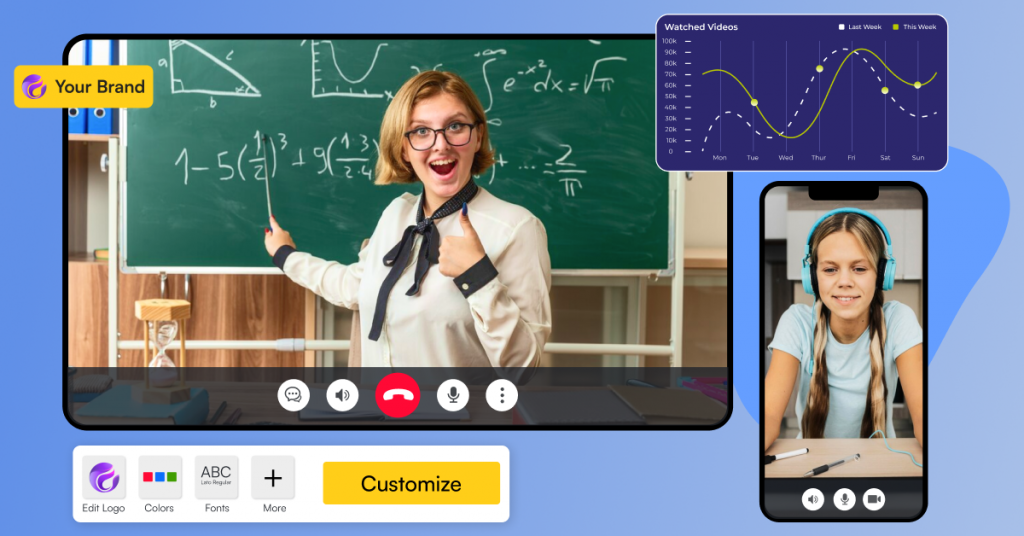
If YouTube shows you the real problem, an enterprise video solution will show you the way out of that mess. For educators who want to monetize educational videos seriously, taking control of the platform is a smart move.
First off, enterprise video platforms are designed to generate revenue through fair pricing. Here, you are not relying on a bunch of ads.
You can charge learners directly through a subscription, a one-off course fee, certification, or even a bundled program.
Secondly, you get to decide your own pricing and packaging, which is a real bonus. Want to offer a beginner, intermediate, and advanced tier?
Easy peasy. Need to give certain groups or companies special access?
No problem. Having that flexibility is a must when deciding how to monetize educational content beyond just relying on ads.
Thirdly, with an enterprise solution, you get to keep all the audience data. You will know who is watching your content, how they are engaging, where they are dropping off, and what they are actually completing.
That info is gold. It lets you improve your courses, offer more personalized learning paths, and make more money from each learner in the long run.
And then there are the security benefits. Enterprise video streaming platforms come with DRM, access control, watermarks, domain restrictions, etc. That means you can rest assured your hard work on creating educational videos is not wasted.


Who Should Monetize Educational Videos?
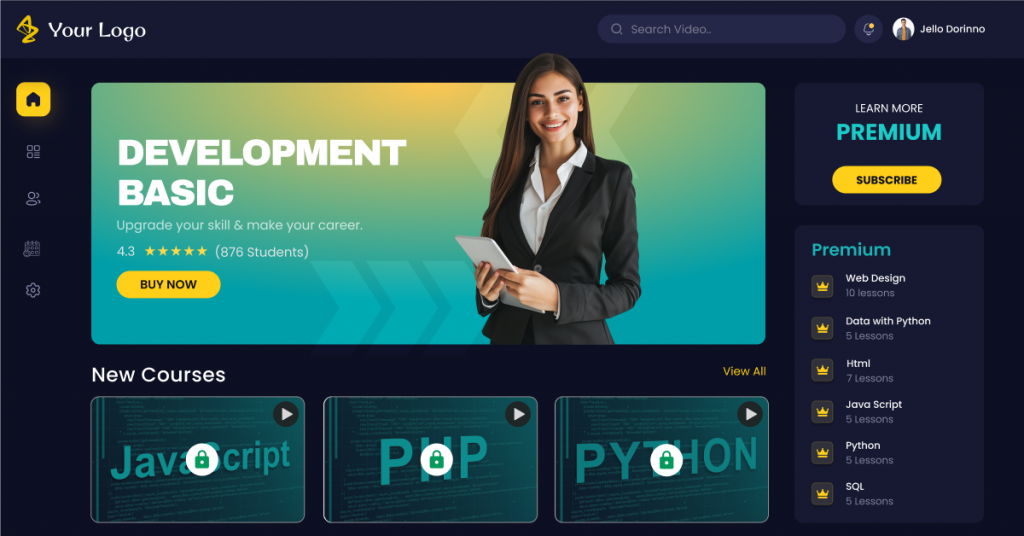
Educational video monetization is not just limited to universities and large institutions, though a few years ago that was indeed the case.
Now, anyone with structured knowledge, a defined audience, and a clear understanding of how to create educational videos can build a profitable education business, provided they choose the right monetization models and platforms.
In this section, let us break down who stands to gain the most from monetizing educational videos outside of YouTube.
💡 Online Educators
Independent educators teaching academic subjects, or niche topics or even skills that people want to develop in the workplace are most likely to do very well out of educational video monetization. These educators often deliver high-value, curriculum-driven content that learners are happy to pay for.
Rather than just relying on ad revenue, online educators can sell videos online through subscription models, bundled courses, or even certification programs. When educators have total control of the platform, they gain greater flexibility, making it easier to measure profitability and scale their offerings over time.
💡 Fitness & Yoga Trainers
Fitness, yoga, and wellness instructors invest heavily into creating programs that are meticulously structured, guided sessions, and progressive training plans. Basically, these are not “one-click watch and forget” videos, they are experiences.
Monetizing educational fitness content through paid memberships or tiered subscriptions works far better than ad-based models. If you ask why? Because, learners expect privacy, consistency, and progress tracking, all of which are difficult to deliver on open platforms.
💡 Language Tutors
Language learning thrives on routine, doing the same thing over and over and over again until it sticks. Teachers offering grammar lessons, speaking practice, or exam prep content are basically made for a subscription-based or cohort-driven business model.
With their own platform, these language tutors can segment their content, so it is tailored to the students’ level and offers premium features such as recorded sessions, downloadable goodies, and assessments; all things that you can’t get through the likes of YouTube.
💡 Coding & Tech Instructors
The whole coding, software development and technical training content is where the real money can be made. Learners are looking for skills that are going to get them a job, certification and hands-on experience with actual real-world projects.
Tech instructors benefit immensely from structured learning paths, gated modules, and premium access models. When hosted on an enterprise video platform, instructors can protect proprietary content and continuously update courses without losing control over distribution.
💡 Corporate Trainers
Don’t even think about putting your corporate training content up on a public platform. Why? Because, the content is sensitive, confidential and you would rather not let just anyone see it.
That is when enterprise video solutions come into play. Trainers can control who gets in on the action (by role, department or even what organization they come from). They can track how everyone is doing, make sure that content stays under wraps and then charge them, either by the licence or the enterprise subscription.
💡 Skill-Based Educators (Music, Art, Soft Skills)
Skill-based learning is experiential. Whether it is music lessons, art tutorials, public speaking, or communication skills, learners pay for progression, not just content.
These kinds of creators need the option to charge for premium memberships, get people into workshops and curate a proper learning journey for them. Indeed, it is about the value people see in what you are selling, something ad platforms just don’t get right.
💡 Coaching Academies
Coaching academies preparing learners for competitive exams, certifications, or professional milestones operate on trust and results. Their content is time-bound, exclusive, and highly valuable.
By monetizing through owned platforms, academies can offer batch-based access, time-limited content availability, and region-specific pricing, while retaining full control over learners and revenue.
💡 Influencers With Educational Content
Not all influencers create entertainment. Many build audiences around finance, productivity, career advice, health education, or personal development.
For these creators, YouTube works well for awareness, but not for monetization depth. Adopting the best monetization platforms to move premium educational content behind paywalls allows influencers to convert followers into paying learners without depending on any algorithms.
Wrapping Up
YouTube has played an important role in democratizing knowledge and helping educators reach a global audience. But reach alone does not build a sustainable education business.
When it comes to monetizing educational content seriously, ad-driven platforms fall short of what educators truly need. Relying on YouTube means trading long-term stability for short-term visibility and that trade rarely works in favor of educators.
If you are thinking about how to monetize educational content in a way that reflects its real value, the shift is clear. Owning a white label OTT platform allows you to build predictable revenue, protect premium content, engage learners directly, and grow without algorithm dependency.
For educators, trainers, and institutions ready to move beyond limitations and build something sustainable, monetizing educational videos on an enterprise video platform is the smarter path forward.
- Request Demo Book a Live, Personalized Demo
- Contact Sales Reach Out to Our OTT Experts
Frequently Asked Questions (FAQs):
1. What Are the Different Ways to Monetize Educational Videos?
Educational videos can be monetized in different ways like ads, sponsorships, memberships, pay-per-view, affiliate marketing, or selling supplementary materials like e-books or courses. Choose the approach that aligns with your content, business and audience.
2. What Are the Benefits of Video Monetization in Education?
Video monetization brings numerous benefits to creators and audiences alike. It includes creation of additional revenue, sustains content creation, and attracts top educators through financial incentives, fostering a sustainable and thriving educational ecosystem.
3. How Can You Monetize Videos?
You can monetize videos through partnering up with Google Ad sense, doing affiliate marketing, or using monetization models like Pay-per-view, sponsorships and by leveraging subscription models.
4. How Do You Choose Video Monetization for Your Educational Business?
To choose a monetization plan for your educational business consider these factors– your target audience, content type, and the monetization platform. Most sought monetization models are advertising, pay-per-view and subscriptions plans(monthly or yearly)
5. How Does Monetization Affect the Viewer Experience for Educational Videos?
Monetization models like advertising affect the Viewer Experience by interrupting the engagement of the viewers in between the viewing experience.


