



Video monetization platforms are on the rise since viewers have outgrown traditional TV. The Nielsen “The Gauge” report confirms this trend; watch time for video-on-demand (44.8%) tops broadcast (20.1%) and cable (24.1%).
This is also reflected in global OTT revenue, which is projected to hit $340 billion in 2026 with a CAGR of 11%. SVOD leads the market at $180B, followed by AVOD at $95B, hybrid model at $40B, and TVOD at $25B.
Since streaming captures more viewing time, content owners and video businesses are actively looking into online video monetization.
If you are a content owner, broadcaster, media house, or niche content creator looking to monetize your video content, here is a list of 12 video monetization platforms. You will find their features, pricing, pros, and cons to help determine which one best suits your audience and content strategy to turn your videos into revenue.
- Fully Customizable
- Lifetime Ownership
- On-Premise/On-Cloud
- 100% White-label
- Zero Revenue Share
- Hire Developers
Top Video Monetization Platforms at a Glance: 2026 Comparison
| Video Monetization Platform | Monetization Models Supported | Pricing Model | Free Trial | White-Label |
| VPlayed | 10+ monetization models, including SVOD, TVOD, AVOD, and hybrid models | One-time license (SaaP) | Free demo | Yes, full source code |
| Dacast | TVOD, SVOD, AVOD | Subscription from $39/month (add on pricing for video paywall and AVOD) | 14 days | Yes |
| Brightcove | AVOD, SVOD, TVOD, Hybrid Models, FAST | Custom pricing for all 3 plans | Demo only | Yes |
| Vimeo OTT | SVOD, TVOD only in starter plan. AVOD, FVOD/ Freemium, Hybrid models, Video paywall in Enterprise plan along with SVOD and TVOD | $1/subscriber/month + 10% TVOD fee | No | Partial |
| Castr | SVOD, TVOD, AVOD, Hybrid models | Starter at $16.67/month | 7 days | Yes |
| Vodlix | SVOD, AVOD, TVOD, FAST, Hybrid | Professional plan available at $1,550/month | 14 days | Yes |
| JWX | SVOD, AVOD, TVOD, SSAI, CSAI | Custom pricing | 30 days | Yes |
| Bitmovin | SVOD, AVOD, TVOD/pay-per-view, FAST channels, Hybrid models, SSAI, CSAI, SGAI, Contextual advertising | Usage-based pricing with no fixed monthly cost | Yes (free tier) | Yes |
| Kaltura | SVOD, AVOD, TVOD, Hybrid Models, FAST, Promotional Tools (Coupons, seasonal passes, and free trials) | Custom pricing | Demo only | Yes |
| Gumlet | AVOD, TVOD, SVOD, Live Commerce (available in higher tiers) | Starter plan: $15/month (billed annually) | Yes (free tier) | Partial |
| Uscreen | SVOD, TVOD (available in starter plan) Live event streaming with one-time access fees, Hybrid models, Digital products, and downloads | Starter at $49/month | 14 days | Yes |
| Muvi | SVOD, AVOD, TVOD, Video Paywall, Crowdfunding/Donation, and hybrid models | Standard: $199/month | 14 days | Yes |
How These Video Monetization Platforms Were Evaluated?
To ensure this list is relevant to a wide range of use cases, the video monetization platforms were evaluated on the basis of their scalability, monetization, and platform control. The criteria used to assess each platform were:
* Monetization Models & Flexibility
The platforms were evaluated by the video monetization models they support (subscription (SVOD), advertising (AVOD), pay-per-view (TVOD), and Free Ad-Supported Streaming TV (FAST). Modern video platforms aren’t dependent on a single revenue stream, so platforms that offer hybrid monetization to diversify income were given preference. Overall, flexibility in revenue and pricing models was preferred.
* Ad Insertion & Technology
For businesses that need AVOD platforms, we evaluated SSAI capabilities, its ad-blocker functionality, AI-based contextual ad placement, and its compatibility with major ad servers like Google Ad Manager.
* Global Revenue Support
We assessed each video monetization platform’s payment capabilities, such as support for multiple payment gateways, international transactions, and billing models. Platforms with flexible payment options were given priority.
* White Label (Frontend & Backend)
Apart from their tools for monetization, the control they offer over frontend and backend was assessed. This includes branding of the visual interface, player and apps, and backend control over workflows, content, and platform operations. Top consideration was given to platforms that offer unbranded video players and allow third-party tool integrations.
* Advanced Security & DRM
Platforms were also assessed on their content protection features, including DRM, encryption (Widevine, FairPlay, PlayReady), watermarking, and geo-blocking restrictions and access controls to avoid illegal distribution and revenue theft.
* Ownership & Revenue Transparency
Platforms were evaluated based on their fee structure (SaaS based recurring fee, one-time licensing). We also looked into the support offered for payment gateways, transparent pricing, and revenue-sharing policies.
* Cross-Platform Distribution
We also looked into their seamless playback across web browsers, iOS, Android, and smart TV platforms. The video content monetization platforms with a consistent viewing experience across multiple devices were given preference.
12 Best Video Monetization Platforms in 2026: The Brief Guide
We have analyzed the top video monetization platforms, their features, reliability, and reviews to help you maximize your content’s value. Let’s discuss each one with detail below:
Looking for the short version before exploring the full comparison? Here’s what each video monetization platform is best known for:
- VPlayed: 10+ monetization models with complete revenue retention
- Dacast: Integrated paywalls for SVOD and TVOD streaming
- Brightcove: AI-driven ad targeting and audience insights
- Vimeo OTT: SVOD for creator-video-driven business; AVOD in higher tiers
- Castr: Pay-per-view live streaming and subscriptions
- Vodlix: White-label OTT streaming with FAST channel support
- JWX: Hybrid monetization with advanced video advertising tools
- Bitmovin: Custom ad-server integrations and developer-led monetization
- Kaltura: Enterprise SVOD, TVOD, and dynamic ad insertion
- Gumlet: AVOD, shoppable video links, and lead-capture tools
- Uscreen: Member subscriptions, community paywalls, and recurring billing
- Muvi: Combines SVOD, TVOD, and AVOD in no-code deployment
1. VPlayed
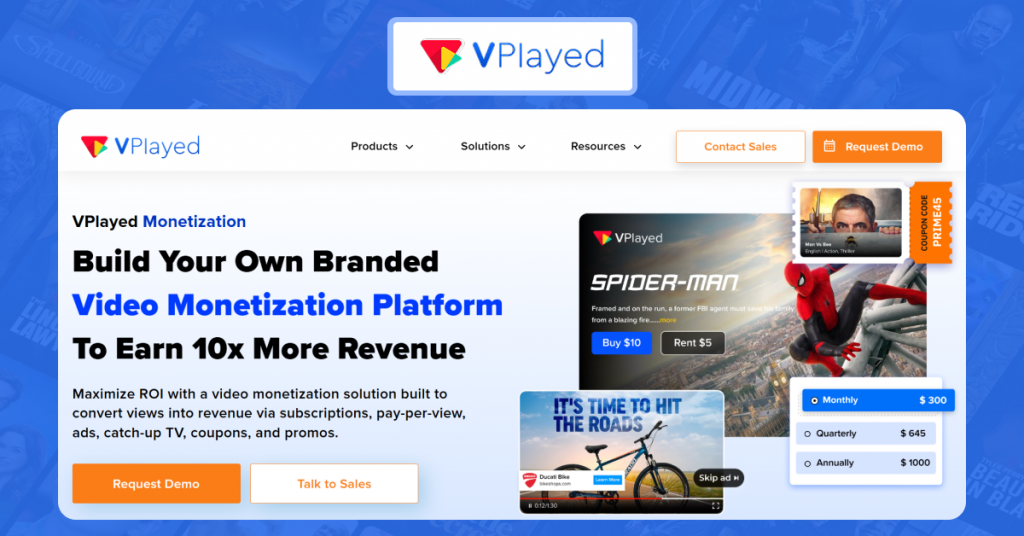
VPlayed is a video monetization platform that offers a one-time SaaP license with zero revenue sharing, giving businesses complete control over their streaming infrastructure and earnings. It enables flexible monetization models and cross-platform delivery at a global scale, making it suitable for businesses aiming to maximize long-term revenue without platform dependency.
Key Features
-
Fully white-label platform with custom UI/UX across 15+ devices, including Android TV, Roku, and Fire TV
-
Multi-DRM protection (Widevine, FairPlay, PlayReady) and AES encryption, along with forensic watermarking
-
200+ third-party integration support for payments, marketing, and analytics
-
Server-side ad insertion bypasses ad blockers for broadcast-quality delivery
-
Actionable revenue analytics with custom reporting
-
Live2VOD software that converts live broadcasts to on-demand videos instantly to increase the content lifespan and viewer convenience
-
Flexible hosting options with both on-premise and cloud deployment to suit any infrastructure strategy
Pros:
- No platform revenue cut, so businesses can retain their full revenue
- Reduces ad-blocker revenue loss with SSAI, ensuring higher ad completion rates and stronger AVOD monetization
- Supports dynamic pricing based on audience segments, helping you maximize revenue across different content types and global audiences
Limitations:
- No free tier to test monetization features, requiring a demo before evaluating revenue models and platform performance
- Limited support for OTT gaming monetization
Pricing
Custom pricing based on business requirements. No revenue-sharing model. Free demo available on request.
Best For
Broadcasters, production houses, and large-scale content owners who require end-to-end video monetization services and ownership of full revenue, white-label control, and multi-model flexibility.
For quote-based plans, fill out this inquiry form. You can also request a free demo here.
2. Dacast
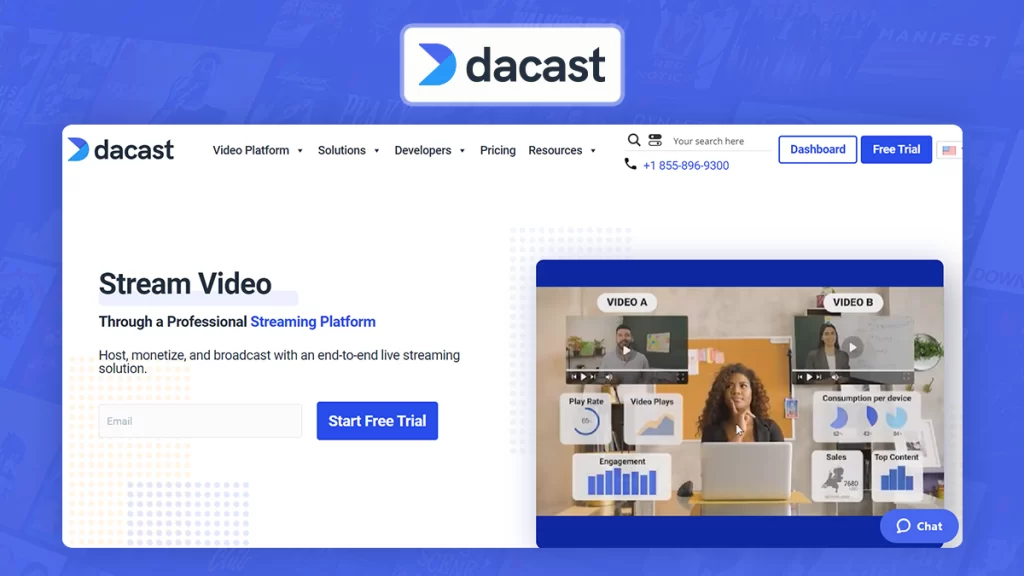
Dacast is the best monetization platform for creators and broadcasters who want a professional online streaming and OTT platform. It helps host, manage, and monetize live and on-demand video content. It enables worldwide streaming and reliable delivery, built-in paywalls, and analytics for video monetization efforts across viewers and devices.
Key Features
-
Akamai partnership guarantees bufferless delivery globally
-
Inbuilt secure paywall to direct payments
-
Global currency support for pricing
-
Revenue, viewer locations, and engagement can be tracked in detail
-
DRM, password protection, and geo-restrictions to prevent unauthorized access
-
Customizable white-label video player
-
Multi-bitrate adaptive streaming for a smooth and consistent playback experience
-
Custom integrations and workflow access through API
Pros:
- Native paywall reduces setup friction and enables quick revenue generation for live events, and reduces cart abandonment
- Supports flexible pricing strategies like group pricing and promo codes, making it easier to run event-based offers and early-bird campaigns
- Displays prices in local currencies, making it easier for global audiences to purchase without confusion
Limitations:
- No monetization features on the Starter plan, requiring an upgrade before you can accept payments or generate revenue
- Delayed payouts of up to 35 days can impact cash flow for businesses relying on a quick revenue turnaround
Best For
Mid-size to enterprise broadcasters and event organizers who need secure, professional live-streaming for global audiences.
Tired of using Dacast?
3. Brightcove
In the video monetization solution space, Brightcove stands out for its AI-powered contextual advertising and advanced server-side ad insertion (SSAI), making it a strong AVOD-focused solution for large media networks. Its AI-driven capabilities help optimize ad placements and maximize revenue, while maintaining a seamless, broadcast-quality viewing experience across both live and on-demand streaming.
Key Features
-
Contextual advertising using AI with scene-level metadata and sentiment-aware ad-breaks
-
Server-side ad insertion (SSAI) is used to circumvent ad blockers to deliver ads in broadcast quality
-
Full suite of analytics, including audience engagement, ad, and subscriber
-
Top-tier security, such as AES encryption and geo-restrictions to protect licensed content
-
Provides speedy, low-latency service to millions of simultaneous viewers across the world
-
Player and SDK upgrades, including iOS/tvOS Liquid Glass support
-
Automatically creates searchable tags and descriptions to enhance the content discoverability and ROI.
Pros:
- Server-side ad insertion ensures seamless playback and reduces ad-blocker impact, increasing ad completion rates
- Uses AI-driven contextual ad placement to insert ads at the right moments to improve viewer experience and increase ad completion rates
- Makes it easy to launch FAST channels and turn back-catalog content into steady ad revenue through linear-style streaming
Limitations:
- Complex pricing tied to factors like metadata fields, video volume, and bandwidth makes monetization costs unpredictable and harder to plan ROI
- A complex backend with extensive settings for ad tags, geo-rules, and pricing tiers can make monetization management challenging for smaller teams
Pricing
Brightcove offers 3 plans:
- Marketing Studio
- Communications Studio
- Media Studio
Custom pricing based on business requirements. Contact sales for detailed plans and enterprise quotes.
Best For
Huge media companies and TV networks that need scalable, AI-based monetization with in-depth analytics and multi-platform distribution.
4. Vimeo OTT
Vimeo OTT is a dedicated video monetization platform aimed at creators who desire to easily create their own subscription-based channels. It offers the infrastructure to serve, transmit, and sell videos online worldwide. It eliminates the technological burdens that come with app development, letting brands devote all their attention to content development and audience retention.
Key Features
-
Built-in checkout system accepts more than 100 currencies and secure transactions via Stripe and in-app purchases
-
Custom-built apps for iOS, Android, Roku, Apple TV, and Xbox without needing a developer
-
Detailed analytics dashboard for tracking revenue, engagement, and churn
-
Integrated marketing tools, including promo codes and email integrations
-
Adaptive streaming, secure video hosting, and international CDN delivery
-
AI-powered tools that support automated video editing, multilingual subtitle translations in 36+ languages, and voice translation
Pros:
- No upfront costs on the Starter plan. Vimeo only takes $1/subscriber, meaning they only make money with videos when you do
- The “Pay What You Want” TVOD feature saw 34% of buyers paying above the base price in beta
- Takes care of VAT/GST, global currencies, and payment processing, so small creators don’t have to spend hours on tax and compliance work
Limitations:
- SVOD scaling gets expensive fast. 1,000 subscribers equals roughly $1,000/month in platform fees before payment processing costs
- AVOD is exclusively for Enterprise accounts, completely unavailable to Starter plan creators
Pricing
Starter charges $1/subscriber/month plus 10% TVOD fees (web-only). Enterprise offers custom pricing with apps, advanced features, and support.
Best For
Independent creators and niche brands that need user-friendly video monetization services to build dedicated viewership communities through multi-device app distribution.
5. Castr
Castr is one of the flexible video monetization platforms that lets creators and businesses offer live stream and on-demand content. This enables them to directly earn revenue through multiple monetization models. It offers paywalls, subscription support, advertising tools, and pay-per-view options. Castr also offers worldwide CDN delivery and analytics to simplify scalable content plans.
Key Features
-
Paywall integration to charge viewers for content access
-
Embeddable HTML5 player that works seamlessly across all browsers and devices
-
Leverages a top-tier global delivery network to prevent buffering for international viewers
-
Pre-recorded live streaming to simulate a linear TV experience
-
White-label customization allows full customization of the viewer interface to reflect your personal brand
-
Detailed sales insights and revenue tracking
-
Permits ingestion of RTSP/RTMP streams from security cameras to support niche 24/7 live-stream applications
Pros:
- All plans include paywall and advertising features, meaning TVOD and AVOD are accessible from the very first paid tier
- Eliminates transaction fees on higher-tier plans, allowing you to retain all earnings from your video sales
- Dedicated event pricing and infrastructure make it effective for webinars, live events, and one-time paid streams
Limitations:
- Full subscription monetization requires a separate OTT product, adding extra cost and setup beyond the core platform
- While it supports multiple models, hybrid monetization lacks depth and flexibility when scaling
Pricing
Castr’s pricing for its live streaming and video hosting:
- Starter at $16.67/month, Standard at $41.67/month
- Premium at $166.67/month
- Ultra at $291.67/month
- Events at $624.99/month
- 7-day free trial
Best For
Small-to-mid-sized businesses and independent broadcasters are interested in affordable and streaming monetization solutions that would enable them to broadcast on more than one platform at a time.
6. Vodlix
Vodlix is an online video monetization platform that offers white-label capabilities and supports content creators, media firms, and businesses. It lets you launch a fully branded streaming service without any infrastructure complications. The platform offers scalable cloud delivery with flexibility to monetize videos at 50+ global CDN locations. It can support live and on-demand content and offers detailed analytics to monitor engagement and revenue levels.
Key Features
-
Tags content automatically and generates descriptions to improve searchability and audience discovery
-
Multi-DRM protection (Widevine, FairPlay, PlayReady) to protect high-quality resources from piracy
-
Live-to-VOD conversion, which is automatically archived to be replayed
-
FAST channel support, full EPG integration, and ad monetization
-
Global CDN support for optimized delivery and buffering-free streaming
-
Video Content Management Systems (CMS) for upload, scheduling, and organization
-
Multi-screen streaming, including web, mobile, smart TV, and OTT devices
Pros:
- Built-in partner and revenue-sharing system makes it easy to work with other creators and split earnings
- Vodlix uses Server-Side Ad Insertion to ensure ads cannot be blocked, protecting your AVOD revenue streams on every device
- No limits on concurrent users lets you handle traffic spikes without paying extra
Limitations:
- Entry plans support basic SVOD/AVOD/TVOD, but FAST channels and advanced ad infrastructure are pushed to Enterprise levels
- FAST monetization comes at a higher-tier cost, making it less accessible for smaller creators
Pricing
- Professional plan available at $1,550/month
- Enterprise plan at $3,850/month
- Ultimate plan (custom pricing for enterprise needs)
- Every plan has a 14-day free trial
Best For
Content creators, media businesses, and niche industries in need of an AI-driven OTT platform for monetization with multi-device applications and adaptable income patterns.


7. JWX
JWX (originally JW Player) is one of the video monetization platforms that offers publishers, broadcasters, and video-driven companies an end-to-end video software platform. It allows them to distribute and monetize content on the web, OTT, and CTV platforms. The platform also offers high-level video monetization of on-demand and live content that has enterprise-level video streaming solutions and AI-based engagement features.
Key Features
-
Adaptive streaming and low buffering playback around the globe
-
Live and video on demand hosting with high-quality playback on all devices
-
Real-time metrics tracking viewability, engagement, and revenue performance
-
Content protection, including geoblocking and DRM support
-
AI-led commercial video studio (JWX Studio) to convert horizontal archives to vertical content
-
Dynamic Content Delivery dynamically personalizes video in real-time based on user behavior, location, and device type
Pros
- Supports both server-side and client-side ad insertion, letting you choose the right ad strategy for different platforms
- Turns horizontal videos into vertical formats using AI so you can monetize the same content on more platforms
- Supports hybrid monetization and lets you combine AVOD, SVOD, and TVOD models to diversify revenue streams across content types
Limitations
- Lacks built-in FAST/linear channel capabilities, limiting expansion into CTV-style ad-supported revenue streams
- Ad revenue depends on how well you connect and manage external ad networks, as it’s not fully automated
Pricing
Custom pricing based on business requirements.
Best For
Publishers, broadcasters, and media companies that need to monetize streaming with flexible ads and subscriptions.
Considering this alternative for JWX!
Here’s how a JWX competitor can transform your video monetization platform with an all-in-one video streaming solution.
8. Bitmovin
Bitmovin is a cloud-native streaming monetization platform that includes encoding, playback, and analytics solutions. It is one of the video monetization sites known for enabling global streaming services to deliver broadcast-quality content. The platform strategizes on maximising playback and minimising bandwidth expenses, and ensures smooth integration into complex advertising systems.
Key Features
-
Advanced player API that guarantees consistent ad performance across web, mobile, and smart TVs
-
Per-title encoding allows less use of data to enhance profit margins on ad-supported content
-
Strong encryption, such as Widevine and PlayReady, to secure premium monetized assets
-
Server-Guided Ad Insertion (SGAI) supports hybrid ad workflows that involve both personalization and ad-blocker resistance
-
AI Scene Analysis creates scene-level metadata to support contextual ad targeting and more intelligent content discovery
-
Integrates major ad providers, such as Google Ad Manager, AWS MediaTailor, and Yospace
Pros
- No tier limits on monetization models. SVOD, AVOD, and TVOD can be used from the free tier.
- Integrates with tools like Google Ad Manager and AWS MediaTailor to support ad monetization
- Uses scene-level data to place more relevant ads, which increases engagement
Limitations
- Usage-based pricing can result in a massive bill during sudden traffic spikes
- No built-in payment system means you must rely on external tools for SVOD and TVOD billing
Pricing
Usage-based pricing with no fixed monthly cost. A free tier is available to get started.
- Live encoding: 6 free hours/month, then $3 per additional hour
- VOD encoding: 2,000 free minutes/month, then $0.02 per minute
- Player: 10,000 free impressions/month, then $1.50 per 1,000 impressions
- Analytics: 100,000 free impressions/month, then $0.65 per 1,000 impressions
Best For
Businesses, media houses, and technology platforms seeking strong video monetization services, including customizable ad and subscription revenue features.
9. Kaltura
Kaltura is one of the best video monetization platforms that is open-source and educator-friendly. It enables organizations to control, distribute, and monetize content on web and OTT devices. The platform is a complete video monetization suite that has advertising facilities and pay models. It supports live streaming, VOD, and virtual events at scale.
Key Features
-
AI-driven personalization offers predictive content suggestions and personalized viewer experiences
-
VAST-Compliant Ad Integration connects with industry-standard ad servers like Google Ad Manager and FreeWheel
-
Multi-DRM protection (Widevine, FairPlay, PlayReady) for premium content security
-
AI-powered analytics that offer insights on viewer behavior and ad performance
-
White-labeling capabilities for fully branded video portals and applications
-
Provides hundreds of open APIs to build your own workflow automation and integrate with third-party software
Pros
- Strong support for hybrid monetization models like tiered subscriptions with ad-supported options
- Supports FAST channels for ad-supported linear streaming without needing subscriptions
- Open-source flexibility makes it easy to adapt monetization and payment systems as needed
Limitations
- Requires configuration and technical setup to fully activate multiple revenue models
- Custom pricing varies by usage, deployment, and features, making ROI harder to predict
Pricing
Custom pricing based on business requirements.
Best For
Large enterprises and telecom providers that require a modular, highly scalable video monetization platform for global OTT and Cloud TV services.
10. Gumlet
Gumlet lets you monetize your videos with automated video processing and global delivery. It offers a high-performance video monetization layer based on high-quality AI-powered compression. The system has a high-speed loading time and reduces bandwidth expenses by 35%. Content owners can protect their content effortlessly and monitor detailed viewer metrics.
Key Features
-
AI-powered compression automatically reduces video file sizes without compromising visual quality or resolution
-
Studio-grade DRM offers Widevine and FairPlay-encrypted premium content
-
Global multi-CDN makes 4k streaming buffer-free even on a slow internet connection
-
In-player CTAs and lead capture forms to turn the viewers into customers
-
AI-generated video chapters and descriptions to improve navigation and content discovery
-
Video CMS with organization and embedding options
Pros
- Includes CTAs and lead capture forms from the Creator plan, helping turn viewers into customers or subscribers
- Live commerce feature turns video engagement into direct purchases through shoppable links
- AI compression reduces file size by up to 35%, which lowers delivery costs and improves AVOD profits
Limitations
- No built-in paywall, so you need third-party tools to handle payments and subscriptions
- Designed more for creator and commerce monetization than complex broadcaster-level ad ecosystems
Pricing
Gumlet offers tiered pricing with a free plan and scalable paid options:
- Free: $0/month with 250 storage minutes and 250 GB streaming
- Creator: $15/month (billed annually) for creators and SMBs
- Growth: $79/month for e-commerce and startups
- Business: $199/month with advanced security, DRM, and higher limits
- Enterprise: Custom pricing for large-scale requirements
Best For
E-learning creators and e-commerce brands seeking a secure, cost-effective video monetization platform that prioritizes fast loading and audience conversion.
11. Uscreen
Uscreen is a video content monetization platform that enables creators to launch and expand branded OTT experiences using built-in tools to sell content to audiences. Creators can generate revenue with live stream monetization and on-demand content to any device. It enables flexible online video monetization and analytics, marketing automations, and global payment solutions to help creators grow revenue internationally.
Key Features
-
Custom-branded mobile and TV apps for iOS, Android, Roku, and Apple TV
-
In-app subscription management, tiered pricing, and free trials
-
Smart analytics to track detailed metrics on subscriber churn, watch time, and specific revenue performance
-
Automated marketing tools, including email campaigns and abandoned cart recovery
-
Live streaming with real-time chat and gated access for paid subscribers
-
Instant conversion of live broadcasts into on-demand videos for your permanent video library
Pros
- Uscreen continuously adds monetization features like donations, fee coverage, group subscriptions, and localized pricing to boost creator revenue
- Uscreen supports Buy Now Pay Later options like Affirm, Afterpay, and Klarna, helping reduce upfront payment friction and boost conversions
- Uscreen offers flexible payment options with Stripe and European methods like iDeal, Sofort, and SEPA to reach global audiences
Limitations
- The per-subscriber model is less efficient when your audience grows, which impacts long-term profitability
- Lack of ad-supported monetization makes Uscreen unsuitable for AVOD-focused businesses
Pricing
- Starter at $49/month (monthly-only, 100 subscriber limit)
- Growth at $149/month and $1.99 per subscriber
- App Essentials at $449/month and $0.99 per subscriber
- Custom plans based on enterprise requirements
Reassessing your partnership with Uscreen?
Make an upgrade with the industry-best uscreen alternative that will assist you in monetizing your content library 10x faster and scale better.
Tired of using Uscreen
12. Muvi
Muvi is a comprehensive video monetization platform that helps creators launch and manage OTT services across the globe. It provides robust online video monetization and live and on-demand services on web, mobile, and TV. Muvi has a flexible billing engine and global payments, which allow businesses to generate revenue seamlessly from content strategies.
Key Features
-
Built-in CMS to manage content, users, and monetization
-
AI-driven automated generation of subtitles, translations, and recommendations
-
Content hosting and live streaming without caps
-
Built-in payment gateway integrations with multi-currency support
-
Clear reports on subscriber behavior, content performance, and revenue generation metrics
-
AWS-supported global CDN delivery
-
Marketing tools, such as coupons, vouchers, and pre-orders
Pros
- Muvi supports SVOD, TVOD, and AVOD across all plans, enabling flexible monetization without needing tier upgrades
- Muvi supports crowdfunding and donations natively, letting creators earn voluntary support beyond subscriptions and ads
- Physical product sales through Muvi Kart extend monetization into live commerce, beyond standard video subscription and ad revenue streams
Limitations
- Muvi supports AVOD but relies on external ad servers, requiring users to manage integrations and ad operations themselves
- Beyond subscription fees, Muvi charges for infrastructure usage, making overall costs rise with higher viewer demand
Pricing
- Standard: $199/mo;
- Professional: $899/mo;
- Enterprise: $2899/mo
- (14-Day Free Trial)
Best For
Media enterprises and broadcasters needing a no-code monetization solution for high-volume video and audio libraries globally
Top OTT Platforms Competing With Muvi
Discover feature-rich streaming solutions that stand out among the leading Muvi competitors in the market..
What to Look For When Choosing a Video Monetization Platform?
Choosing the right platform to monetize your content dictates how you distribute and convert the content into revenue. Here’s how to choose the right platform using 9 key features
- Growth & Performance Support: Make sure the platform can handle high concurrent viewers during live PPV events and a growing content library. The best monetization platforms can accommodate growing business requirements.
- Flexible Monetization: Look for dynamic support in monetization models such as SVOD, AVOD, TVOD, FAST, and hybrid models. This way you won’t be tied down to one monetization model, and you can also maximize yield per viewer.
- Multi-DRM & Content Security: Studio-grade security features such as Widevine, FairPlay, and PlayReady are non-negotiable. Also look for dynamic watermarking and geo-restrictions, and robust access control.
- Pricing Model (Revenue Share vs Flat Fee): Look into whether the monetization platform asks for revenue share based on subscriber count or usage-based. While revenue share lowers upfront cost, flat pricing offers better long-term profitability.
Discover how to build a pay per view website with advanced monetization, content management, and video delivery capabilities.
- Multi-Currency Payment Gateways: Global payment integrations that support localized currency and automated billing keep friction at bay.
- Real-Time Revenue Analytics: Advanced dashboards help keep track of viewer retention and churn rates. They also show earnings metrics to help make better decisions.
- Integrations & APIs: See if they allow seamless integration with third-party ad networks. Additional marketing and analytics integrations extend platform capabilities
- Custom Branding: White-label OTT platforms help build trust and create a strong, independent brand presence.
- Multi-Device Streaming Support: See if the platform supports multiple device streaming to reach audiences using different screens without compromising playback quality.
Conclusion
Choosing the right video monetization platform boils down to your business size, content type, and long-term monetization goals.
- For enterprise media networks: Platforms with AI-driven ad targeting like Brightcove and Kaltura work well.
- For independent creators: Community-focused tools and easy app deployment across devices are offered by Uscreen and Vimeo OTT
- For live event broadcasters: Dacast and Castr come with reliable global delivery and paywalls. Their prices are affordable for businesses with lower upfront budgets
- For no-code deployment: Muvi, Vodlix, and Gumlet offer rapid launches and quick time-to-market
- For total ownership and control: VPlayed stands out with zero revenue sharing, 10+ monetization models, and white-label customization. It is a solid choice for long-term profitability and brand authority.
Evaluate your priorities based on your monetization goals and choose the one that aligns with them.
- Request Demo Book a Live, Personalized Demo
- Contact Sales Reach Out to Our OTT Experts
Frequently Asked Questions (FAQ):
1. What is a video monetization platform?
A video monetization platform is software that lets content owners earn revenue by publishing their video content online. It offers tools to host, stream, and apply different monetization models like subscriptions (SVOD), advertising (AVOD), or pay-per-view (TVOD) based on the content type.
2. What monetization models do video monetization platforms support?
Most video monetization platforms support primary models such as subscription (SVOD), advertising (AVOD), and pay-per-view (TVOD). Some advanced platforms like VPlayed support hybrid monetization models, FAST channels, donations, catch-up TV, CSAI, and SSAI.
3. What features should you look for in a video monetization platform?
Look for flexible monetization models (SVOD, TVOD, AVOD, Hybrid models) to generate multiple streams of revenue. Multi-DRM to protect content from piracy. Analytics to keep track of audience engagement and revenue metrics. Multi-device streaming for maximum audience reach.
4. Can I monetize both live streaming and video-on-demand (VOD) content with the same platform?
Yes, platforms like VPlayed let you monetize both live streaming and video-on-demand content within the same platform. You can make use of PPV for exclusive live streaming, and the automatic live-to-VOD archiving helps extend monetization with SVOD and AVOD.
5. What is the difference between AVOD, SVOD, TVOD, and PPV?
AVOD displays ads but offers content access for free. SVOD is subscription-based, in which users pay a recurring monthly or yearly subscription fee. TVOD and PPV are similar, where users pay a one-time payment to rent or buy a specific piece of content.
6. How do you choose the best video monetization platform for your business?
The best video monetization platform for your business depends on the monetization goals and type of content you offer. But there are some basic features to help identify the right platform, such as flexible monetization, multi-DRM, real-time analytics, live-to-VOD archiving, and multi-device compatibility.
7. Which industries benefit most from video monetization platforms?
Media enterprises, broadcasters, educators, fitness trainers, sports leagues, religious organizations, event organizers, and content owners benefit from video monetization platforms. Any business that can distribute live or on-demand video content can generate revenue through subscriptions, advertising, pay-per-view, or hybrid monetization models.
8. What are the types of video monetization platforms?
The most common types of video monetization platforms are Subscription-Based (SVOD) for recurring revenue, Advertisement-Based (AVOD) for ad-driven earnings, and Transactional (TVOD) for pay-per-view access. Additionally, Hybrid model platforms combine multiple revenue streams for maximum flexibility.


