

![How to Build AI Software [AI-Driven Software Development]](https://www.contus.com/blog/wp-content/uploads/2025/09/How-to-Build-AI-Software.webp)
The demand to build a software with AI keeps growing every day because businesses have realized that AI software cuts costs, automates repetitive manual tasks, and speeds up decision-making.
One of Gartner’s ai usage statistics says that 55% of companies have taken up an AI-first strategy, showing the pressing need for businesses to create AI software. It’s easy to get overwhelmed by all the AI trends you see online, but all you need is the right roadmap on how to build a software using ai.
It doesn’t matter whether you are looking into creating your own AI tool from scratch or if you want to partner with an AI software development company; this blog will guide you through the practical steps of how to develop AI software in 2026. Let’s get started.
Key Takeaways
- Building AI software requires a structured roadmap, from understanding the goals of the AI to deploying and maintaining AI software.
- AI applications differ across industries, demanding domain-specific data and compliance.
- Programming languages like Python, Java and a strong tech stack are essential to build enterprise-grade AI systems.
- Discover how to develop AI software from scratch that is profitable and aligns with your business goals.
- Future AI trends are reshaping the industry and it is growing at a rapid pace. In fact, the AI market is projected to reach USD $155.21 billion by 2030, with a CAGR increase of 37.6% from 2025 to 2030.
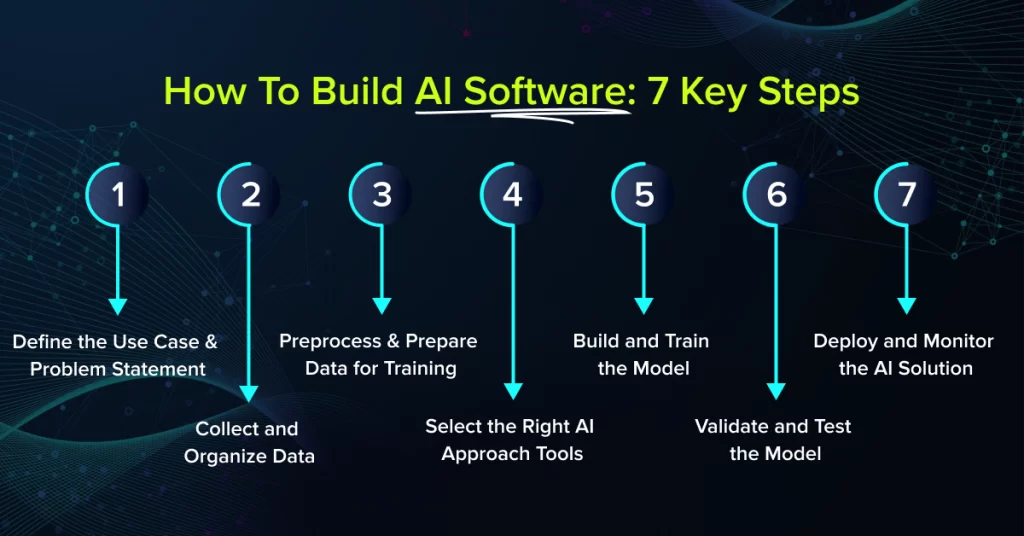
How To Build AI Software Step by Step [7 Key Flow]
To develop a software using AI, you need to follow a structured process.
- Define the problem statement
- Collect and organize data
- Prepare data for training
- Select the right AI approach and tools
- Build and train the model
- Validate and test the model
- Deploy and monitor the AI solution
Let’s take a deeper look at how each step works. Here is the detailed step-by-step guide on how to create a AI software.
Define The Problem Statement
Start by identifying the problem and how your AI will solve it. Clear goals will make the process easier. So ask yourself:
- Who will use this AI and will it simplify their workflow?
- Does your AI software idea align with your broader business goals?
A clear problem statement shapes the data you collect, the model you choose, and how you measure success. Even most experienced teams can struggle without this clarity on how to make a AI software that is scalable.
Collect and Organize Data
If you want to know how to make an AI software that solves business problems, you need to collect high-quality data. This can be a public dataset or proprietary data like transaction records, sensor data, customer interactions, etc.
Make sure:
- To collect data that connects to the problem you are solving.
- To use a mix of structured and unstructured data for richer insights.
- To clean, label, and organize data early to speed up development.
Properly collected data lets you clearly see how to create an AI software that actually works in real-world scenarios.
Preprocess and Prepare Data for Training
Once the data is collected, the next step is to process it for training. This includes organizing, labeling, removing duplicates, and fixing incomplete entries so that AI can learn accurately.
Three quick tips for effective preprocessing:
- Use clear, descriptive file names so that the LLMs can understand what is in the file.
- Convert tables into text formats like XML to make it chatbot-friendly.
- Retrain the model whenever you update the data to maintain accuracy.
Data preparation directly impacts the model performance. For example, computer vision models may require enhanced images while NP models rely on tokenized and cleaned text. Proper preprocessing is a core foundation to create AI software that learns from clean, structured, and unbiased data.
Select The Right AI Approach and Tools
Choosing the right technique is highly important to developing AI software in 2026, with all these emerging technologies. Depending on the use case, developers pick AI technology and algorithms like machine learning, deep learning, natural language processing, or computer vision.
- Pick the AI technique that fits your problem (Machine learning, Deep learning, NLP, or Computer vision)
- Use reliable frameworks like TensorFlow, PyTorch, or Scikit-learn.
- Use cloud-based AI tools to speed up development by 2x.
- Choose infrastructure that supports long-term scaling.
- Decide early between open-source tools and commercial platforms.
For those exploring how to create your own AI software, start with open-source frameworks. Cloud-based resources make experimentation and scaling much easier.
Build and Train The Model
Now, the developers will build the AI model’s architecture and train it using the prepared dataset. Through iterative training, the model learns patterns and improves its ability to perform tasks. For example, a recommendation system learns user behavior to recommend relevant products.
- Define clear evaluation metrics to track training progress.
- Monitor for errors like overfitting or underperformance.
- Allocate enough computing resources for large models.
A good training pipeline determines how to create an AI software that learns, adapts and works precisely. And if you want to build AI without coding knowledge, no-code platforms like Google Cloud AutoML or Azure AI Studio make it easy to get started.
Validate and Test The Model
After development, the model is tested to evaluate how it performs in a real-life scenario. Developers use separate training, validation, and test sets to measure accuracy and stability. This stage helps identify potential threats before deployment and ensures the model is reliable.
- The validation set helps fine-tune the model so it performs well outside controlled environments.
- Bias and fairness checks are essential. For example, healthcare AI should work across diverse patient groups.
- Continuous testing ensures the model adapts and stays accurate as new data is added.
Regular evaluation helps maintain trust and performance over time. Also, proper testing lays the foundation for a robust, scalable AI software development solution.
Deploy and Monitor The AI Solution
The final stage in how to build AI software is deployment. Trained and validated AI models are integrated into applications, workflows, or products where end-users interact with them. This may involve deploying on cloud platforms, edge devices, or on-premise systems, depending on the use case.
- Retrain models periodically with new data to stay accurate.
- Monitor performance, detect drift, and maintain compliance.
- Implement robust monitoring practices for reliability and efficiency.
Following these steps ensures a structured process from idea to implementation, making your AI scalable and ready for real-world scenarios.
Types of Industry-Specific AI Software Solutions
Now that we have covered the roadmap for building AI software, let’s see how AI-based software development is applied across various industries.
| Industry-specific AI | Example |
| Healthcare AI | Helps with early diagnosis by analyzing medical images. They can also predict outcomes of treatments and help with personalized treatment plans. |
| eCommerce AI | Recommends products based on an individual’s shopping or browsing history. Analyzes trends and inventory and helps maintain stock at the right levels. |
| Education AI | Helps with attendance tracking and personalizes curriculum and lesson plans based on the student’s needs. |
| Finance AI | Predicts financial risk by analyzing economic indicators and helps with automated loan approvals and fraud detection. |
| Automotive AI | AI is used in automotive vehicles like self-driving cars. Monitors traffic and helps reduce fuel emissions and congestion. Also monitors vehicle parts for possible breakdowns. |
| Manufacturing AI | Has predictive maintenance capability, which keeps the machine from breakdowns and expensive repairs. |
| Human Resources AI | Automates resume screening and interview scheduling. Minimizes bias related to gender, race, and background. |
Which Programming Language is Helpful for AI Software Development?
Python is the most widely used programming language for AI software development because of its simplicity and powerful AI/ML libraries. When deciding how to create an AI software, factors like cost and time to market heavily influence the decision.
Let’s take a look at the top five languages commonly used in AI development and the unique benefits they bring.
Python
Python is the most popular programming language for AI development due to its simplicity and powerful libraries like TensorFlow and PyTorch. In fact, 47.9% developers prefer Python, making it a top choice.
It’s easy syntax, quick prototyping, and fast deployment make it ideal for building artificial intelligence software. Companies also hire AI developers skilled in Python to reduce overall software development costs and speed up time-to-market.
Java
Java is a strong choice for enterprise AI software as it integrates smoothly with existing systems and supports NLP, cross-platform compatibility, and secure backend operations.
From an AI development cost perspective, businesses avoid expensive migrations by extending their existing Java-based systems with AI capabilities. This makes Java useful in banking and telecom industries.
R
R may not be the first pick when thinking about how to create artificial intelligence software, but it is effective in data-driven use cases. Finance & healthcare industries use it for statistical modeling & advanced analytics.
With strong libraries for data-intensive AI tasks, R enables rapid experimentation, faster insights, and reduced reliance on expensive third-party analytics tools.
C++
Some industries like robotics, IoT, or high-frequency trading, can’t afford delays. For such performance-critical AI applications, C++ is a top choice due to its speed, low-level control, and efficient resource use.
If your goal is to build AI software that needs minimal latency and rapid processing, choose C++. Its precision makes it essential for anyone exploring how to create artificial intelligence software for real-time settings.
Julia
Julia is a new language rapidly growing with over 50 million downloads. It blends the speed of C++ & simplicity of Python, making it ideal for teams exploring how to make AI software involving heavy math computations.
It helps businesses cut cloud and infrastructure costs by reducing the computing power. Julia is a strong choice for companies looking for how to build an AI software used in large-scale simulations & research-heavy apps.
Here is a comparison table of the programming languages for your easy understanding.
| Programming Language | Best For | Business Benefits | Cost Impact |
| Python | Prototyping, chatbots, NLP, computer vision | Large ecosystem, faster dev cycles, easy hiring | Lower developer costs and faster time-to-market |
| Java | Enterprise AI, legacy system integration | Scalability, stability, strong security | Saves migration costs, long-term enterprise fit |
| R | Data-heavy AI, predictive analytics | Advanced statistical modeling, great for research | Reduces dependency on external analytics tools |
| C++ | Robotics, IoT, real-time AI | High performance, low latency execution | Higher developer costs but delivers great ROI |
| Julia | Scientific computing, simulations | Combines speed of C++ with Python-like ease | Lowers cloud expenses for computation-heavy tasks |
Real-Time Challenges to Develop AI Software
As one of the AI software development companies ourselves, the challenges we face when creating AI software aren’t just technical; they span across people and data as well.
Here are a few common challenges.
- Issues in integrating with legacy systems: Integrating with older systems can be complex due to data silos and limited processing capabilities. You need the right architecture and APIs for an AI system to work well.
- Knowledge gap: The lack of experts who understand the older systems as well as AI systems. Also, hiring top AI developers and retaining them is a challenge.
- Model drift: Yes, AI will work just fine at the beginning, but the data drift will lead to inaccuracy. Keeping a close eye on model drift and retraining is essential.
- Data bias: Gathering relevant data, preparing it before you create AI software has to be pristine because your AI is only as good as the data you feed it.
- Data Compliance: There are regulatory laws constantly changing worldwide, and it’s very important to stick to them to keep AI ethical.
- Scalability issues: The AI system will work as intended during testing, but could fail when scaling is needed.
Benefits in AI Software Development
There’s no doubt that AI is transforming industries and everyday life with measurable benefits. Here are some areas of advantage.
Higher business profits: AI boosts productivity and decision-making, directly improving revenue. According to Forbes, employees who use AI earn 40% more, highlighting its role in efficiency and performance.
Healthcare innovation: AI analyzing patterns can help diagnose and personalize treatments and improve access to care.
Better everyday living: AI acts as a reliable assistant in simplifying tasks, improving reasoning, and automating routine work so people can focus on what truly matters.
Smart and adaptive education: By personalizing learning based on progress and goals, AI helps learners stay engaged, motivated, and supported throughout their journey.
How CONTUS Tech Can Help to build AI software
When businesses think about how to create AI software from scratch, the challenge often lies in bridging the gap between vision and execution. This is also where many companies struggle with the AI build vs buy decision. And that is where CONTUS Tech makes the process easier.
CONTUS Tech specializes in AI software development, AI agent development services, agentic AI development services, AI voice agent development, and generative AI, thus assisting businesses in transforming ideas into reality. We provide consulting and prototyping of the entire process of creating an AI product on a full scale, starting with the initial stage and continuing through to the final one.
Check out our case studies to see how we’ve helped businesses turn AI strategies into real success stories.
Our partnerships with top cloud providers like AWS, Microsoft, and Google ensure that every AI deployment is scalable, secure, and cost-efficient.
For businesses seeking guidance on how to make a AI software, CONTUS Tech combines technical expertise and strategic insight to build solutions that are innovative today and sustainable for the future.
Connect With Our Team, Discuss Your AI Software Development Requirements, and Begin Your Project in Just Next Few Days.
Frequently Asked Questions
1. Which are the core components of artificial intelligence?
Artificial intelligence is built on several foundational components that work together to mimic human-like decision-making. Key among them are Machine Learning, Natural Language Processing (NLP), Computer Vision, Robotics, Data Reasoning, Perception, and Algorithms.
2. What are the benefits of developing an AI software solution?
AI software automates repetitive tasks, reduces costs, and boosts productivity. It enhances decision-making with data insights, enabling teams to focus on complex work while delivering scalable, personalized experiences that drive growth.
3. How much does AI MVP software development cost?
AI MVP software development cost vary based on project scope, data complexity, and infrastructure needs. A proof of concept may start in the tens of thousands, while full-fledged AI solutions often require six to seven figure investments for complete development and deployment.
4. What are some common challenges that companies face when implementing an AI model?
Challenges include data quality issues, high infrastructure costs, lack of skilled talent, integration with legacy systems, and ensuring fairness in algorithms. Indeed, continuous testing and monitoring are required to avoid bias and maintain model performance.
5. How can companies ensure the security of their AI systems?
Securing AI systems involves protecting data pipelines, preventing model poisoning, and securing APIs. Use differential privacy, adversarial testing, constant monitoring, and compliance standards to reduce risks and safeguard operations.
6. How can businesses determine the ROI of implementing AI software development?
ROI is measured by comparing the cost of AI implementation against measurable gains like reduced operational expenses, higher productivity, improved customer satisfaction, or revenue growth. Tracking KPIs pre and post deployment helps validate financial and strategic impact.
7. How can i hire an experienced ai software development company for scalable automation projects?
To hire an AI software development company, define your project goals, technologies, and scalability needs. Review their portfolio, skills in Python, TensorFlow, & Kubernetes, and assess security practices. Finally, start with a PoC before signing a contract.


