





- Know how to hire remote developers strategically.
- Understand the role and benefits of hiring remote developers.
- Explore different remote development team hiring models.
- Follow a 7 step-by-step proven process on how to hire remote developers quickly.
- Know the best practices and mistakes to avoid when hiring developers remotely.
Is your software team facing challenges in managing and optimizing your business systems? Or are you looking for ways to expand your in-house development team?
Whether you’re a startup or an enterprise, you can eliminate the hassle by hiring remote developers to support your growing business needs.
If you’re wondering how to hire remote developers instead of an in-house development team?, then this is for you !
Hiring remote software developers can help you reduce recruitment costs, shorten the hiring process, minimize the time spent interviewing candidates, keep everything online and lower the overall hiring timeline. It also gives you access to world-class talent, top-ranking developers across countries and ensures seamless business development.
By building the right remote development team, companies can achieve up to 10x faster growth, adapt quickly to changing market demands and streamline both the hiring and employee management processes. Since everything can be managed remotely, businesses can collaborate effectively without the need for frequent in-person hiring processes.
In this blog, we’ll explore how to hire remote development team and the 7 proven steps that suggest the best practices on hiring remote developers effectively!
What Does a Remote Developer Do?
Before you get into the discussion of how to hire a remote team of software developer, lets see what they actually do:
The role of a remote software developer is to build, design and create software programs and systems for organizations and businesses they work for. They are primarily responsible for designing, developing, testing, deploying and maintaining high-quality software solutions.
Unlike in-house employees who work on-site, remote developers perform their tasks from home, from any location or from anywhere in the world. Once hired by an organization or enterprise, they are required to report, communicate and collaborate with their respective team members.
They must meet project deadlines, discuss the roadmap, attend team meetings (both online or on-site, when required) and deliver work that meets quality expectations. They also collaborate with team members using various online communication tools.
Tell us your technology needs and project requirements and we will help you connect with developers who fit your goals.
Different Types of Remote Development Teams
Based on the organization size and project demands, you need to choose the right company to hire a remote software developers. But, choosing the right hiring model requires a strategic evaluation of your business priorities, project requirements, development budget, delivery timelines, the need for specialized technical expertise and the level of control you want over your projects.
We have highlighted the top remote development hiring models to help you pick the one that best aligns with your business goals, project budget and architectural requirements.
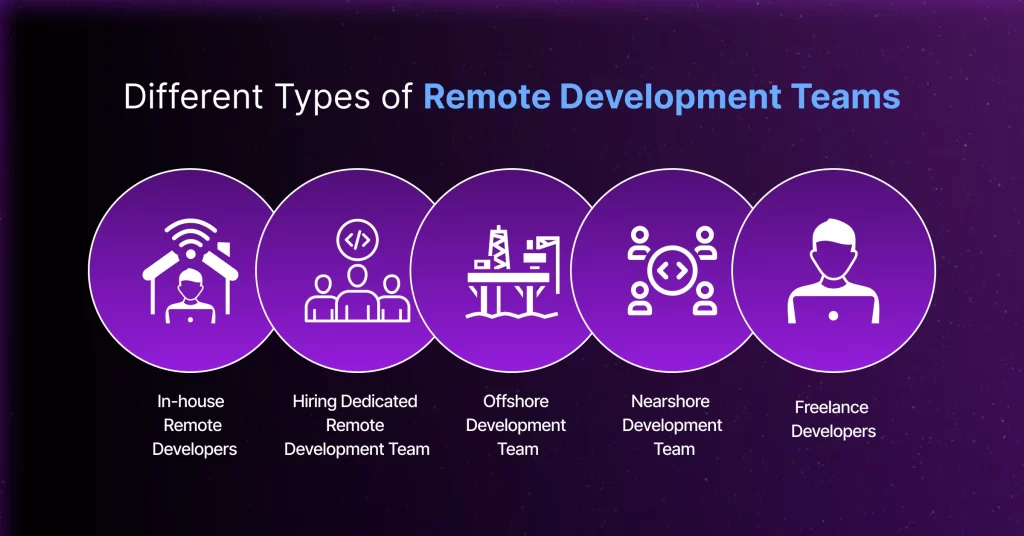
In-house Remote Developers
In-house remote developers are employees who are directly hired by your organization to join them remotely instead of working from the office.
Such developers remain fully integrated into your company’s work culture, workflows and long-term goals while enjoying the flexibility of remote work.
Pros
- Can have better collaboration and project transparency across internal departments.
- Takes complete control over project priorities and development workflows.
- Works closely with the organization, ensuring greater transparency and accountability.
- Strong alignment with project objectives, team workflows and overall business goals.
Cons
- The hiring process could be lengthy and can delay project initiation.
- Requires higher salary package and employee benefit costs as a full-time employee
Best Suited For
In-house remote developers are best suited for businesses that build large-scale digital products, maintain systems full-time or require developers to work for longer periods on more than one project.
Hiring Dedicated Remote Development Team
You will have a dedicated remote development team that works as a team on your project. Whether you recruit them remotely or hire them through a software services company, they will function as an extended part of your internal team.
They follow your organization’s processes, CRM and software tools and product development roadmap, just like your internal teams.
Pros
- Recruiting them gives you access to specialized and seasoned technical expertise.
- Helps you set up a team much faster and hassle-free.
- You have the option to scale your team based on evolving project requirements.
- No need for administrative or employee-based monitoring.
Cons
- This requires clear communication and constant reviews and discussions.
- If you have time zone differences, you need to manage things accordingly.
Best Suited For
Best for businesses looking for how to hire remote software developers who need a scalable development team and can’t afford to spend time hiring and managing an in-house team.
Offshore Development Team
An offshore development team means hiring an entire team that is located in a different part of the world, usually from regions where labor costs for development services are lower.
Such companies use this opportunity to get complete access to a skilled team that fits within their software development budget.
Pros
- You can achieve significant cost savings compared to local hiring.
- You will get access to a larger team with the right talent.
- You can scale the team based on your budget and product requirements.
- You can be sure of round-the-clock team dedication.
Cons
- You may have time zone differences that could slow down communication.
- You may struggle with adapting to cultural and language differences.
Best Suited For
Companies that are keen on managing budget costs and have expertise in managing teams from different cultures, languages and skill levels.
Nearshore Development Team
Nearshore development involves hiring a development team in a neighboring country that shares similar working time zones.
This hiring model is highly sought after because it balances development costs with easier communication and seamless collaboration.
Pros
- You can have access to the team during your working hours.
- Real-time, faster communication and timely decision-making.
- Fewer cultural and language hurdles.
- Less team travel and in-person meeting costs.
Cons
- It might be harder to find a smaller talent pool in such regions.
- You might not get access to niche development skill sets.
Best Suited For
Companies that need access to nearby talent, with easy access to virtual and in-person meetings within their preferred time zones and working hours.
Freelance Developers
Hiring freelance developers gives you access to independent professionals who are hired based on hourly rates or on a contract basis.
They tend to work on their own without having to align with organizational workflows and they are mostly sought for smaller projects.
Pros
- The hiring process might be quick and effortless.
- It’s much more cost-effective and budget-friendly compared to other models.
- As they work on a flexible schedule, there is no need for you to track or monitor their progress.
- You can easily get access to specialized expertise for any requirements involving demanding technologies.
Cons
- You will have only limited availability with no promising long tie support
- Managing multiple freelancers may challenge your coordination effort
Best Suited For
For startups, small businesses and organizations that need short-term technical expertise for smaller projects.
Get access to skilled developers who can align with your technology needs, project scope and delivery goals.
When Should You Hire Remote Developers?
This can be determined by certain signs that indicate when your organization needs to hire remote developers as the next step. Let’s explore some of the key insights:
When you Lack the Desired Skill Set in your Team
When your existing team does not possess the necessary skills to take on a project or meet growing demands, hiring remote developers can help. If you feel that you currently need a higher level of development skills, hiring remote developers can help you fulfill your skill requirements.
When you are Struggling with High Developmental Cost
When your existing organizational system struggles to cope with development costs and you are looking for an alternative that matches your budget or lowers your budget expectations, hiring a dedicated remote team can help you overcome the cost challenges.
When you Struggle to Achieve the Time-to-market Milestone
When your existing development team does not possess the necessary resources and skill sets to meet your project deadlines and ensure timely delivery, hiring remote developers can help you overcome these challenges, make better decisions and deliver projects on time.
Why Businesses Hire Remote Developers
If you are someone who is still wondering how to hire a team of remote developers for businesses or hire remote developers for a project, either way you need to look beyond the time zone, cultural and location challenges.
Here are some of the key benefits that explain why businesses of are looking for ways to hire remote developers for their startups or already established firms:
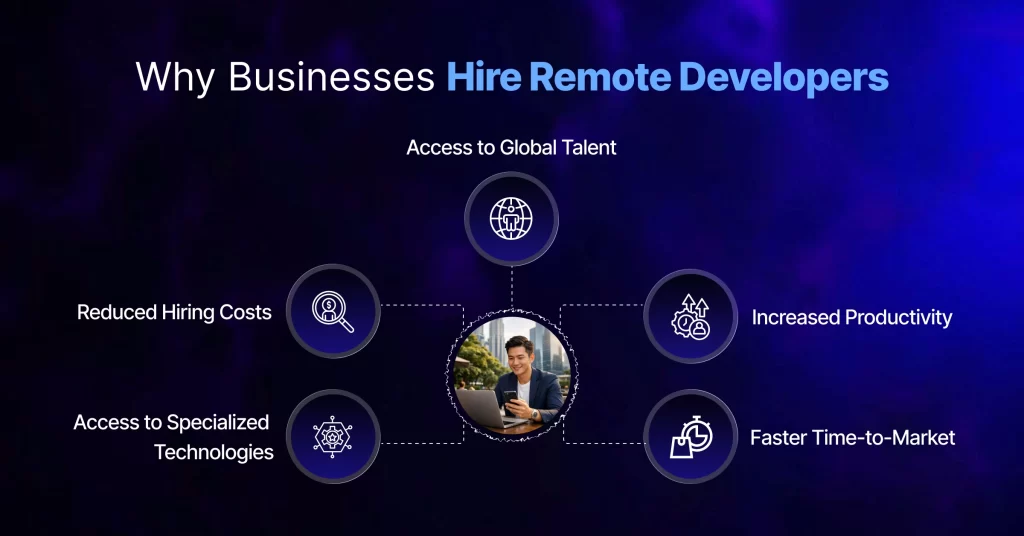
Access to Global Talent
Unlike in-house recruitment, hiring a remote development team gives you the privilege of accessing global talent from across the world. You can choose the best talent from any part of the world, get in touch with them irrespective of time zones and hire them to work on your projects.
Reduced Hiring Costs
In-house software developers have to be paid high salary packages, but hiring remote developers for a specific period or project contract can help you manage costs effectively. It can help you stay aligned with your project while still being cautious about the limited budget for the project.
Access to Specialized Technologies
If you are looking for specific skill sets, expertise, or tools, hiring remote developers with such talents can make your search more reliable and effortless. You can easily identify the required talent through portfolios and hire the specific talent needed for your project without having to compromise on cost or other major factors.
Increased Productivity
Hiring a dedicated team can facilitate work hours, as they will be contracted for a specific timeline, and hence, the productivity will be aligned with your benchmark. Instead of worrying about progress, productivity, and task management, you can stay relaxed and stress-free without having to worry about micromanaging things, as the team you hire will be more professional and experienced.
Faster Time-to-Market
As the hired team is mostly timeline- and contract-based, they will work to deliver the project on time, ensuring a faster time to market. This means you need not worry about the team’s efficiency, commitment to project deadlines or timely project delivery to market. Everything stays under control.
Step-by-Step Guide on How to Hire a Remote Team of Software Developers
If you are still wondering how to hire a remote team of software developers effectively, then here is a step-by-step playbook that tells you exactly how to hire top talent at your convenience, the right way.
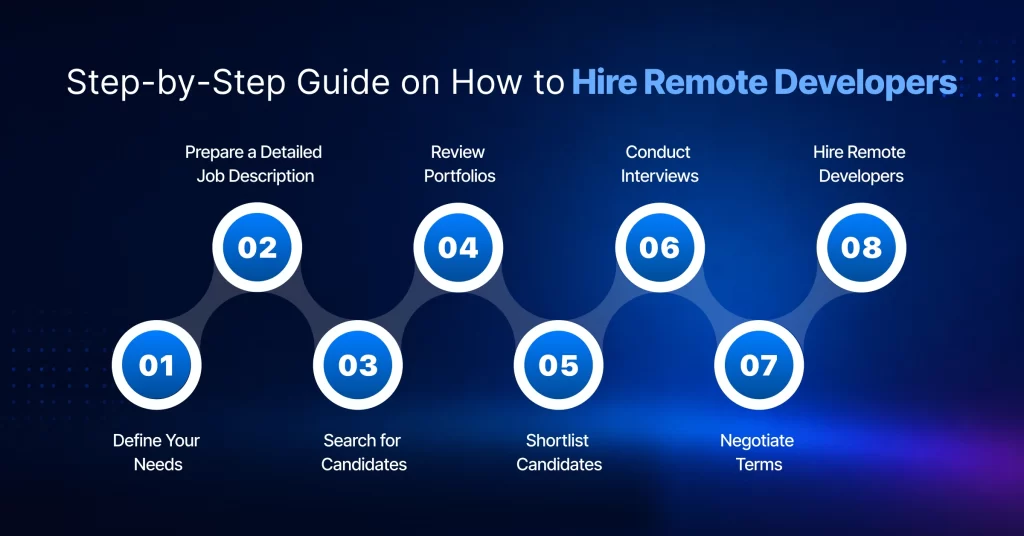
1. Define Your Needs
Start by listing out the skills required for your project scope, technologies, experience level, budget, and timeline. Sorting this out as a first step can help you roll out your requirements for the project right from the beginning.
Building your project roadmap after this will help you determine how exactly your project might progress before reaching the deadline and delivering it right on time.
2. Prepare a Detailed Job Description
Get clear with your talent requirements, roles, and responsibilities. Create a detailed and self-explanatory job description highlighting the role, responsibilities, technical requirements, years of experience, skills required, portfolio of project work, working hours, remote-work requirements and hiring cost that will be provided.
This helps attract the most suitable candidates right from the beginning.
3. Search for Candidates
Search for candidates in the right places. Post ads for hiring remote developers on dedicated and popular forums, communities and specialized software developer hiring companies. Give attention to authentic sources.
Look for developers through professional networks, job platforms, developer communities or specialized remote hiring companies. This way, you can find the right talent the first time.
Join 100+ companies across 15 countries who trust Hire Developer to build and scale their engineering teams.
4. Review Portfolios
Fix a dedicated review team and find the right talent pool without skipping any details or information. Sort and filter the right candidates based on their expertise, region, experience, skill set, project delivery, team spirit and remote work arrangement flexibility, so that you can review their talents and experience effectively for the next step.
5. Shortlist Candidates
Once the portfolio is reviewed, you can shortlist the talents that best match the scope of the project, expected outcomes, their availability beyond time-zone challenges and their previous experience in delivering exceptional software projects in a remote setup. All this helps you find the right resource and makes the next step a seamless one.
6. Conduct Interviews
This is a crucial step where you assess their technical, practical, communication and problem-solving skills. If possible, meet them in person to interview them or connect with them virtually and assess them through various rounds of evaluation to filter the best candidate who matches all your requirements.
7. Negotiate Terms
Discuss with them the most crucial parts of the remote hiring setup. Explain your security and compliance requirements, contract policies, compensation, billing details and what is the expected cost to hire remote developers before officially hiring them.
8. Hire Remote Developers
Officially welcome them, introduce them to your work style, team, and project-related team members and provide them with a smooth onboarding process.
Introduce them to your project roadmap and check how they align with it.
Build your development team with skilled remote talent while keeping hiring and development costs under control.
Mistakes to Avoid when Hiring Remote Developers
Here are some common mistakes you should avoid before getting started with how to hire remote software developers. Avoiding these challenges and errors can save you time, money and effort.
Here’s what you should know, just as much as you spend time learning about the benefits of hiring remote developers.
Hiring only Based on Cost
Being cost-conscious is good, but relying too much on a hiring team totally based on their offered price alone can blindside you to other setbacks. So, as much as you consider costs, check out their talent level, skill set and quality before committing to hiring remote developers.
Ignoring Communication Skills
As hiring remote teams mostly works offshore, nearshore, and across any part of the world, make sure they are aware of a universal language like English or any other official language that both parties are aware of.
Alternatively, have a translator or someone who is already familiar with the language of the hired remote developers. This way, you can keep communication seamless from start to finish.
Poor Documentation
Keep a clear and very authentic account of what you do by managing and tracking projects with clear and straightforward documentation, so that there are no messes, gaps, or setbacks that could lead to problems while billing or towards the delivery.
Make sure everything is filed, documented and kept track of.
Weak Project Planning
Always stay on track. Leave space and opportunities to enhance and improve projects if needed. Always have a clear blueprint before starting, establish a professional roadmap and get ready for seamless and effortless project management so that you don’t need to go back and forth to find exactly what was planned, discussed or reviewed.
Streamline planning professionally to eliminate any chaos and communication gaps.
Why Hire Remote Developers from CONTUS Tech
You might be wondering how to get started with hiring remote developers, but knowing how to do it effectively and which services to approach can be challenging. We have made a thorough evaluation of several software development service providers that offer remote developer hiring solutions based on your business needs, budget, technical requirements and project scope.
Based on the lot of services available in the market, CONTUS Tech has been helping businesses and enterprises effortlessly hire skilled remote developers without going through a lengthy and complicated hiring process.
Headquartered in Chennai and having established its presence across the USA, Europe, UAE, Africa, and more, CONTUS Tech has been steadily focusing on delivering next-level software development solutions that help businesses accelerate project delivery with quality, reliability, and efficiency.
Their services mainly include offshore hiring, hiring dedicated dev teams, nearshore remote developers hiring that are most suitable for software development, DevOps services, cloud solutions, and other technology services. These solutions help businesses find and onboard skilled developers who can seamlessly integrate into their existing teams and contribute effectively to their projects.
If you are looking for a team that focuses on a clear-cut remote developer hiring strategy by offering a structured roadmap covering talent identification, skill assessment, technical evaluation, onboarding, and project execution, then CONTUS Tech can be your reliable software services partner to help you build and manage a skilled remote development team.
Whether you want to hire skilled remote developers, build a dedicated software development team, scale your existing technical workforce, or find developers with expertise in specific technologies, CONTUS Tech can help you identify the right talent based on your project requirements.
Right from talent sourcing and technical evaluation to onboarding and ongoing project support, Contus Tech helps make the entire remote hiring process more seamless and progressive.
FAQs about Hire Remote Developers
Why should I hire remote developers?
Hiring remote developers gives you access to a wider global talent pool without geographical limitations. It reduces hiring costs, improves flexibility and helps you scale your software development project faster.
How to hire remote development team?
You can get started by defining your project requirements, the technical skills expected of the developers, their experience level, budget and project timeline. Based on these factors, you can define the candidate’s roles and responsibilities, assess them through the interview process and onboard them using a streamlined approach aligned with your team’s requirements.
What is the difference between remote developers and freelancers?
Hiring remote developers means engaging a dedicated team that is aligned with the organization’s goals and committed to long-term projects, while working from anywhere in the world. Whereas, freelancers typically work independently on specific projects or tasks for a short period and may handle multiple clients simultaneously, often with less transparency and involvement in the organization’s processes.
Which countries are best for hiring remote developers?
You can opt for developers from countries such as India, Poland, Ukraine, the Philippines and Brazil to hire skilled remote developers. Choosing offshore or nearshore developers totally depends on the required skills, budget, time-zone preferences and the style of communication.
How long does it take to hire remote developers?
The time taken to hire remote developers may vary from a few days to several weeks, depending on the project requirements, allocated budget, expected location and the overall evaluation process.


