



AI is now becoming a part of everyday work, helping users find information, generate answers, create content and make decisions, while businesses today are using it to automate workflows. It also automates data management and retrieval, enabling advanced searches, automating tasks, generating responses, powering AI chatbots and agents, fueling creativity and increasingly influencing everyday decisions, from individuals and businesses to enterprise-level operations.
AI’s growth so far has been rapid and extraordinary. By 2030, the global AI market is valued at approximately $255 billion and is projected to skyrocket past $1,218 billion by 2030. What started as a breakthrough technology has now become a major force transforming how industries work, businesses operate and products evolve.
But besides the torrid pace of AI advancement, you might have bigger questions, like:
How widely is AI actually being adopted? Which industries are embracing it the fastest? How much are businesses investing in AI and what impact does it have on your everyday work?
To help you get a clear picture of how AI is evolving across businesses and industries, we have compiled 90+ of the top AI statistics for 2026. Let’s dive in and explore them.
See where your business stands today!
✨ TL; DR: A Glance at the Best Artificial Intelligence Statistics!
Here are the top AI statistics to help you understand current AI trends, its growing presence and future potential.
If you’re looking to kick-start your AI-driven strategy and take your business, customer service, support or marketing to the next level, here’s what you should know:
- By 2030, AI will contribute $15.7 trillion to the overall global economy.
- At least 72% of companies across the world are now using AI for business operations.
- By 2030, China is foreseen to become the global AI leader, achieving a market share of 26.1%
- AI will replace nearly 85 million jobs worldwide and may create 97 million new job roles.
- Worldwide, AI technology is used by 35% of companies.
- According to PWC, by 2035, AI is expected to boost productivity by 40%
- In the healthcare industry, around 38% use computers as part of treatment processes and healthcare services.
- About 54% of organizations use AI as cost -effective
- 48% of IT firms use AI for automation and 45% of them use AI for IT cybersecurity.
- AI is used by 92% of companies and they are planning to increase investments at least in the next few decades.
✨ How We Selected and Verified These AI Statistics
Get microscopic detail on how we gathered the top trending AI statistics, how our team conducted the research, handled the data and sorted and arranged it in a way that helps you identify the most important AI statistics you need to ace the business market.
- Conducted Independent research: We referred to top AI statistics blogs and recent research from radixweb, G2, rebootonline, masterofcode covering blog publications released between January 2025 and Sep 2026.
- G2 proprietary research : We gathered insights from G2 reviews, along with data from various external sources, to identify and analyze the top AI development companies.
- Review analysis: We reviewed more than 3,000 AI users and analyzed their experiences across multiple AI categories, including AI-adopted businesses, AI-driven user experiences, AI-integrated communication, AI chatbots and AI-integrated solutions. This data was collected to understand real-world user experiences, user demands and expectations.
- Time frame: All quoted data, links and references were sourced from recently published blogs from 2025 to 2026.
- Source verification: We verified every statistic against its original source, confirmed the figures and provided links to publicly available references wherever possible across the internet.
✨ AI Adoption Statistics by Industry 2026
This section explores the recent AI adoption statistics across industries and organizations to see how leveraging AI enhances efficiency, automates workflows and boosts customer experiences.
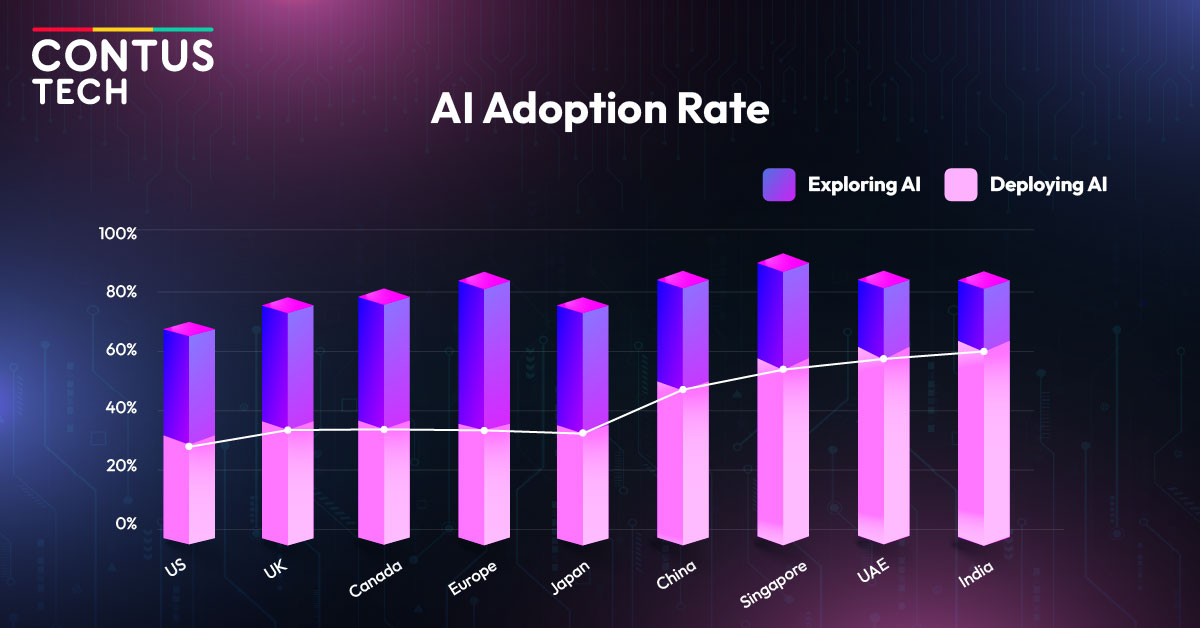
These top trending statistics explain how the AI adoption rate differs by each sector while showcasing the growing role of AI in business operations.
- 50% of businesses & entrepreneurs plan to incorporate AI technologies.
- 29% of business people use Claude AI.
- 97% of business promotions use ChatGPT.
- AI is said to boost the customer relationships of nearly 2/3 of business owners.
- By 2026, 60% of SMBs are expected to adopt AI-powered tools, powered by SaaS accessibility.
- Marketing and sales automation uses AI, with 40–45% of businesses using it for content creation, ad targeting, email marketing and CRM insights.
- According to 54% of consumers think AI could improve the customer experience.
- The manufacturing industry will achieve the greatest benefit of $3.8 trillion by 2035 from AI
- The IT and telecom sector organizations utilize 63% for AI.
- Automotive organizations implement AI by 44%.
- 87% of educational professionals said to have not received any AI training as part of professional development.
✨ Top AI Statistics in Business Operations
We hear a lot about AI’s potential in business, whether it’s a startup, an enterprise-grade organization or a mid-sized company. But we hear less about what’s actually happening in the AI sector right now: which business operations AI has been adopted into, how adoption varies by your team size and industry.
- 46% of businesses use AI for analytics and reporting, making it the most widely adopted AI function.
- 45% of businesses use AI for customer support and chatbots.
- 34% of businesses use AI for automated call answering, while 33% are considering implementing it.
- Only 2% of sole traders have no plans to adopt AI in their business.
- 83% of mid-sized businesses with around 50–99 employees are either fully or selectively adopting AI.
- Only 3% of businesses with 50–99 employees have no plans or ideas to use AI.
- 46% of businesses use AI for analytics and reporting, making it the most-adopted function.
- 45% of businesses use AI for customer support and chatbots.
- 74% of legal businesses are engaged with AI.
- 31% of businesses are seriously considering AI adoption.
✨ AI Usage Statistics and User Demographics
This section highlights how AI is being embraced across different age groups and genders, and how children have become increasingly connected to AI technologies.
It is essential to understand how users interact with AI through valuable insights that suggest AI adoption, demographics and its future scope.
- Women use AI more often than men every month, mainly looking for virtual assistants and fitness-related queries
- More than men, Women use algorithmic recommendations for playlists.
- Only 84.7% of women use autonomous vehicle than 85.6% of men.
- In the United States of America, 53% of Americans have already used AI.
- LLMs are not used by 4 out of 5 people aged 18-25 years.
- People aged 61+ years: 30.8% use AI every week.
- Men have slightly more awareness of AI than women, at 38% vs 23%
- 53% of users with postgraduate qualifications use AI.
- 65% of AI users today belong to Millennials or Gen Z.
✨ Generative AI Statistics
Businesses are looking for deeper insights into GenAI market trends, competitor strategies, business analysis and customer preferences to make more informed decisions and capitalize on upcoming business opportunities or project development more effectively.
- Enterprises spent $37 billion on generative AI applications and infrastructure in 2025, up 3.2× from $11.5 billion in 2024.
- 90% of software development professionals use AI in their everyday work.
- AI tools are used every day by 51% of professional developers.
- Nearly 80% of new GitHub developers use Copilot within their first week.
- In 2026, the global average cost of a data breach was $4.99 million.
- The average cost of an AI-enabled data breach is $6 million, roughly $1 million higher than the overall average.
- One in four malicious breaches is now AI-enabled, representing a 56% increase from the previous year.
- More than 20% of organizations reported breaches targeting their AI models or AI applications.
- 38% of employees have shared confidential company data with unapproved AI systems.
- In 2026, AI infrastructure accounted for $1.432 trillion, making it the single largest category.
✨ AI Adoption Statistics by Industry 2026
This section explores the recent AI adoption statistics across industries and organizations to see how leveraging AI enhances efficiency, automates workflows and boosts customer experiences.
These top trending statistics explain how the AI adoption rate differs by each sector while showcasing the growing role of AI in business operations.
- 50% of businesses & entrepreneurs plan to incorporate AI technologies.
- 29% of business people use Claude AI.
- 97% of business promotions use ChatGPT.
- AI is said to boost the customer relationships of nearly 2/3 of business owners.
- By 2026, 60% of SMBs are expected to adopt AI-powered tools, powered by SaaS accessibility.
- Marketing and sales automation uses AI, with 40–45% of businesses using it for content creation, ad targeting, email marketing and CRM insights.
- According to 54% of consumers think AI could improve the customer experience.
- The manufacturing industry will achieve the greatest benefit of $3.8 trillion by 2035 from AI
- The IT and telecom sector organizations utilize 63% for AI.
- Automotive organizations implement AI by 44%.
- 87% of educational professionals said to have not received any AI training as part of professional development.
✨ AI Productivity, ROI and Business Impact Statistics
Here are the top statistics that can help you safeguard your budget on AI projects instead of losing enormous amounts of money on unnecessary or unwanted AI investments.
- 1 in 5 organizations say AI operating costs, including token spend are limiting their AI use.
- Only 28% of AI use cases fully succeed and meet ROI expectations, while 20% fail outright.
- In early 2026, ChatGPT has reached 900 million weekly users , nearly making double the profit compared to previous year.
- 95% of organizations using generative AI report no measurable P&L impact.
- AI projects between 80–95% fail to deliver ROI, often due to poor data and weak integration.
✨ AI Statistics on Market Size, Investment & Growth
Analyzing market size, investment, and revenue growth can help you understand why your enterprise needs AI. Here are the top AI statistics showing measurable productivity improvements across software development, knowledge work, sales and operations.
- Private AI investment grew 44.5% in one year.
- AI can cut customer service costs by 30%.
- By 2030, the Enterprise AI market is expected to grow from $97.2 billion in 2025 to $229.3 billion.
- The AI agents market is expected to reach $47.1 billion by 2030, growing rapidly at an annual rate of 45.8%.
- By 2035, AI could boost worker productivity by up to 40% across 16 industries, including manufacturing.
✨ AI in Marketing, Sales and Customer Service
Here is the key evidence showing how AI is transforming marketing, sales and customer service, helping us assess its role in revenue generation, marketing effectiveness and customer experience.
- AI Chip Market is growing 35% annually and its exepcted to reach $83.25B by 2027
- Professionals who use AI weekly said tyo have 78% shorter deal cycles.
- The global AI market is expected to grow by 37.3% annually, reaching $1.81 trillion by 2030.
- The AI-enabled sales teams is said to attain 76% win rates.
- Persoanlized AI campaigns increase conversion rates by up to 60%
✨ AI Workforce, Jobs and Skills Statistics
As AI continues to grow, it has become a rising concern for many people in the workforce. There are fears that AI will replace manual jobs, leading to unemployment and fewer opportunities.
However, with the right statistics, insights and preparation, people can better understand these changes and get ready for emerging opportunities. AI is not only transforming existing roles but also creating new career paths and job opportunities in the AI technology field.
- By 2030, cashiers and ticket clerks are expected to lose their jobs because of AI.
- Between 2025 and 2030, data specialists will see steady job growth.
- By 2030, because of artificial intelligence and machine learning, it is said that 92 million jobs will be replaced in the US.
- AI is said to create approximately 97 million new jobs
- The global workforce suggests that by 2030, AI is expected to create an additional labor demand between 21% to 33%
✨ AI Risks, Accuracy and Governance Statistics
Here are the top AI governance statistics that capture the most critical changes in GenAI governance, linking security incidents, adoption maturity and privacy trends that directly shape enterprise readiness.
- Only 25% of organizations have implemented AI governance programs, showing a clear gap between awareness and action.
- Just 27% of business boards include AI governance in their committee charters, indicating limited leadership involvement.
- 97% of AI-related breach victims lacked proper access controls, highlighting enforcement as a key weakness.
- 98% of organizations expect AI governance budgets to increase, signaling a shift toward proactive investment.
✨ Future of AI Statistics
Looking at the future of AI, it is clear that there will be groundbreaking advancements that reshape industries and transform the way we interact with technology.
- By 2027, AI tech debt could be reduced by 70% through simulation platforms.
- By 2026, organizations without advanced AI monitoring and observability could see a 20% drop in production models.
- By 2026, investment in startups built around foundation models could exceed $10 billion.
- 30% of new applications could use AI-driven personalized interfaces by 2026
- Analytics tools could drive 40% of digital product improvements, up from 10%, by 2026.
- By 2027, over 35% of software could use AI-based digital twins for UX development.
We hope these well-defined and forward-looking statistics help you understand the scope of AI in today’s world. Instead of building strategies and entering the market without prior knowledge, it is important to understand how these insights and statistics can guide better decision-making, identify opportunities and support faster growth.
Here’s to a great beginning and an AI-driven future.🍻
Frequently Asked Questions
1. How is AI impacting business growth?
AI today helps businesses automate repetitive tasks, generate answers, create content, minimize workloads, reduce operational costs and improve operational efficiency.
It also facilitates smarter business optimization, faster application performance, faster decision-making, personalized and customized customer experiences and grow business revenue opportunities
2. What industries are adopting AI the fastest?
Various industries today, including information technology, finance, healthcare, retail, manufacturing, and professional services, are rapidly adopting AI for automation and modernizing their existing business systems.
AI is primarily being used to automate manual tasks, enable faster resolutions, provide AI-powered customer service, support data analysis and forecasting and optimize business processes.
3. How is generative AI changing business operations?
The process behind generative AI is transforming the way businesses create content, generate solutions, and integrate AI agents or voice assistants into communication systems. Generative AI is transforming how businesses create content, analyze information, communicate, and handle routine tasks.
Some of the top AI-powered tools generate text, images, code, reports, and responses, helping AI teams work faster and more efficiently.
4. How does AI improve business productivity?
Integrating AI into your business systems comes with the major advantage of improving productivity by automating repetitive work and helping employees access data instantly, analyze issues faster and act on information and queries more quickly than ever, without having to go through manual, tedious processes.
By doing this, you can streamline business workflows, reduce manual effort, automate tasks and allow employees to focus effortlessly on higher-value tasks.
5. How much is the AI industry expected to grow?
By the end of 2026 and the beginning of 2027 and beyond, the AI industry is expected to experience significant growth over the coming years as businesses increase their investment in AI technologies, cloud computing, data analytics and enterprise adoption.
Businesses are also increasingly converting their existing systems into AI-driven systems, as failing to do so could leave businesses outdated and less competitive.
6. What are the key AI trends to watch in 2026?
If you are a business, enterprise or industry seeking AI-centric business optimization, you need to be aware of key trends such as AI agents, enterprise generative AI, multimodal AI, AI-powered automation and increasingly personalized AI solutions. Businesses are also focusing more on responsible AI, AI governance, security and integrating AI into everyday workflows.
Sources & References
Connect With Our Team, Discuss Your AI Development Requirements, and Begin Your Project in Just Next Few Days.


