





Building software from scratch, developing a long-term business goal,or simply modernizing an existing legacy system, all of these initiatives require you to work with a reliable software development services company to deliver a world-class product.
But before you get started, you need to have a clear picture of your project strategy, well-defined requirements, the right talent, and a development process aligned with your business objectives. An Agile approach can help teams adapt quickly while keeping the project focused on delivering the right outcomes.
To help you get started, here are the top step-by-step guidelines that discuss the key stages of software development. These include understanding user needs, identifying the target market, planning the product architecture, and establishing a clear roadmap from scratch.
Whether you’re turning a business idea into a digital product or developing an application for your organization, writing code is only one part of the journey. There are various steps involved throughout the product development journey, from defining your idea to turning it into a market-ready product.
Explore our step-by-step guide to learn how to take your software idea from concept to a successful, market-ready product.
Work with experienced product engineers who understand your business goals and build with performance, usability and scale in mind.
What is Software Product Development?
Software product development is the process of strategizing, planning, building and launching a new product with business-specific features and performance outcomes. It can involve developing an entirely new product, modernizing an existing product or upgrading the processes, techniques or development methodologies of a system for next-level progress and growth.
The development process also involves creating software products that can change the way a business operates and deliver a better customer experience. The roadmap of the development process must combine the idea, plan, innovation, market trends and user demands to deliver impactful benefits for customers.
The process usually involves several steps and a comprehensive approach that includes different software development phases and procedures, ultimately leading to the construction of a functional software product in a cost-effective way.
Software developers also integrate AI automation, third-party tools and modernizing features while developing a robust software product to meet specific market needs within your business development budget. This helps improve existing processes, techniques and methods to optimize the customer experience.
Existing production processes, methods, techniques and systems can also be upgraded to boost customer experience and satisfaction. Ultimately, building an effective software product helps businesses stay competitive, adapt to changing market demands and deliver greater user experience to their customers.
How Does Software Product Development Benefit Your Business?
Designing your ideal software needs to be more than just solving a one-time business problem or providing an immediate solution.
Though new software product development requires building a product from scratch, which may seem challenging and time-consuming, the benefits it offers improve the way businesses operate, foster better user experiences for customers and prepare your business for effortless growth.
Also, developing a high-tech business model provides the opportunity to create digital solutions that are aligned with your objectives rather than relying entirely on one-size-fits-all applications.
Using the right technology can play a major role in helping a business succeed. A thoughtfully developed software product, built using software development methodologies, can help remove operational bottlenecks, simplify everyday tasks, enable teams to serve customers at scale and drive 20X business growth.
Here are some of the top benefits of developing a new software product for your business growth:
Reach Customers Globally Beyond Your Local Market
Developing a digital software product can make your services available to customers regardless of their location. Whether you are a B2B or B2C business, you can build web and mobile solutions to enter new markets, connect with different customer segments and create new marketing channels to generate revenue.
Deliver More Impactful Customer Experiences
Your users and customers expect businesses to provide smarter, faster, convenient and optimized digital experiences. Opting for a smooth software development process can help organizations deliver smoother communication, instant support, personalized services and improved security. These enhancements can contribute to stronger customer relationships, higher user retention and greater customer loyalty.
Automate Repetitive Tasks and Streamline Operations
If your teams are spending too much time on manual tasks, they can consume valuable employee time and resources. Automating routine tasks allows teams to focus on higher-value responsibilities while reducing unnecessary manual effort.
Building software similar to HubSpot, monday.com, Zapier and Jira can improve productivity, streamline day-to-day operations, reduce costs and help teams work more productively.
Build Custom Software That Supports Your Business Objectives
If you are opting for a personalized software product, you need to ensure that, throughout the design and development process, your solution stands out from competitors and delivers a unique, advanced and world-class experience that keeps customers coming back for more.
Custom software development gives organizations the flexibility, freedom and control to optimize solutions and workflows, simplify business processes, connect multiple systems and introduce new
digital services, all tailored to unique business needs.
How to Build a Software Product: Development Steps
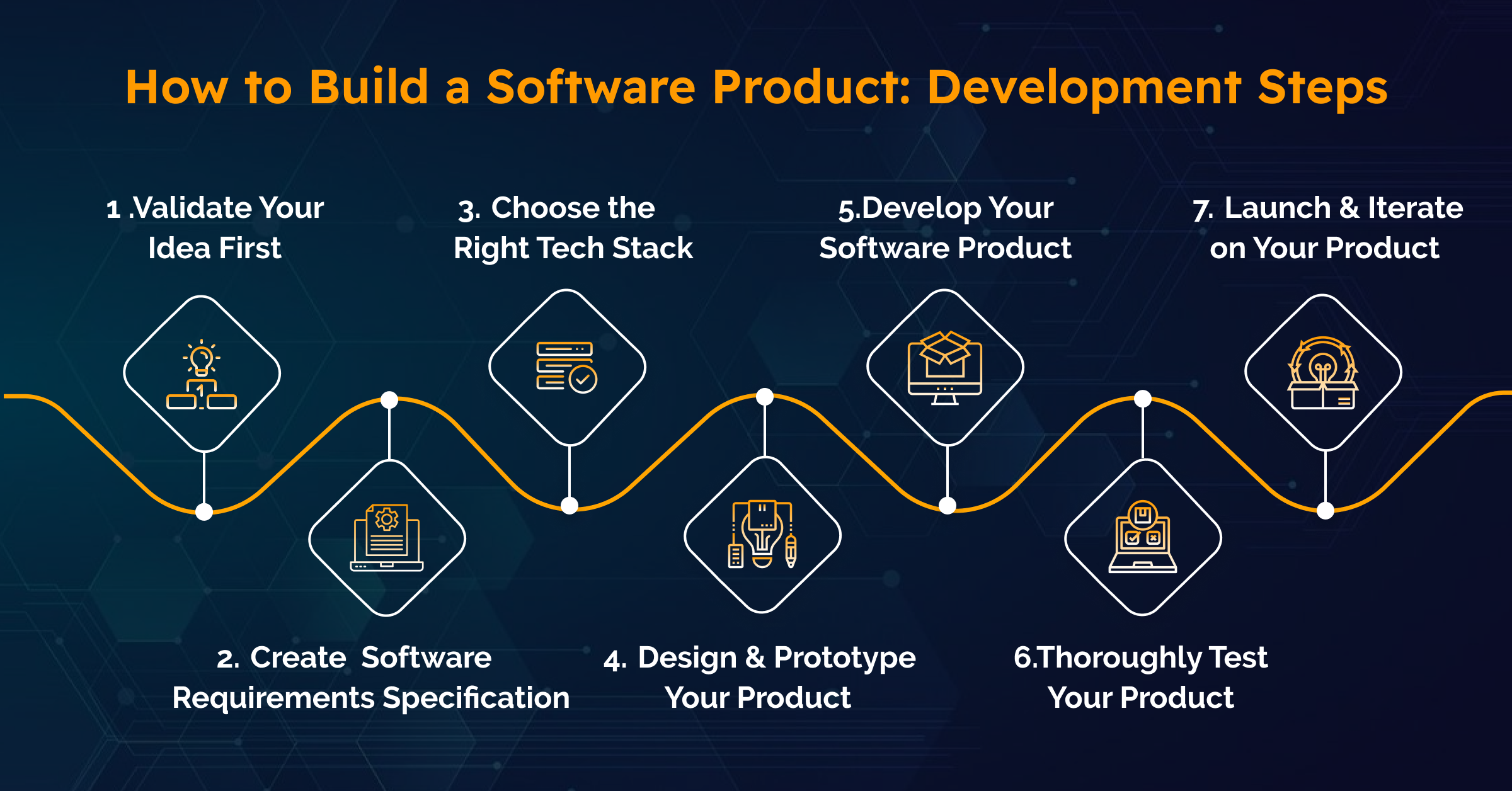
Creating a software product is a step-by-step process. Collaboration among teams, using the right tools, and adherence to industry standards ensure that the steps move smoothly with minimal hassles.
To build a software product, you have to validate your idea, develop an SRS, opt for a compatible tech stack, create a well-defined prototype, code and test the software product, and, finally, launch the product. Each of these steps is explained below.
✅ Step 1: Validate Your Idea First
Every software product development process kicks off with idea validation. The objective here is to prove that a product idea is feasible and is something that there is a market for.
Product discovery is the best way to validate a product idea. It includes strategies like market and user research and competitive analysis.
Upon successful completion of idea validation, you will have clarity on the marketability of your product idea and the next steps to take.
✅ Step 2: Create a Software Requirements Specification
A software requirements specification (SRS) is a detailed documentation of a software product that is to be developed. The document will be used by all the teams in the development process.
The document is similar to a blueprint, outlining the functionality of the final product and the steps it must follow to build the said functionality.
A well-defined SRS has two elements: functional and non-functional requirements. The functional requirements describe the overall functionality of the product, ensuring that the core features are accurately performed. The non-functional requirements, on the other hand, focus on system quality and performance.
✅ Step 3: Choose the Right Tech Stack
The tech stack is a critical aspect when building a software product. It decides the future upgrade path the developed software product will have to rely on.
The tech stack is also dependent on the platform and operating system you plan to launch the software product on.
It is important to note that the chosen tech stack also impacts the cost and development time. So, choose wisely!
Bring us your idea and we’ll help shape the technology, architecture and execution needed to make it market-ready.
✅ Step 4: Design and Prototype Your Product
The UI and UX of the software product are vital to its success. An appealing UI and a smoother UX ensure hassle-free user interactions.
The design step of software product development usually involves the following.
- User Research: Analyze the market to strategize a design that is user-friendly and expresses your brand’s tone.
- Prepare Wireframes and Mockups: Create a hand-drawn sketch (wireframe) and well-defined representation of the final design (mockups) to share with stakeholders and development teams.
- Develop Prototypes: Prepare high-fidelity prototypes that map user journeys and test them for design flaws.
✅ Step 5: Develop Your Software Product
The product engineering team takes over, writing code to turn the idea into a functional product.
Most teams opt for one of the popular development methodologies, like Scrum or Kanban. These methodologies speed up the development process and promote efficient resource usage.
It is important to make sure development teams follow coding best practices (like writing clean code, using version control, and running frequent code reviews). These practices reduce the risk of major bugs and ensure the codebase is clean and easy to refactor.
✅ Step 6: Thoroughly Test Your Product
Testing is vital to software product development as it finds and eliminates bugs and performance issues, which interfere with the proper functioning of the product.
A well-defined testing strategy also focuses on the product’s security, building robust defense measures that offer protection from cyber threats and malware. Product teams often use automation tools, like Selenium, to improve the speed and efficiency of the testing process.
The most commonly used software testing strategies are unit testing, performance testing, integration testing, and regression testing. Many teams now also explore ai testing tools to enhance coverage and accuracy during this stage.
✅ Step 7: Launch and Iterate on Your Product
A smooth launch is vital for a successful software product. A detailed launch plan is useful in this regard.
The launch plan includes strategies to detect and eliminate issues that may interfere with a successful launch. It also covers the promotional part of the software product.
After launching the software product, the improvement part begins. The team collects user feedback and performance metrics to find ways to enhance the product. This is a process that continues throughout the lifetime of the product.
Different Software Product Development Methodologies
Using a future-ready software development methodology determines how a software product is strategized, conceptualized, planned, developed, tested and delivered on time. Having a proper development methodology helps businesses build enterprise-grade software with greater effectiveness and flexibility while meeting project deadlines, adapting to market trends and responding to evolving customer needs.
The Waterfall Software Development Methodology
The Waterfall software development methodology follows a structured and progressive approach, with each phase moving sequentially in a linear direction, much like a waterfall flowing steadily downward. This methodology involves:
- Most effective for projects with well-defined requirements and expected outcomes.
- The process involves a linear and predefined development workflow.
- The development process moves through one stage at a time.
- The development project requirements and demands are established at an earlier stage.
- The development stages follow clear documentation, milestones and project launch visibility.
- Not suitable for software development projects that require constant improvements and changes.
The Agile Software Development Methodology
This Agile product development methodology is an iterative development approach to managing and building software projects that focuses on delivering continuous feature releases and involving customer feedback in software development iterations.
- This development approach breaks down every stage of progress into small and manageable iterations.
- Allows development teams to improve the product throughout software product planning to launch
- Regularly get customer feedback and reviews to enhance features.
- Makes it easier to adapt to evolving market trends and requirements.
- Best suited for regular feature releases and bug fixes instead of one-time product delivery.
- Ideal method for developing products that need flexibility and continuous enhancement.
The Scrum Software Development Methodology
The Scrum method is a pragmatic development framework that focuses on continuous learning and adapting to evolving project requirements. From the beginning of the project, the development team may not have all the answers.
Instead, they continuously learn, adapt to new techniques and incorporate innovations as the project progresses.
- This methodology delivers a structured way to apply Agile principles.
- The software development process and discussion are organized into short periods called sprints.
- The development team periodically selects specific tasks and goals for each sprint.
- The progress of the project is reviewed regularly to identify improvements.
- Changing priorities and adapting to new techniques are always welcome.
- Most suitable for collaborative teams working on software products that evolve with time.
The DevOps Software Development Methodology
The DevOps development methodology involves every stage of the software development lifecycle, from conceptualization, design and development to integration, testing, deployment and release.
Many businesses choose DevOps to accelerate development, improve efficiency and deliver high-quality software.
- The development methodology integrates development, testing, deployment and post-launch operations.
- It encourages teams to work together throughout the product development lifecycle.
- Its automation and innovation reduce repetitive development tasks and streamline deployment activities.
- It helps businesses deliver regular updates and fix bugs more quickly and effectively.
- Its continuous monitoring of the development process helps identify performance issues earlier and even after release.
- This methodology enables faster delivery, a stable release process and continuous post-deployment product improvements.
How Long Does it Take to Build a Software Product?
Each step in the software development life cycle has to be completed before moving on to the next. The time required to complete each step can vary based on the complexity of the software project.
To give a rough estimate, the time taken to develop a software product can range from 2 months to over a year. The complexity of the project is a major factor when estimating the time taken to develop a software product.
Basic software products can be built in roughly 2 to 6 months. Software products with intermediate complexity take at least 7 months and, in some cases, up to a year.
The more complex software products, with advanced integrations, can take over a year for development.
The complexity aside, here is a stage-wise split of the time taken to build a software product.
| Development Stage | Approximate Time Taken |
|---|---|
| Planning | 1 -3 Weeks |
| Analysis | 2 – 4 Weeks |
| Design | 1 – 5 Weeks |
| Development | 4 – 12 Weeks |
| Testing & Debugging | 3 – 6 Weeks |
| Implementation | 1 – 3 Weeks |
| Maintenance & Support | Continuous Process |
Get clarity on the scope, resources, timeline and investment required before beginning development.
Additional factors play a role in the total time taken to develop a software product. They are:
- The size of the development team
- The scope of the project
- The project management approach
- The technology stack
- The availability of resources
Top Challenges When Developing a Software Product
Challenges are a common occurrence in most software development projects. Even the most carefully planned projects often run into delays when minor issues are overlooked.
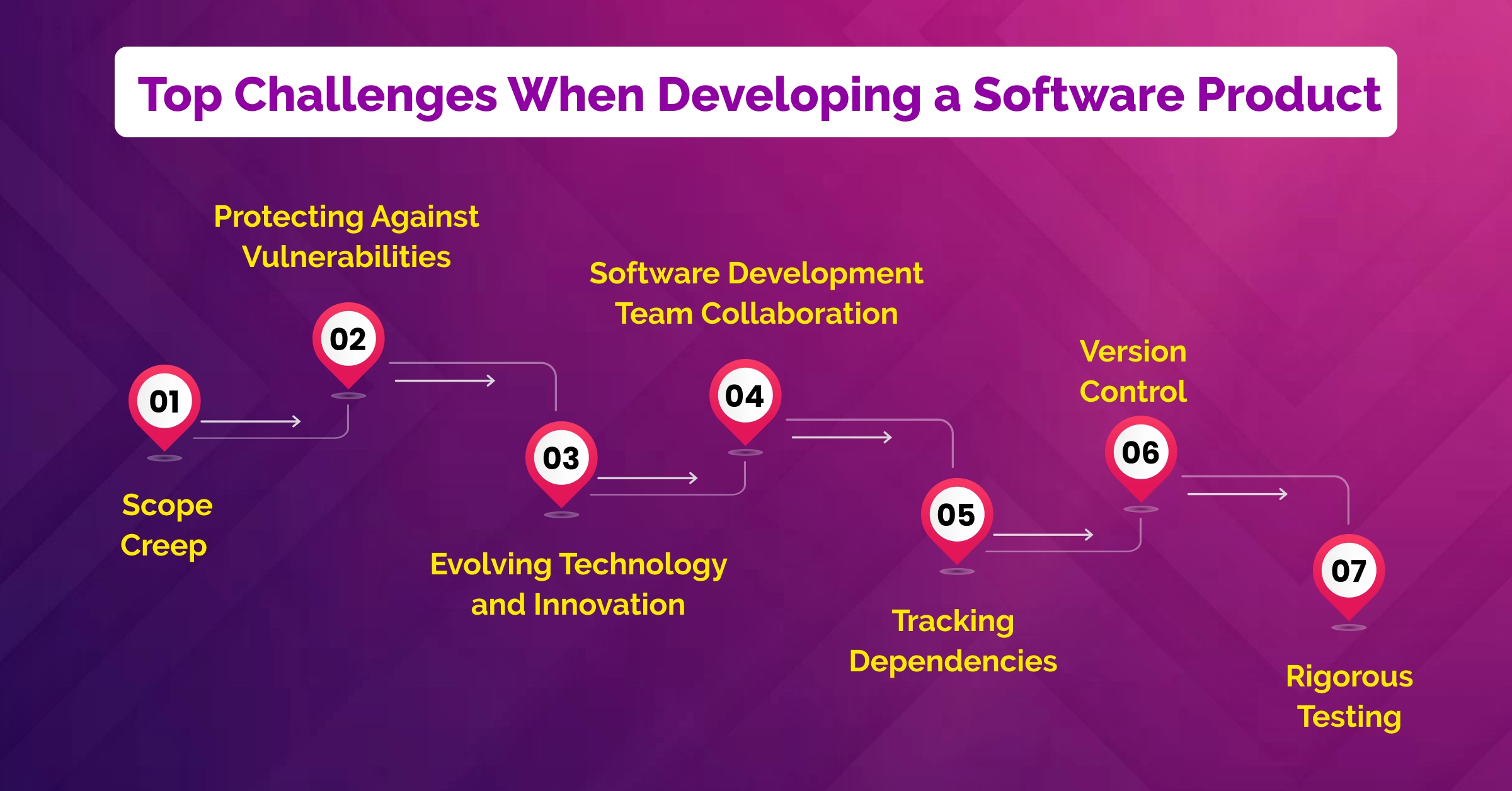
The top challenges development teams face when building a software product include scope creep, dealing with security vulnerabilities, staying updated with evolving tech, cross-team collaboration issues, keeping track of dependencies, version control issues, and testing challenges.
🚨 Scope Creep
When you hire software development teams, especially inexperienced ones, often get carried away when adding new features. Sometimes, this enthusiasm to improve the software product may lead to scope creep, leading to development delays. These delays inevitably lead to a shift in timelines for other processes.
Scope creep can be tackled by defining clear objectives in the planning and analysis stage. Development teams must also adhere to the identified objectives, rather than making improvements that impact the development timeline.
🚨 Protecting Against Vulnerabilities
New and innovative security threats seem to be increasing by the day. It is important for development teams to implement measures to create a robust product without vulnerabilities.
However, this is easier said than done. Development teams may have to shift from traditional methods to low-code/no-code solutions that are effective at preventing cyber attacks. But these solutions are fairly new, and the training required is often considered a deterrent for development teams.
🚨 Evolving Technology and Innovation
Software packages, particularly open-source ones, are evolving on a regular basis. They usually require code updates to be compatible with the latest versions, a process that is often time-consuming.
The eagerness to try out a new tool in the market can also lead to delays, as development teams may be insufficiently trained to use the tool. There are also chances for scope creep to appear in such situations.
🚨 Team Collaboration
Team collaboration is a vital aspect when it comes to building a software product. All teams involved in the software product development process must be on the same page when it comes to goals and timelines to avoid delays.
Sadly, communication issues are common in some situations. Miscommunicated feedback and requirements often result in delays that could’ve been avoided, which in turn impact the overall timeline of the software product development project.
🚨 Tracking Dependencies
Dependencies can make or break a software project. When software dependencies are overlooked, the product in development can exhibit unstable behaviour or lead to build failures. All this can cause avoidable delays in the development process.
To avoid dependency issues when creating a software product, development teams often rely on dedicated project management tools. In addition to documenting dependencies, these tools also show how different components/modules interact with each other and the larger system.
🚨 Version Control
Version control is a vital part of the software product development lifecycle. It tracks and manages changes to the source code as the project progresses from one iteration to the next.
Issues with version control can be devastating, as the product in development can be irreparably damaged. No-code and low-code tools help in this regard. Xano and Airtable are popular options.
🚨 Rigorous Testing
Testing is critical to the success of a software product. It helps in identifying product-breaking bugs and enhances usability and functionality.
Challenges like complex requirements, frequent code changes, test script maintenance, and limited test coverage often plague testing teams. Delays in the testing process often lead to delays in launching the product. These challenges can be eliminated by a comprehensive testing process carried out by an experienced testing team.
Wrapping Up
You just read an expert guide on how to develop a software product.
Creating a software product might seem easy on paper, but in theory, it is an undertaking that has numerous challenges. There are seven steps to building a software product. Each step presents unique challenges that must be addressed and overcome to ensure product success.
The time taken to develop a software product should also be considered. Based on the complexity, a software product can take up to a year for complete development. It is important to note that this timeline may extend if the development team runs into unforeseen or avoidable difficulties.
Learning how to create a software product by yourself may sound tempting. But it’s recommended to let the experts, like CONTUS Tech, take care of that. We have been recognized as the best enterprise software development company close to 20 years. Our specialists know what works, what doesn’t work, and how to make things work. So, you can rest assured knowing that you have the right people on the job.
Our expertise spans multiple industries, from entertainment, healthcare, and education to automotive, fintech, and telecom. We also provide fully-customized product development solutions that prioritize timely delivery, smooth UIs, and exceptional performance.
Contact us today to get started!!
Put your roadmap into action with the engineering expertise needed to build, test and deliver your software product.
FAQ’s to Build a Software Product from Scratch
1. How much does it cost to build a software product?
It depends on the complexity of the product, required features, technologies used, the composition of the development team. The first stage is creating the MVP which will allow decreasing the expenses of the startup.
2. Should startups build an MVP first?
Yes. Building an MVP allows startups to validate their idea, gather real user feedback and test market demand before investing in a full-featured software product. It also helps reduce development risks and costs.
3. How can startups avoid overspending on software development?
It is possible to keep development expenses under control by validating their idea first, focusing on the required features, creating an MVP, implementing the agile development methodology and cooperating with an experienced software development company.
4. How do you know if your enterprise software product is successful?
A software product is considered successful when it solves the intended business problem, achieves high user adoption, improves operational efficiency and meets key performance indicators such as customer retention, revenue growth and user satisfaction.
5. How do I validate my software idea before building software from scratch?
Validate your software idea by conducting market research, identifying your target audience, analyzing competitors, gathering customer feedback and testing the concept with an MVP or prototype before starting full-scale development.
6. How long does it take to develop software from scratch?
The time depends on the size of the project, features required and the level of complexity of the technology. Developing MVPs can take a couple of months while developing full-scale products may take even longer.
Connect With Our Team, Discuss Your Software Product Development Requirements, and Begin Your Project in Just Next Few Days.


