



Best overall shortlist: The strongest Vimeo OTT alternatives in 2026 are VPlayed, Dacast, Brightcove, Kaltura, Muvi, Uscreen, Castr, Vodlix, Lightcast, and Enveu. These streaming platforms offer varying levels of OTT customization, monetization flexibility and scalability.
Why businesses switch: Vimeo OTT remains a popular choice, but growing content businesses often seek greater branding control, more flexible video monetization models, deeper platform customization and better ownership over their streaming infrastructure.
What matters most: Compare video streaming platforms based on monetization options, white-label capabilities, live streaming support, content security, analytics, customization depth and long-term scalability rather than monthly pricing alone.
Fast recommendation: If you need complete platform ownership and extensive customization, start with VPlayed or Kaltura. If enterprise-scale streaming is your priority, evaluate Brightcove and Dacast. For creator-focused subscription businesses, Uscreen and Muvi are worth considering.
The best Vimeo OTT alternatives in 2026 depend on what you are trying to achieve, but most content owners should start with video streaming platforms like VPlayed, Dacast, Brightcove, Kaltura, Vodlix, Lightcast, Muvi, Castr, Uscreen and Enveu.
Vimeo OTT remains a popular choice for launching subscription-based video streaming services, but many businesses eventually look for greater customization, monetization flexibility and control over their OTT platform’s future.
That is where the market begins to split. Some organizations need an OTT platform that can support large-scale growth, custom workflows, and advanced streaming requirements.
Others are simply searching for a solution that offers more platform ownership, branding freedom, or flexible revenue models. These are very different business needs, yet many comparison guides group them together.
How we evaluated: We compared these video streaming platforms across the factors that matter most in Vimeo OTT alternative & migrations, including customization, monetization options, content security, live streaming capabilities, analytics, scalability, and deployment flexibility.
Rather than relying on a single score, we focused on identifying which OTT platforms are the best fit for different business models.
- Fully Customizable
- Lifetime Ownership
- On-Premise/On-Cloud
- 100% White-label
- Zero Revenue Share
- Hire Developers
What is a Vimeo OTT alternative?
A Vimeo OTT alternative is any streaming platform that can replace some or all of Vimeo OTT’s functionality, including OTT app development, video hosting, content management, live streaming, monetization, analytics, subscriber management and content delivery.
If you want the short answer first, here is the ordered shortlist based on customization, monetization capabilities, scalability, security, analytics and overall business flexibility:
- VPlayed
- Dacast
- Brightcove
- Kaltura
- Vodlix
- Lightcast
- Muvi
- Castr
- Uscreen
- Enveu
Why Businesses Look for Vimeo OTT Alternatives
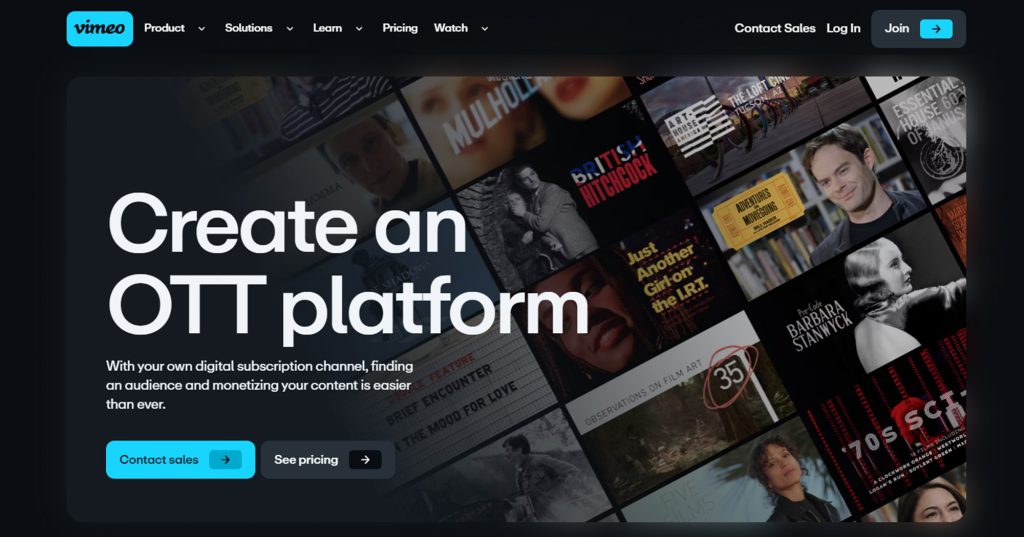
Vimeo OTT remains a recognized streaming platform as it offers video hosting, OTT app deployment, subscriber management, monetization tools, and content distribution capabilities that help businesses launch and scale their video streaming operations. Many creators, media companies, and content owners continue to use it successfully.
However, businesses start looking for Vimeo OTT alternatives because they reach a stage where they need greater flexibility. Some want deeper customization over their apps and user experience. Others look for more control over monetization, ownership of their technology stack, or the ability to scale without being tied to a predefined OTT platform framework.
The challenge is that not every streaming business has the same requirements. A broadcaster delivering live events, a media company launching a global OTT service, and an educator building a subscription learning platform are solving very different problems. The OTT platform that works for one business model may not be the best fit for another.
We have seen this pattern repeatedly across OTT migrations. The deciding factor is rarely a feature checklist alone. Instead, it comes down to how well an OTT platforms aligns with long-term business goals, content strategy, monetization plans, and operational control.
That is why evaluating alternatives requires looking beyond pricing and comparing the overall flexibility each video streaming platform brings to the table.
Top 10 Vimeo OTT Alternatives at a Glance (2026 Comparison)
| Platform Name | Pricing Model | Monetization Types | White-label | Free Trial |
| VPlayed | One-time licensing cost (SaaP) | SVOD, AVOD, TVOD, PVOD, SSAI, CSAI | Full (Source Code) | Demo on Request |
| Dacast | Starter plan from $39/month (live streaming) | SVOD, AVOD, TVOD, Pay-Per-View | Yes | 14 Days |
| Brightcove | Custom pricing | Hybrid, SVOD, AVOD (SSAI), Freemium | Yes | No (Demo Only) |
| Kaltura | Custom pricing | SVOD, AVOD, TVOD, Hybrid | Yes (Open Source) | 30 Days |
| Vodlix | Starts from $1,550/month (Professional plan) | SVOD, AVOD, TVOD, FAST Channels | Yes | 14 Days |
| Lightcast | Custom pricing | SVOD, AVOD, TVOD, Social Tipping | Yes | Demo on Request |
| Muvi | Starts from $399/month (Standard plan) | SVOD, AVOD, TVOD, PVOD, FAST | Yes | 14 Days |
| Castr | Starts from $16.70/month (Starter plan) | SVOD, TVOD, Pay-Per-View | Yes | 7 Days |
| Uscreen | Starts from $49/month (Starter plan) | SVOD, TVOD, Subscriptions, Courses | Yes | 14 Days |
| Enveu | Starts from $549/month (Lite plan) | Pay-Per-Episode, SVOD, AVOD, Audio | Yes | Demo on Request |
The 10 Best Vimeo OTT Alternatives in 2026
Not every OTT platforms is built the same, and the right fit depends on your content model, audience scale, and monetization goals. Here are the ten best Vimeo OTT alternatives worth considering in 2026: VPlayed, Dacast, Brightcove, Kaltura, Vodlix, Lightcast, Muvi, Castr, UScreen, and Envue.
1. VPlayed
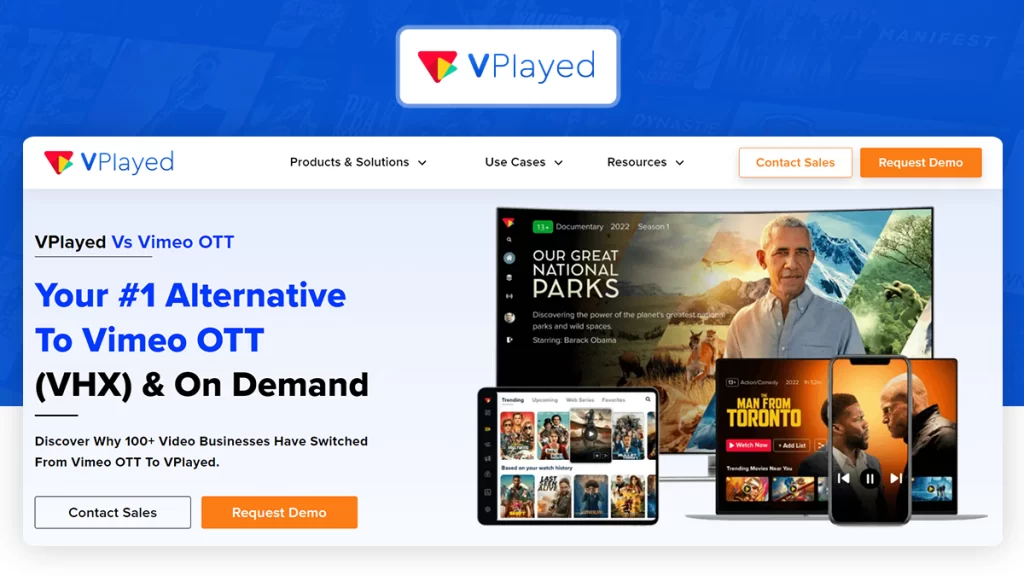
Unlike Vimeo OTT’s SaaS subscription model, VPlayed operates on a one-time SaaP (Software as a Product) licensing structure with 0% revenue share and full source code access. This allows media businesses to truly own the platform, audience, and whole revenue.
In a technical assessment of VPlayed vs Vimeo, VPlayed stands out as a highly customizable OTT streaming solution designed for live, on-demand, and linear content. The platform features a robust backend CMS, global CDN integration, and a secure HTML5 video player with adaptive bitrate output to ensure buffer-free playback even for a high number of concurrent viewers.
Key Features That Make It a Strong Vimeo OTT Alternative
10+ video monetization models: Supports SVOD, TVOD, AVOD, pay-per-view, catch-up TV, and third-party ad integration for diversified revenue.
200+ third-party integrations: Connect with marketing, storage, payments, and automation tools for seamless scalability.
Multi-screen apps: Intelligent multi-device optimization across smart TVs, mobile devices, web platforms, and streaming boxes for seamless viewing experiences.
Bulk migration support: Data migration without downtime and no data loss.
Advanced analytics: Monitor user actions, subscribers, user trends, and platform performance in real time.
Plans and Pricing
Pricing can be requested, with VPlayed serving companies in need of custom-made OTT solutions. There is a free demo to test features and functionality prior to commitment.
Best For
Media companies and broadcasters who prioritize full platform ownership and long-term scalability. It is an ideal choice for those seeking a seamless migration from Vimeo to a more customizable, self-hosted solution. It provides thorough customization and scalability over time for content owners without paying repeated subscription costs.
2. Dacast
In contrast to Vimeo OTT’s per-subscriber pricing, Dacast charges based on bandwidth usage, making it more predictable and often more cost-efficient for high-volume live streaming and event-based broadcasting.
As a cloud-based video hosting platform, Dacast serves a wide range of industries, from media firms to religious communities. It provides a fully-fledged streaming environment with white-label offerings, allowing businesses to build custom players and branded landing pages. Dacast ensures stable global delivery with Akamai CDN, including optimized access in China using professional RTMP and HLS protocols.
Features That Set Dacast Apart from Vimeo OTT
Global Connectivity: One of the few providers that can deliver content in China with an official ICP (Internet Content Provider) license.
White-label customization: Complete control over video player, including custom logos, colors, and watermarking to retain brand identity.
Multi-screen apps: Intelligent multi-device optimization across smart TVs, mobile devices, web platforms, and streaming boxes for seamless viewing experiences.
Multilingual support: Platform accommodates international audiences.
Customer support: Live rep and phone support 24/7.
Flexible monetization: Supports SVOD, TVOD, and AVOD models with safe paywall options.
Plans and Pricing
- Starter: $39/month (2.4 TB bandwidth/year).
- Event: $63/month (6 TB upfront, ideal for occasional large broadcasts).
- Scale: $165/month (24 TB/year, includes phone support and advanced library management).
- Custom: Enterprise plan available with custom SLAs, migration support, and dedicated assistance
Best For
Broadcasters and enterprises that require stable live streaming. It is the top choice for those needing to bypass the Great Firewall of China, utilize advanced SRT ingest for reliable field broadcasts, or launch branded “Expo” video galleries without the subscriber-based fee hikes common in other OTT platforms.
Compare the Top Dacast Competitors
Evaluate the best Dacast competitors based on platform features, pricing flexibility, security, and business growth potential.
3. Brightcove
Brightcove goes well beyond Vimeo OTT’s ad capabilities with enterprise-grade SSAI and AI-powered contextual advertising localised across 50+ languages. It is a video hosting and OTT solution built specifically for large-scale streaming and cross-platform delivery.
Beyond standard subscriptions, Brightcove supports complex hybrid models by combining advertising and freemium access, optimized by server-side ad insertion to bypass ad blockers. The platform utilizes adaptive bitrate streaming and multi-platform DRM to safeguard premium content while maintaining consistent viewing quality. Its advanced AI Suite automates metadata creation and enables real-time dubbing, allowing broadcasters to localize content for global audiences.
Features That Position Brightcove Above Vimeo OTT
Advanced Analytics: Provides in-depth QoE (Quality of Experience) and dynamic engagement insights to help optimize content strategy.
100+ integrations: Offers integration with marketing tools, analytics, and publishing.
User-friendly interface: The Video Cloud Studio UI is observed by users as friendly to the non-technical team despite being enterprise-level.
Multilingual support: Supports English, French, Spanish, Japanese, Korean, and Chinese.
Plans and Pricing
Pricing is quoted on demand, since Brightcove focuses on the mid-market and enterprise clientele with custom quotes depending on their use, features, and support needs.
Best For
Brightcove works best with enterprise-level broadcasters and global marketing teams requiring sophisticated AI-driven metadata automation and real-time dubbing. It is the premier choice for organizations managing massive content libraries that need high-security PlayReady/Widevine DRM and seamless integration with complex tech stacks like Salesforce or HubSpot.
4. Kaltura
Kaltura’s open-source architecture and deep LMS integrations make it the go-to Vimeo OTT alternative for universities and enterprise learning platforms. It offers features like virtual classrooms, interactive video quizzing, and in-video search that indexes every spoken word.
It provides a “video-as-a-service” model that enables technical teams to build custom workflows with its robust API. Its infrastructure supports lecture capture, webinars, and secure internal video portals. With an HTML5 player and advanced security controls, Kaltura ensures that sensitive educational and corporate assets remain protected while being accessible across all devices.
Kaltura’s Strengths as a Vimeo OTT Alternative
Integrations: Supports integrations with major LMS and CRM in addition to connecting with Salesforce, HubSpot, and marketing platforms.
Accessibility-First: Provides advanced captioning and UI elements that target the needs of accessibility and visually impaired users.
Video analytics: Monitor impressions, unique viewers, minutes watched, completion rates, and drop-off patterns with a CSV export option.
AI-powered engagement: Quiz, summary, chapter, and highlight clip creation tools based on video content.
Interactive features: Real-time chat during live sessions.
Plans and Pricing
Provides a 30-day trial of different products. Enterprise plans come with custom quotes depending on uses, features, and support needs.
Best For
Kaltura is ideal for organizations with in-house technical teams that need flexible APIs, strong customization, and reliable performance at scale. Institutions like Utah Valley University use Kaltura for its easy integration with Canvas, allowing video-based learning and content management within existing academic workflows
Is Kaltura Holding You Back?
5. Vodlix
Vodlix addresses Vimeo OTT’s limited VR/XR support by offering native immersive content delivery alongside standard OTT workflows. As a Vimeo competitor built for next-gen content, it provides a robust backend CMS with live and VOD delivery for businesses that want to bridge the gap between traditional video and the Metaverse.
The platform provides fully white-labeled apps across web, mobile, and connected TV devices, including specialized support for Oculus Rift, Samsung Gear, and Google Daydream. Beyond its 16K VR capabilities, Vodlix simplifies content management with TMDB metadata integration, which automatically syncs movie details, trailers, and cast information to your library.
How Vodlix Addresses Vimeo OTT’s Limitations
Hybrid Monetization: Combines AVOD, SVOD, and TVOD seamlessly with the support of advanced FAST channels.
Multi-language support: The platform supports an international audience with native language features.
Live streaming capabilities: Events and linear channel real-time broadcasting with low-latency options.
Reports and analytics: Advanced viewer insights, engagement metrics, and QoE tracking to optimize content strategy.
Immersive Tech: One of the few platforms that supports VR and XR content delivery.
Plans and Pricing
Vodlix offers three tiers: Professional plan available at $1,550/month, Enterprise plan at $3,850/month, and Ultimate plan (custom pricing for enterprise needs). Every plan has a 14-day free trial.
Best For
Vodlix is ideal for media businesses exploring immersive storytelling and advanced streaming formats. It suits teams looking to experiment with interactive experiences and manage diverse content types. It also supports consistent performance across emerging devices while maintaining flexibility in delivery and audience engagement.
Is Brightcove Holding You Back?
Want To Find The Best Vimeo OTT Alternative For your OTT platform
Request Demo

6. Lightcast
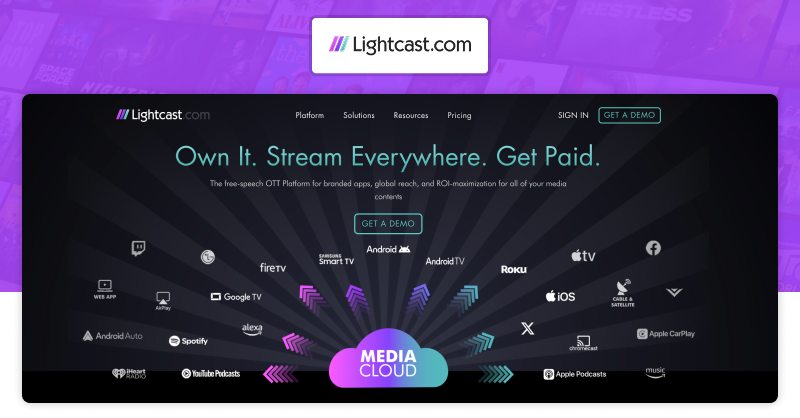
Lightcast excels in cross-platform automation while Vimeo OTT focuses on a simplified storefront. Lightcast allows broadcasters to distribute content to social media, web, and TV apps simultaneously with a single click. What sets Lightcast apart as a Vimeo OTT alternative is its Media Cloud management system.
Unlike Vimeo, which often requires manual metadata entry for each platform, Lightcast automates the transcoding and formatting process. Also, its real-time control feature allows you to update your app’s navigation, graphics, and content on the fly across all platforms (iOS, Roku, Fire TV, etc.) without waiting for app store reviews or developer intervention.
Lightcast Strengths as a Vimeo Alternative
Full monetization control: Supports AVOD, SVOD, and TVOD models with complete revenue retention as opposed to platforms that require revenue sharing.
White-label branding: Fully branded TV and mobile apps that maintain institutional identity across all touchpoints.
Ultra-fast CDN: A multi-layered content delivery network that grants playback without any difficulties, no matter where the viewer is located.
Role-based team access: Multi-user content management, which has approval workflow and permission controls.
AI and automations: Easy automated video and streaming processes for optimized content processes.
Plans and Pricing
Lightcast does not offer public pricing: custom quote only. They provide custom packages tailored to the bandwidth, number of apps, and storage services.
Best For
Lightcast works best for churches, nonprofits, independent broadcasters, and universities that need branded apps across 10+ platforms without a development team. The hands-on onboarding support and Media Cloud’s ease of use are the deciding factors for most users.
7. Muvi
Muvi offers a flat-fee model, unlike Vimeo, which charges per subscriber and takes a 10% cut on transactions. Muvi keeps your revenue intact regardless of how large your subscriber base grows. Muvi is a no-code OTT platform that allows users to create their own video or audio streaming service instantly.
It covers multilingual support, global CDN delivery, DRM, and in-built monetization features such as SVOD, TVOD, AVOD, PVOD, hybrid models, and FAST. This Vimeo competitor has a proprietary AI engine (Alie) that tags metadata automatically, auto-generates subtitles, and enables scene-level search for better content discoverability.
Features That Position Muvi Above Vimeo OTT
Enterprise-grade security: Multi-DRM, watermarking, ISO 27001:2013 certification, and encryption with multi-DRM and multi-SSL guarantee the data security measures taken against unauthorized access and digital violations.
Complete customization: A visual designer and a totally customizable platform with white-label branding throughout all touchpoints.
Advanced analytics: Detailed revenue, user registration, bandwidth usage, and viewing behavior reports with CSV export.
Global Reach: Provides multi-currency and multi-language services so that creators can go global without friction on technical aspects.
Plans and Pricing
- Muvi offers four tiers:
- Standard at $399/month
- Professional at $1,274/month
- Enterprise at $3,315/month
- Ultimate with custom pricing.
Best For
Muvi works best for corporate L&D teams, growing media brands, and enterprises where video is the core product. It’s the right fit when scale, security, and complete ownership of the streaming experience matter more than course-style learning tools or mechanics.
8. Castr
Castr lets you stream live and VOD content to 40+ platforms without per-subscriber fees, while Vimeo OTT focuses on building a single branded platform. It is a flexible streaming solution built for wider reach and reliable live broadcasting. Castr delivers adaptive bitrate playback through a multi-CDN network, including Akamai, Fastly, and Cloudflare, ensuring low latency.
For businesses looking to improve engagement, its standout VOD-to-Live feature allows you to schedule pre-recorded content into automated, 24/7 linear channels. Unlike Vimeo’s “pay-as-you-grow” subscriber model, Castr offers transparent, bandwidth-based pricing, allowing you to retain 100% of your earnings from pay-per-view and subscription sales.
Why Castr Stands Out as a Vimeo OTT Alternative
Multistreaming capabilities: Allows streaming to many social platforms at the same time, saving on bandwidth and maximizing the audience reach.
Advanced Security Controls: IP and geo-blocking, tokenized URLs, and domain restrictions protect content across all distribution channels.
User-friendly interface: Simple dashboard even to non-technical users, and there are no intricate streaming keys, but toggle switches.
24/7 customer support: Live and chat support on all plans.
Monetization options: Paywalls and advertising integration to make revenue from live content.
Pricing and Plans
Castr’s pricing for its live streaming and video hosting: Starter at $16.67/month, Standard at $41.67/month, Premium at $166.67/month, Ultra at $291.67/month, and Events at $624.99/month.
Best For
Castr works best for churches, nonprofit broadcasters, and live event teams that need dependable multistreaming to 30+ platforms without a steep learning curve. It’s a strong fit for small teams where reliability and responsive support matter more than deep OTT app capabilities.
9. UScreen
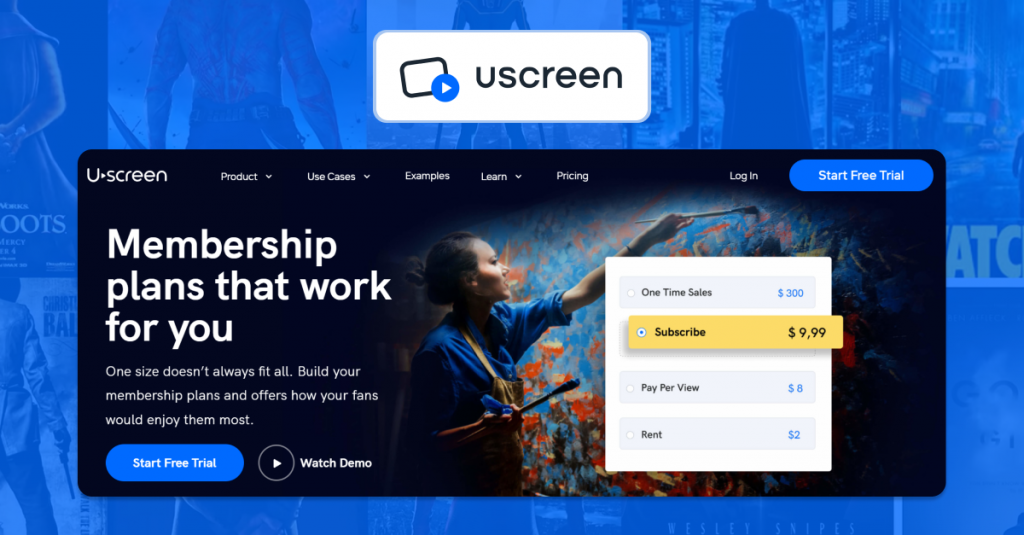
Uscreen prioritizes community-led growth with built-in engagement tools, unlike Vimeo OTT, which focuses on a premium viewing experience. It is an alternative to the Vimeo streaming service for creators who want to transform a simple video library into a membership site with native community spaces.
Uscreen provides a comprehensive CMS compatible with on-demand content, live streaming, and deep audience analytics across web and branded mobile/TV apps. Its built-in marketing suite focuses on Win-Back automation and “Try Again” sequences. It automates the process of recovering canceled subscribers, which is a technical advantage for businesses focused on long-term retention.
Some Important Uscreen Features Include
Membership-centric tools: Community has in-built feeds, discussion boards, member challenges, and live-video chat features.
No platform revenue cut on basic plans: On Uscreen’s entry tier, creators keep revenue without platform deductions beyond transaction fees. On higher tiers, modest per-subscriber fees apply.
Advanced analytics: Detailed insights into viewers and real-time revenue analysis.
Flexible monetization: Supports SVOD, TVOD, and live pay-per-view with various integrations of payment gateways.
Marketing tools::Inbuilt email capture, coupons, free trials, and upsell workflow without third-party integrations using advanced plans.
Plans and Pricing
Uscreen has four pricing options: Starter at $49/month (monthly-only, 100 subscriber limit), Growth at $149/month and $1.99 per subscriber, App Essentials at $449/month and $0.99 per subscriber, and Custom plans based on enterprise requirements.
Best For
Uscreen works best for fitness instructors, independent educators, and niche content creators who want their own branded membership app. It’s a better choice for content owners who want a subscriber community, live streaming, and passive income through on-demand video, all in one place.
Explore Leading Uscreen Competitors
Compare the top Uscreen Competitors offering advanced OTT streaming, audience engagement, and video monetization capabilities.
10. Envue
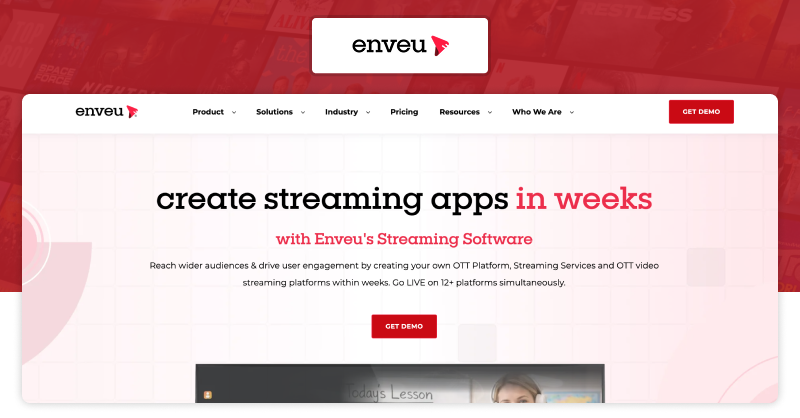
Enveu is a mobile-first alternative that specializes in vertical video delivery, whereas Vimeo OTT focuses on long-form streaming. It is the ideal choice for niche creators and media publishers who want to capture the “TikTok-style” consumption habits of younger audiences while retaining 100% of their revenue.
Enveu’s Experience Cloud playout allows creators to manage both audio and video content in a single hub, offering a Spotify-like playback experience for podcasts and music. The swipe-to-watch navigation encourages continuous watching, and the pay-per-episode monetization model allows viewers to unlock short-form clips individually. Also, the low-code environment allows faster launch across 12+ platforms, including mobile, web, and Smart TVs.
Some Notable Envue Features Include
Intuitive Dashboard: It offers an extremely intuitive video CMS that simplifies the bulk uploading process and metadata management.
Mux integration: Collaborates with Mux Video Platform to deliver video on a global scale with adaptive bitrate streaming, global CDN, automatic encoding, and analytics.
Micro-drama specialization: Intelligent multi-device support that specifically serves the exploding micro-drama format, which provides endlessly smooth experiences on mobile, desktop, tablet, and TV.
Offline playback: Provided to the handheld devices with data-saving features to allow the end users to control the bandwidth.
Comprehensive toolset: Experience Manager, Content Manager, Campaign Manager, Subscription Manager, and Analytics.
Plans and Pricing
Envue has three levels: Lite, which is priced at $549/month, Professional (priced custom), and Enterprise (priced custom). All plans have a demo.
Best For
Enveu works best for media publishers, regional broadcasters, and content brands that need to go live across 12+ platforms quickly without a large development team. It’s particularly well-suited for mobile-first content formats like micro-dramas and short-form serialized video.
How to Migrate From Vimeo OTT: A Step-by-Step Guide
To migrate from Vimeo OTT, you need a strategic roadmap since it involves moving large volumes of data. This protects your SEO rankings and prevents revenue churn. Here is a brief guide on how to migrate to a Vimeo OTT competitor.
What Data Can You Export From Vimeo OTT?
Before switching, you can export your entire video library (original source files), CSVs of subscriber data (emails and status), and detailed payment history. You can also download metadata like titles and descriptions, and app settings. This ensures continuity when rebuilding your platform on a Vimeo OTT alternative.
Vimeo OTT Migration Checklist: 6 Steps Before Switching
- Audit Your Vimeo OTT Library: Review all existing videos, categories, and metadata to ensure lossless migration without losing SEO value.
- Select Your Replacement: Choose a platform like VPlayed for total ownership or Muvi for no-code speed.
- Secure Subscriber Data: Export your customer lists and payment tokens to migrate billing profiles without forcing users to re-subscribe.
- Configure Your New Environment: Set up your CMS, monetization models, and branded apps on the new infrastructure.
- Migrate Content with Zero Downtime: Use a “parallel stream” approach to move files while keeping your current site live.
- Communicate the Change: Notify subscribers via email at least 14 days before the final cutover to ensure a seamless transition.
Vimeo OTT Alternatives: Key Factors to Consider
Vimeo OTT alternatives cannot be chosen with a mere feature scan. From monetization flexibility and white label branding to app support, streaming performance, security, and pricing scalability, each factor shapes long-term growth. This is what you should consider when making a choice.
More Monetization Options
Although Vimeo monetization supports SVOD, TVOD, AVOD, PPV, and FVOD, some businesses need hybrid monetization, sophisticated ad integrations, or dynamic paywalls.
Many alternatives to Vimeo offer broader monetization options such as server-side advertisement insertion, subscription tiers, coupons, affiliate connections, and more detailed analytics. If revenue experimentation is the core of your strategy, platform flexibility becomes a deciding factor.
White Label Branding
Vimeo provides branding customization, but deeper UI control, feature-level customization, and backend flexibility can vary depending on plan tiers. Many Vimeo OTT reviews mention a lack of an intuitive interface and settings that vanish overnight, making simple tasks technically challenging.
Vimeo’s white-label streaming service includes custom domains and branded apps, but alternatives may offer greater flexibility in API access, UI customization, or backend control depending on your technical requirements. For enterprises that treat their OTT platform as a core product rather than a distribution channel, customization depth impacts brand identity.
Multi-Platform App Support
Your viewers desire to consume content on their terms using their phones, Roku, or Apple TV. A major factor in any Vimeo OTT is the “time-to-market,” meaning how quickly the platform can deploy your branded apps across these various ecosystems.
Although it does provide app builds, Vimeo OTT competitors typically offer a smoother, no-code template that enables you to launch on 10+ platforms at once without paying for a development team.
Streaming Quality and Content Delivery Performance
Video quality directly affects viewer retention. Although Vimeo OTT uses a multi-CDN strategy for global playback, some users report occasional inconsistencies in upload speeds or localized playback hiccups.
Leading Vimeo OTT alternatives often differentiate themselves by offering advanced multi-CDN redundancy or more flexible adaptive bitrate streaming configurations. These features allow for smoother transitions during network fluctuations and give platform owners more control over how their content is routed to specific global regions.
Security
Vimeo offers DRM and domain-level controls, but customers in the enterprise usually compare watermarking, forensic tracking, playback tokenization, geo-blocking accuracy, and advanced access control.
Platforms that have solid multi-layer security infrastructures do not allow unauthorized sharing and recording of screens to ensure greater protection of high-value content libraries and minimize the risk of piracy.
Pricing Structure and Scalability
Probably the biggest challenge is the Vimeo OTT pricing, which typically has an element of per-subscriber (usually $1/month/user). This success tax has the potential to cut into your margins as you expand.
Scalable options tend to shift towards either flat-rate or usage-based pricing, where you can grow your user base without experiencing a direct proportionate increase in the load on your platform. SaaP-based platforms also have the option of avoiding recurring fees, providing businesses with more predictability of long term costs as well as ownership of the platform.
Seamless Migration Services
Another big obstacle to switching to any Vimeo OTT alternatives is migration. It requires the transfer of content libraries, subscriber data, payment histories, and app settings.
Check whether the Vimeo competitor offers structured migration assistance that guarantees zero data loss while minimizing downtime, ensuring your audience experiences minimal disruption.
Total Cost of Ownership: Vimeo OTT vs Alternatives at Scale
While Vimeo OTT may appear cost-effective at first, its per-subscriber pricing and transaction fees can significantly increase total costs as your platform grows. In the long run, expenses tied to scaling audiences, app maintenance, and revenue share can add up. In contrast, many alternatives to Vimeo OTT offer flat-rate or one-time pricing models. This gives businesses better cost predictability and higher revenue retention.
Wrapping Up:
Choosing an alternative to Vimeo OTT is not just about the features they offer. It is primarily about how well it aligns with your revenue and content strategies and long-term ownership goals.
Some Vimeo OTT alternatives, like VPlayed and Brightcove, cater to businesses prioritizing SSAI-driven monetization, full white-label control, and DRM-backed security. With flexible deployment models, they function less as hosting tools and more as scalable OTT infrastructure.
For small teams and content creators, Vimeo competitors like Castr, Uscreen, or Dacast offer accessible entry points and simple monetization models. For large-scale broadcasters who need intricate security, ad workflows, and scaling demands, Brightcove and Kaltura offer infrastructure depth.
Before committing, evaluate your audience size, available technical capability, and growth roadmap. The correct platform must not only be useful where you are at the moment, but must also be able to grow with where you are heading.
- Request Demo Book a Live, Personalized Demo
- Contact Sales Reach Out to Our OTT Experts
Frequently Asked Questions (FAQ)
1. What is Vimeo OTT?
Vimeo OTT (Vimeo Streaming) is a great and worthy choice for video creators, media companies, filmmakers, and brands to launch premium OTT channels and apps to deliver high quality video streaming, custom branding, and monetize content online with options like SVOD, TVOD and AVOD.
2. What is the difference between vimeo and vimeo ott?
Vimeo is a video streaming platform for creating, hosting, sharing, and monetizing videos online, while Vimeo OTT is an exclusive service for content creators, media companies, and filmmakers to launch their own streaming platforms, take content worldwide, and monetize via subscription or pay-per-view streaming revenue models.
3. How does Vimeo OTT make money?
Vimeo OTT earns most of its revenue from content creators, businesses, and media organizations with the premium account memberships and subscriptions. Vimeo OTT profits from charging their users for their exclusive video content and streaming services accessed by them and they charge 10% commission for on-demand videos and Vimeo OTT.
4. What is the difference between Vimeo OTT and VPlayed?
The main difference between VPlayed and Vimeo OTT is in the services and business models offered by both the parties. Vimeo OTT is a SaaS model with recurring payments, whereas VPlayed follows a SaaP model with a one-time pricing structure, and VPlayed offers services as self-hosted, white-label video streaming that can be customized, scaled largely and even source-code is provided, but these services are notably absent in Vimeo OTT.
5. How much should I pay commission for vimeo OTT?
The commission fees for Vimeo OTT vary based on the subscription plan, almost 10% is taken as commission but it varies based on the plans and the subscribed services.
People Frequently Read:


