



Your role with video content doesn’t end upon publishing or uploading. Security and privacy remain the topmost concerns in the video streaming industry. In fact, pirated content costs the global economy $71 billion per year, whereas it costs the U.S. economy around $30 billion per year.
Video streaming businesses compromise their brand by using public platforms for sensitive content. If your business relies heavily on video content, relying on free, insecure tools poses revenue risks. This is where secure video streaming platforms enter the fray.
In this blog, we’ll review 8 popular platforms for securing video content. Then, we’ll share some key security practices for safe video streaming, like encryption, access control, IP restrictions, and compliance compatibility.
Secure Video Streaming Platforms Compared
| Platform | DRM Support | AccessControl | Anti-Piracy | BestFor | StartingPrice |
| VPlayed | Multi-DRM | Advanced(Role-based, Geo/IP restriction) | Dynamicwatermarking | OTT, Enterprises | Custompricing |
| Dacast | DRM(via integrations) | Basic | Refererrestrictions | Broadcasting companies | $39/mo |
| Brightcove | Multi-DRM | Moderate(Role-based) | Dynamicwatermarking | Media-tech enterprises | $199/mo |
| GudSho | DRM available | Basic(paywall,User authentication) | Secure hosting,Anti-screen recording | Content creators | Custompricing |
| Kaltura | Multi-DRM | Advanced(SSO, geo-blocking) | Dynamicwatermarking | EdTech firms,Enterprises | Pay-as-you-gopricing |
| IBM Video Streaming | LimitedDRM | Advanced(SSO, geo-blocking) | Basic | Corporate streaming | $154/mo |
| Panopto | LimitedDRM | Advanced(Role-based, SSO, geo-blocking) | Basic | Enterprise streaming | Custompricing |
| VdoCipher | Multi-DRM | Basic(Token URLs) | Basic | Mediapublishers | $149/year |
How We Evaluated These Platforms?
Our primary evaluation criterion is that content security measures shouldn’t hinder playback performance. We looked at how well each platform protects content during (1) upload, (2) storage, (3) delivery, and (4) playback.
Other criteria that influenced our decision: DRM capabilities (Widevine, FairPlay, PlayReady), encryption protocols, secure ingestion and storage, signed or tokenized delivery, granular access controls (user-level permissions, geo/IP blocking), watermarking, and session management. We also contacted several clients of the platforms from our list to analyze their incident response capabilities.
If you’re looking for the safest way to stream and protect premium content, here’s a quick snapshot of what each platform does best:
The 8 Best Secure Video Streaming Platforms: Deep Dive
We considered and tested more than 15 different video streaming platforms. The most important part was verifying that they didn’t have inconsistent security practices and had no unfixed problems. This eliminated about half the platforms from our list, as they either weren’t security compliant or only were under specific circumstances. Here’s a quick glance at the the final 8 platforms that made it our list:
Let’s review the final 8 platforms in detail:
1. VPlayed
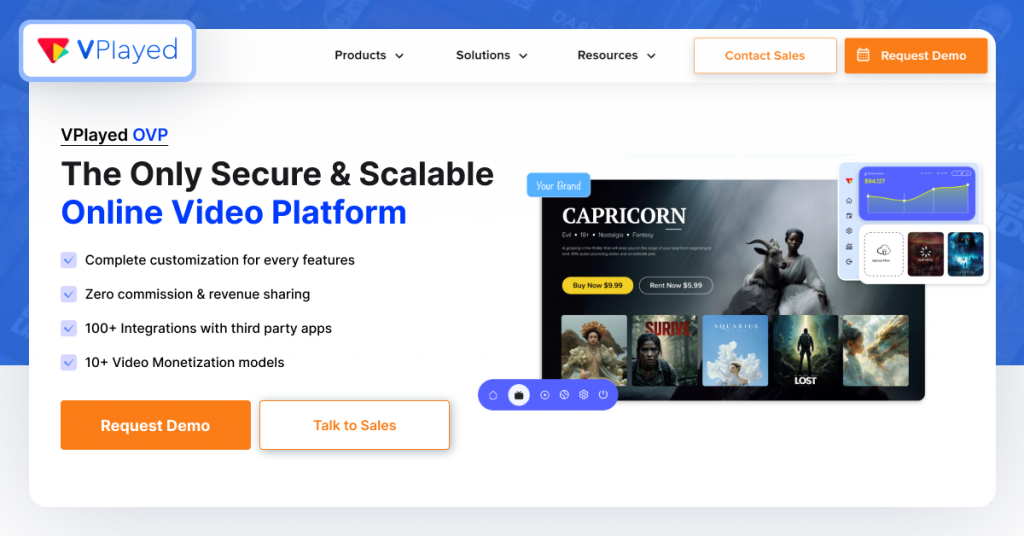
VPlayed is the benchmark secure video streaming platform; it’s the one that most security professionals recommend, including this review article from Spotlightr. It keeps video streaming operations simple while protecting everything in the background. Its security practices focus on securing content from ingestion to delivery, utilizing both DRM (Digital Rights Management) and content-level protections.
Businesses that prioritize access control appreciate how safe and restricted VPlayed is. It’s built for sensitive video libraries that want to be accessed only by the concerned or delegated staff (like internal employees of a corporate organization).
Key Security Features:
* Multi-DRM Support: Uses multiple Digital Rights Management (DRM) technologies, including Widevine, FairPlay, and PlayReady to prevent copyright infringement.
* Encryption: Employs advanced, 128-bit or 256-bit AES encryption to ensure that video content remains secure during storage and transmission.
* DDoS Protection: Protects live streams and VOD content from malicious traffic and attacks.
* In-Player Safeguards: Implements security features, such as IP blocking, screenshot prevention, and access management, directly within the player.
* Geo-Blocking & IP Restrictions: Restricts access to content based on specific locations or IP addresses.
Pros:
* Token-based authentication and expiring playback URLs that prevent unauthorized sharing of video links.
* Dynamic watermarking and anti-screen capturing measures to deter privacy violations
* Granular, role-based access permissions to restrict who can view or manage video assets.
Cons:
* Limited transparency around security certifications (e.g., SOC 2 or ISO standards)
* Self-hosted deployment can shift security responsibility to clients
* Some security features require custom configuration.
Pricing
VPlayed doesn’t explicitly disclose pricing information on its website. However, they follow a one-time licensing model for their platform. Contact their sales team to know more.
2. Dacast
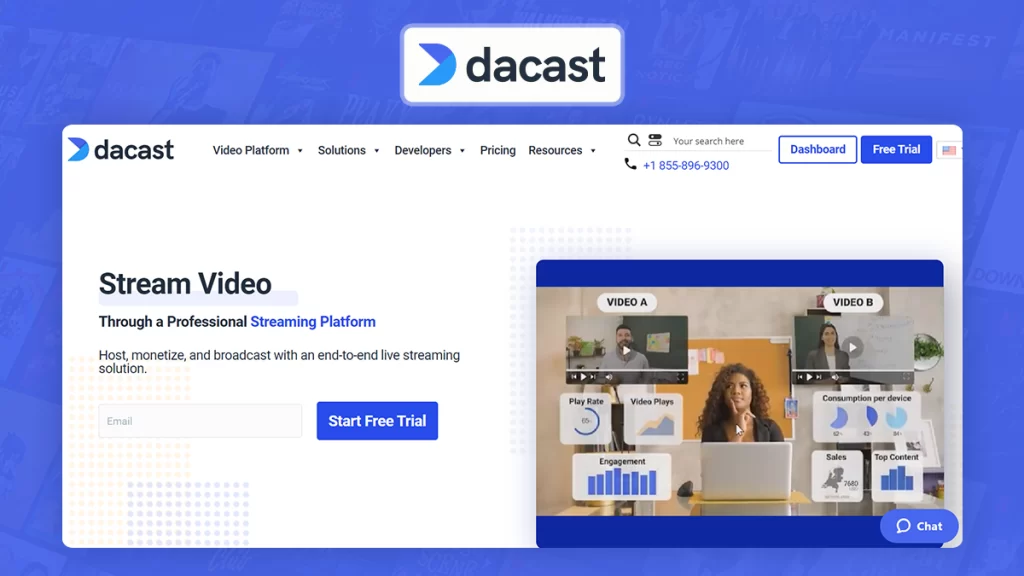
Dacast is similar to VPlayed in many ways, but their approach to security differs. VPlayed emphasizes infrastructure-level security controls, whereas Dacast focuses on simpler built-in security features. Content owners and broadcasters get tools to protect live and on-demand content from piracy and unauthorized access. These kinds of tools matter for content businesses operating in data regulatory environments (e.g., GDPR, CCPA, and HIPAA).
Dacast is good for businesses that want encrypted video delivery without trading away ease of use. Dacast uses protocols like SRT (Secure Reliable Transport) for secure video ingestion and content delivery networks (CDNs) for reliable, high-quality streaming.
Key Security Features:
* Domain Restriction: Limits where your video player can be embedded, preventing unauthorized website embedding.
* SSL/TLS encryption: Protects sensitive user data, such as credit card information, during payments.
* HTTPS Video Delivery: Facilitates the secure transmission of video content over an encrypted connection. Dacast’s delivery method breaks the video into segments and transfers them over a secure channel.
* Monetization Security: Maintains high-level security for pay per view streaming and subscription payments (paywall).
* Tokenized URLs: Facilitates access control to videos via tokenized URLs.
Pros:
* Integrated paywall with single-device log-in enforcement
* Built-in DRM protection for premium content
* Dacast uses tokenized security for video delivery.
Cons:
* Lacks deeper customization of security infrastructure
* Lacks dynamic watermarking and screen-capture detection mechanisms
* Key security features like DRM are tied to high-tier plans.
Pricing:
Compare the Top Dacast Competitors
Evaluate the best Dacast competitors based on platform features, pricing flexibility, security, and business growth potential.
3. Brightcove
Brightcove is designed for content teams that operate in highly regulated security environments, with certifications such as CSA STAR Level 1 and ISO 27001. The platform adheres to standard security practices, including DRM, encryption, IP blocking, geo-blocking, and domain restrictions. What we really liked about Brightcove is its player-level mid-stream check, which is used to validate the viewer’s credentials. And if the check fails, the player will stop video playback.
Besides being known for its security and privacy, Brightcove is a complete package for enterprises. You can host, stream, monetize, and manage video content across devices. This adaptability has gained traction among media-tech companies, content library owners, and corporations.
Key Features:
* SSO Integration: Make it available through Google SSO for validating content from service providers.
* Role-based Access Control: Configure Brightcove studio to restrict users access to specific modules (media, publishing, advertising, and analytics).
* Data Security: Employs secure protocols (HTTPS/SFTP) for data transfer and uses encrypted, segregated S3 buckets for storage.
* Asset Management: Reconfigures asset storage periodically, making it necessary to use APIs to prevent broken links.
* Playback Tokens: Uses signed JSON Web Tokens (JWT) for secure license requests.
Pros:
* Multi-DRM support to ensure secure playback across browsers and devices
* Forensic watermarking and embeddable invisible identifiers to trace the source of video leaks
* Offers playback rights API to enforce secure access policies.
Cons:
* Enterprise-grade security infrastructure can be overkill for smaller businesses
* Brightcove’s increased authentication checks during playback can impact performance optimization
* Some security configurations may feel technical.
Pricing:
Pricing:
Empower your OTT business with the most secure video streaming platform in the market. Check out the Brightcove Competitors for a better understanding.
4. GUDSHO
GudSho earns the fourth spot in our list for delivering reliable video protection and monetization security features, despite offering fewer enterprise-grade security controls. GudSho specializes in facilitating secure streaming for live webinars, internal communication, and corporate broadcasts. It includes admin-level controls to define authorization levels for specific files or systems.
The platform focuses heavily on encrypting data in transit and ensures no data is shared with third parties. While the platform’s compliance side of things is unclear, its AI-powered video editing features remain among the best in the industry.
Key Features:
* Access controls: Regulates who can access or view videos with granular and restricted controls.
* Marketing Suite: In-video CTAs, lead generation forms, and detailed analytics to track engagement and ROI.
* Webinar Hosting: Provides tools to host live webinars, including landing pages with features like countdown timers and live chat.
* Brand Watermarks: Protect your videos from copyright violations by implementing static watermarks on your content.
Pros:
* Secure cloud video hosting infrastructure
* Restricts content access through secure video paywalls
* Security features are integrated directly into the platform.
Cons:
* Lacks anti-piracy monitoring tools
* Security framework is not ideal for enterprise use cases
* Information about compliance standards is unclear.
Pricing:
Pricing information is not available on GudSho’s website. Contact their sales team to get a tailored quote, along with a 7-day free trial.
5. Kaltura
Kaltura is a comprehensive video platform equipped with both basic and advanced security features. Enterprises and educational institutions use role-based access controls to periodically restrict video viewing. Kaltura’s x-factor is its AES encryption, which works alongside HTTPS, secure password protection, and a web browser to provide secure video streaming.
Unlike other platforms in this list, Kaltura is compliant-heavy. The platform adheres to international standards, including ISO/IEC 27001, ISO 27799, and SOC-2 Type II.
Key Features:
* Per-rendition Level: Encrypts each individual version (rendition) of a video during the transcoding process.
* HTML Purifier: Removes malicious code (like XSS) and ensures the output is clean and safe.
* IP Whitelisting: Give content access only to certain IP addresses, leaving other IP addresses without access.
* API Security: Provides secure API authentication, preferring user-based credentials over, or in addition to, partner secrets.
* Access Controls: Uses Single Sign-On (SSO), role-based permissions, and IP restrictions to ensure only authorized users access content.
Pros:
* Restricts content access using IP filtering, geo-blocking, and domain restrictions.
* Provides API-based security configuration to enforce security policies
* Multi-layered security architecture (encryption, DRM, token-based authentication, and secure streaming protocols).
Cons:
* Enterprise-level security infrastructure can significantly increase operational costs
* Involves longer deployment cycles
* API-driven architecture leaves potential attack surfaces.
Pricing:
They follow a pay-as-you-go pricing model. But you can also request custom quotes based on your requirements.
Switch to the best Kaltura Alternative with the industry-best video streaming platform powered by robust security features like AES encryption, geo-blocking, and more.
6. IBM Cloud Video
IBM Video streaming operates entirely on a public cloud, which leaves an increased attack surface. However, the platform combats security risks with end-to-end encryption (AES-256) for content in transit, password protection, and GEO-blocking. The platform restricts video access by allowing only approved email domains. This way, corporations can ensure that only internal employees can access sensitive training material.
IBM Video Streaming is genuinely built to be a secure, encrypted video streaming platform. Its data security policies and technical explanations check out. It uses one of the best data erasure and data masking practices available.
Key Features:
* SSO (Single Sign-On): Integrates with SAML 2.0 and OpenID Connect (OIDC) for secure, managed user access.
* Data Erasure: Personally identifiable information (PII) is removed from data sources, including backups, after 30 days.
* AI Capabilities: Empowers enterprise users with automated closed captioning and deep search capabilities to locate content within videos.
* Encryption: Protects video data in transit and at rest using advanced encryption standards.
* Regulatory Compliance: Aligns with standards like GDPR.
Pros:
* Works well with compliance-ready configurations and enterprise governance frameworks
* Uses OAuth-based access tokens for API interactions. This reduces the risk of unauthorized system access.
* Supports RTMPS ingest (RTMP over TLS/SSL) that ensures video streams are encrypted during transmission.
Cons:
* Integration workflows can be complex for beginners
* Lacks anti-piracy features like forensic watermarking or screen-capture prevention
* Isn’t suitable for large-scale OTT distribution.
Pricing:


7. Panopto

Panopto is ideal for educational and governmental agencies needing a secure internal video streaming platform for internal use. It offers encrypted data transmission (SSL), role-based access control (RBAC), SSO integration (SAML/OAuth), and regular third-party penetration testing. These features allow educational institutions to safeguard content security and data security in tandem.
Panopto works well with a number of LMS (Learning Management Systems). The platform secures video repositories in LMSes with support for multiple credential types, including OAuth, SAML 2.0, Active Directory, and LMS ID providers.
Key Features:
* Private Live Streaming: Restrict access to live streams for specific users, leveraging Panopto’s single sign-on (SSO) systems like OAuth, SAML, etc.
* SOC 2 compliant: Panopto reduces risks of data breaches, meets regulatory requirements like HIPAA or GDPR.
* Integrations: Can integrate with other systems like Learning Management Systems (LMS), Content Management Systems (CMS), and web portals.
* Video Playback: Monetize educational videos effectively with Panopto’s playback support quality of up to 4K.
* Application Security: The platform includes features to prevent SQL injection and other malicious inputs.
Pros:
* Compliance with major data security standards (SOC 2 audits, GDPR regulations)
* Suitable for corporate training and education environments
* Enforces strong encryption for data (both at rest and in transit).
Cons:
* Lacks advanced security measures for OTT and media broadcasting
* Lesser emphasis on multi-DRM systems and forensic watermarking
* Security configuration relies on the configuration of external systems.
Pricing:
8. VdoCipher
VdoCipher uses Google Widevine DRM (similar to Netflix) to prevent unauthorized video downloads. This gives content owners the opportunity to implement Hollywood-grade security across their video operations. The platform uses unique, time-sensitive embed code to authenticate users for each playback session. This helps content owners prevent URL sharing.
VdoCipher is an excellent choice for course platforms, training portals, and secure video hosting, but organizations looking for end-to-end OTT streaming infrastructure may find broader functionality in other platforms.
Key Features:
* Dynamic Watermarking: Displays viewer-specific details like IP address, email ID, or user ID directly on the video.
* IP Whitelisting: Restricts video playback to specific websites, preventing unauthorized embedding or embedding on third-party sites.
* Screen Capture Protection: Implements techniques to discourage or detect screen capture software on mobile and desktop devices.
* Piracy Tracker: Monitor the unauthorized users who are illegally distributing your video content with video heatmaps.
Pros:
* Playback session analytics and piracy monitoring tools
* Encrypted video delivery made possible
* Uses multiple DRM providers to protect premium content.
Cons:
* Less emphasis on access control compared to other options in this list
* Lacks functionalities for OTT distribution and platform ecosystem
* Platform setup is complex and has a steep learning curve.
Pricing:
How to Choose the Right Secure Video Streaming Platform?
Each platform addresses a distinct security risk inherent in video streaming workflows. Whether or not the platform’s capabilities align with your needs is the cornerstone of choosing the right platform. Use these selection criteria to accelerate your platform decision:
1) Start with your streaming protocol requirements
Video streaming protocols determine whether your video streaming platform integrates with DRM systems or not. Choosing the right, compatible protocol can handle adaptive bitrate delivery across varying network conditions. Choosing the wrong protocol can lead to a poor streaming experience, resulting in audio/video desynchronization, and so on.
The table below highlights key streaming protocols and their security capabilities:
| Protocol | Best For | Security Mechanism | Limitation |
| HLS | VOD & Live | AES-128, FairPlay DRM | Higher latency |
| MPEG-DASH | VOD & Adaptive streaming | CENC + Widevine, PlayReady DRM | Limited native Apple support |
| RTMPS | Live ingest | TLS encryption | Not used for playback |
| SRT | Low-latency live streaming | AES encryption | No native DRM support |
| WebRTC | Real-time streaming | DTLS + SRTP encryption | Limited scalability for large audiences |
2) Consider your compliance requirements
Based on the industry and demographic in which your business operates, your platform may need to fulfill compliance regulations like GDPR (EU), HIPAA (US healthcare), SOC-2 (global), and ISO (global).
If your business operates in banking, healthcare, education, or serves Fortune 500 enterprises, compliance standards like HIPAA and SOC 2 are non-negotiable. Platforms like Kaltura, Panopto, and IBM Video Streaming are ideal choices for businesses operating in regulated environments.
3) Choose your deployment model
How you deploy your secure video platform determines the degree of control you can exercise on your video infrastructure. Cloud deployment model is known for its quick setup and scalability, while the on-premise model enables greater control over your data and security policies. In this, the public cloud should never be on your consideration as it poses several vulnerabilities. Look for a platform that offers a true self-hosted (on-premise) model or private cloud deployment model.
4) Evaluate your use case needs
If your use case involves protecting premium video content from piracy, prioritize platforms with extensive DRM support. Platforms like Kaltura, VPlayed, and Brightcove offer multi-DRM support, so content owners don’t end up losing their content to piracy.
For enterprises and corporations wanting to protect their sensitive content, platforms like IBM Video streaming and Panopto offer robust access control mechanisms.
5) Analyze the cost and ownership factor
Secure video streaming often involves multiple components, including hosting, bandwidth, DRM licensing, and ongoing maintenance. Per-usage pricing may appear affordable; however, it can escalate quickly as user counts grow. Look for platforms that offer complete freedom from overage fees and enable complete ownership with their pricing structure.
Check Out the Steps to Create a Video Streaming Server
Ready to put this concept into practice? Check out the step-by-step process to build a video streaming server.
10 Best Practices for Secure Video Streaming
Content creators work hard to protect the value of their videos, yet even a single leak or unauthorized stream can undermine profitability. That’s why implementing practices like encrypted video streaming, password-protected streaming, dynamic token security, and other advanced safeguards is essential for securing your revenue and your audience.
1. AES Encryption
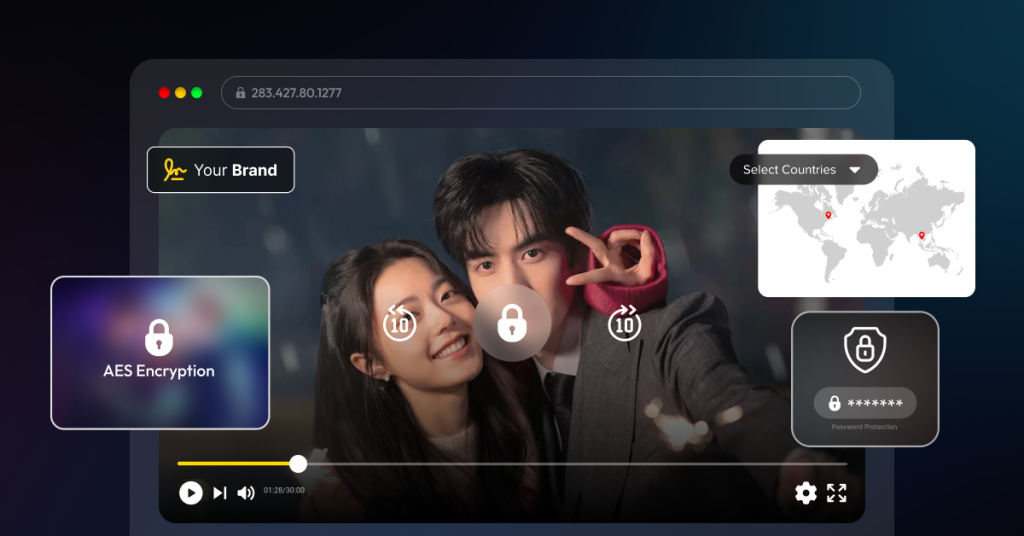
AES (Advanced Encryption System) is a symmetric block cipher, which splits a message into smaller blocks and encrypts those blocks to convert the plaintext message to an unintelligible form called ciphertext. AES uses multiple cryptographic keys (128-bit, 192-bit, and 256-bit) to protect the confidentiality and integrity of data.
During encrypted video streaming, viewers can access the video only when they have the correct access key. Without it, viewers or even illegal hackers can only see a scrambled mess of useless data.
2. Secure Payment Gateways
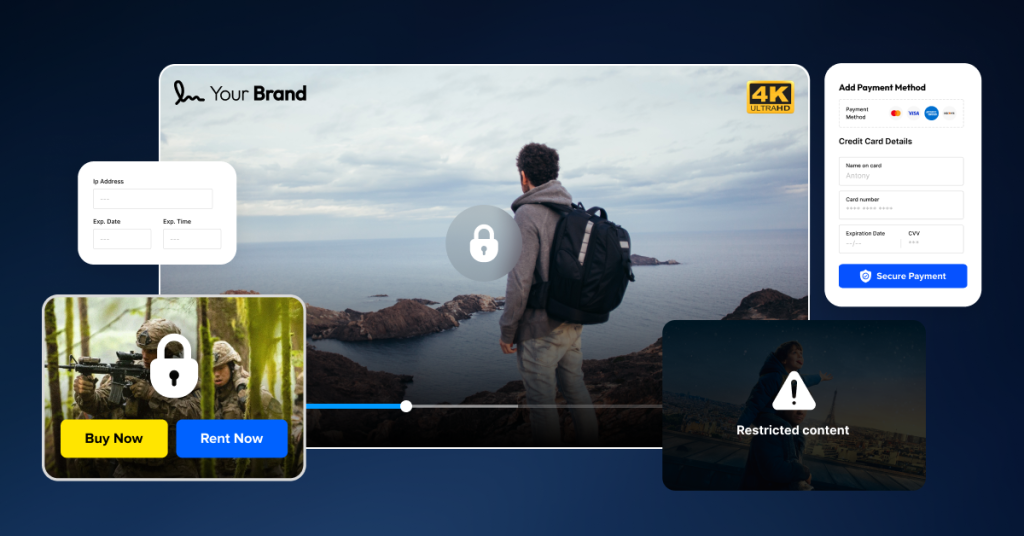
Secure payment gateways ensure that viewers can purchase or access video content without exposing their financial information. These gateways act as encrypted channels between the user’s device and a secure video streaming platform, safeguarding sensitive data such as card numbers, billing details, and authentication credentials.
Modern payment gateways support additional layers of protection, including tokenization, multi-currency support, and 3D Secure authentication.
3. Password Protected Videos
Password protection is a classic and consistently reliable method for securing video content. By restricting access behind a unique password, creators can control exactly who can view their videos, ensuring that only authorized audiences are granted entry.
This method helps prevent unauthorized sharing, accidental exposure, and unmonitored distribution of internal training sessions, gated webinars, paid courses, and sensitive corporate videos. Most online video platforms allow creators to update, rotate, or customize passwords to maintain ongoing security.
4. Geographic (IP) Restrictions
Geographic or IP-based restrictions limit video access to specific countries, regions, or IP addresses. IP restrictions ensure that your content is only viewable by audiences within approved locations, reducing the risk of unauthorized distribution across different markets.
Mapping viewer IP addresses to their geographic locations enables video streaming platforms to block access for unsupported regions. This is especially useful for creators managing licensing agreements, protecting region-specific releases, or preventing content misuse from known piracy hotspots.
5. Secure Video Data Centers and CDN
Secure data centers and Content Delivery Networks (CDNs) play an integral role in keeping video content secure during delivery. These infrastructures are designed with security measures like firewalls, intrusion detection systems, and physical access controls.
A secure CDN distributes video content across geographically dispersed servers, helping in optimal playback and minimizing exposure to interception or attacks. For content creators, this means maximizing their revenue potential with uninterrupted playback and secure content delivery.
6. DRM with Forensic Watermarking
If DRM enforces strict access controls, forensic watermarking embeds invisible, tamper-proof identifiers in the video content. This prevents copying, downloading, or unauthorized redistribution of the live stream or pre-recorded video.
Certain video streaming platforms strengthen their security posture with multi-DRM support, combining DRM systems like Google’s Widevine, Apple’s FairPlay, and Microsoft’s PlayReady, into a single solution to protect digital content.
7. Video Paywall
A video paywall is a straightforward and effective way to secure access to premium content by placing it behind a payment barrier. This ensures that only paying viewers can watch your videos, helping creators protect both the value and profitability of their work.
Paywalls typically integrate with secure payment gateways and user authentication systems, allowing you to offer various monetization models such as one-time purchases, rentals, or recurring subscriptions. Each viewer must complete a verified transaction before gaining access, which significantly reduces unauthorized viewing and limits content sharing.
8. Advanced SSL Certification
Advanced SSL (Secure Sockets Layer) certification facilitates safe data exchange between servers and browsers with cryptographic keys.
Platforms using advanced SSL certificates (including TLS, its modern successor) authenticate the server’s identity and establish a secure, encrypted connection for every viewer session. This prevents man-in-the-middle attacks, session hijacking, and data manipulation during transmission.
9. Parental Control
Parental control fosters a safe viewing environment with restricted access to age-inappropriate or sensitive video content.
Using tools such as content ratings, PIN-protected access, and viewing restrictions, parental controls prevent minors from encountering unsuitable videos. Streaming platforms can also apply profile-based settings, enabling households or organizations to tailor access for different users.
10. Dynamic Token Security
Dynamic token security provides time-sensitive, user-specific access to video content or livestream, ensuring that only authorized viewers can watch your content. Each token contains encrypted information such as user credentials, IP address, and expiration time, making it extremely difficult for unauthorized users to reuse or share links.
Conclusion
If you are looking to protect your video content from unauthorized access, platforms with secure video streaming capabilities are the right choice for you. The right secure video streaming platform can be chosen based on your business’s security and compliance requirements. If you have content that is meant for internal teams, then a platform with advanced access control mechanisms (role-based, geo-blocking) might be enough.
But if you have exclusive content (meant for subscriptions and pay-per-view), you should opt for a solution that provides DRM encryption. This protects your video content from illegal distribution and unauthorized downloads. If you deal with memberships and handle personal information of users, you need to comply with the GDPR. Then, you should opt for a platform that is compliant-ready, regardless of the region you operate in.
- Request Demo Book a Live, Personalized Demo
- Contact Sales Reach Out to Our OTT Experts
Frequently Asked Questions (FAQ):
1. How Do I Securely Stream Video?
To securely stream a video in a digital platform, invest in multiple security protocols such as aes encryption, https delivery, SSL / TLS encrypted paywall, password-protected video, geographic restrictions, token authorization system and IP restrictions.
2. What Are The Top Features To Look For In A Video Streaming Platform?
A top video streaming platform holds the following features–A Video CMS, video CDN, Video analytics tool, Video AES, monetization methods, White label streaming, engagement tools and video marketing tools like social media share.
3. Why Should You Secure Your Video Streaming Platform?
There are numerous reasons for safeguarding digital streams, some are digital theft of intellectual property, confidentiality purposes, digital misuse of the content, copyright infringement.
4. How To Create A Secure Online Video Platform?
A secure online video platform must enable different security protocols like AES Encryption, Geo blocking, Paywall protection, Login protection, SSL certification & much more. This ensures security & prevents unauthorized access to the content from anywhere, any time.
5. What is the difference between a secure video streaming platform and a regular streaming platform?
Regular streaming platforms offer basic security features like password protection or limited encryption. On the other hand, secure video streaming platforms include DRM, encryption (AES-128 or AES-256), tokenized or signed URLs, access controls (role-based, geo/IP restrictions), and watermarking. These features protect your video content most often.
6. What are the most critical features a secure video streaming platform should offer?
The most critical features a secure video streaming platform should offer are multi-DRM support, encryption, session management, tokenized URLs, access control, and crisis management. This way, you can rest assured that your video content will be guarded at every stage (from upload to storage, and delivery to playback).
7. Can I migrate my video content from my existing platform to a secure video streaming platform?
Yes, you can. Most secure platforms offer managed migration services as part of their setup. These platforms also support API integration to sync external applications during the transition.
8. Why should businesses switch to secure video streaming?
Businesses that rely on video content should switch to secure video streaming to avoid losing control. If they don’t, they face unavoidable consequences of losing revenue, content, and user data. More so, failure to adhere to compliance regulations (like GDPR) could result in hefty fines.


